Why “Organized” Starch Kills Softness: Using Science to Pick Better Enzymes.
Bread going stale is the ultimate headache for every baker. We often blame simple moisture loss, but the science suggests it’s actually about how starch “tidies up” at the nano-level. New X-ray tech reveals that disorder, not order, might be the secret to lasting freshness-changing how we select enzymes forever.
You know the drill: amylose sets the gel during cooling, but amylopectin is the slow-moving culprit behind long-term staling.
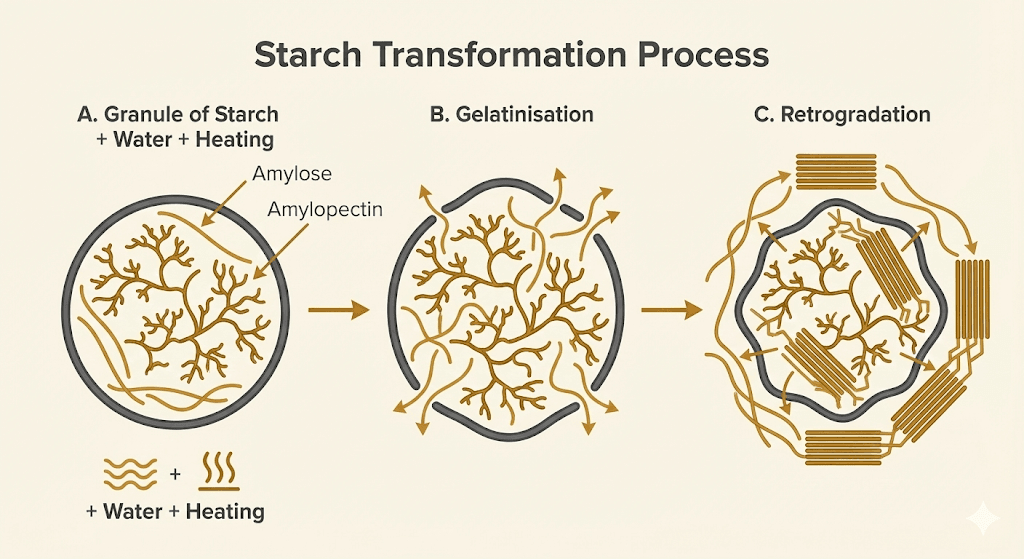
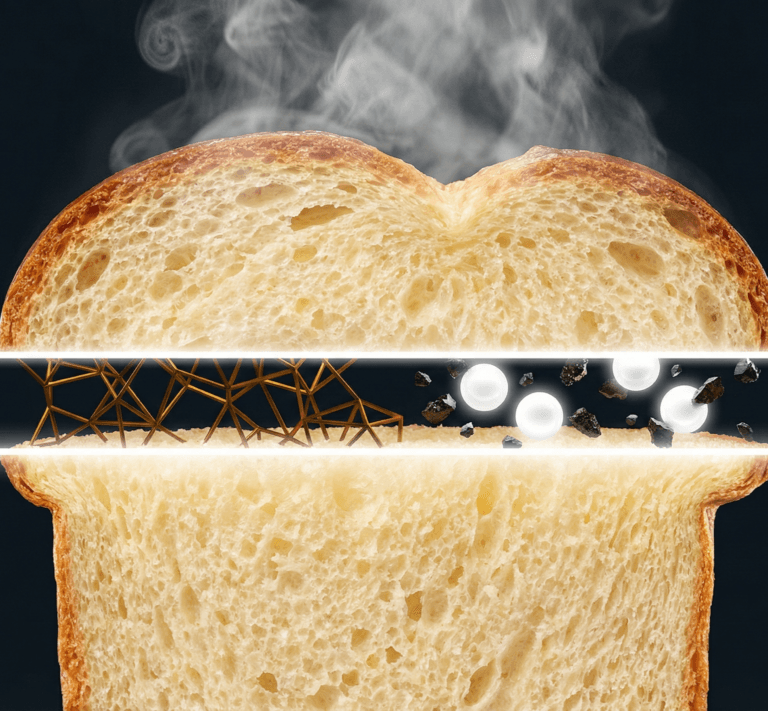
However, recent studies using Small-Angle X-ray Scattering (SAXS) have given us a look at what is actually happening inside the crumb, and it contradicts the old idea that staling is just random crystallization.
Researchers have focused on the Radius of Gyration (R_g); a fancy term for measuring how starch particles distribute their mass around a center point.
- The Findings: Over time, the “uniformity” of these starch particles increases.
- The Correlation: As the starch particles become more uniform (more “organized” or “tidy”), the crumb firmness shoots up.
- The Takeaway: In the world of bread softness, organization is the enemy. We want the starch structure to remain heterogeneous (messy) to keep the crumb soft.
Industrial Application
This isn’t just academic fluff; it validates why certain enzyme cocktails work better than others.
If you are currently evaluating a new shelf-life extender, you are essentially looking for a tool that prevents this “uniformity.”
- Enzyme Selection: These findings suggest that the most effective enzymes (like advanced maltogenic amylases) likely work by snipping starch chains in a way that physically prevents them from lining up into those uniform, firm particles. They force the starch to stay “disordered.”
- Predictive Power: Instead of waiting 21 days for a squeeze test, R&D departments can combine methods like SAXS, Differential Scanning Calorimetry (DSC), and Low-Field NMR.
- The Result: By measuring the “order” of the starch early on, you could potentially predict the firmness of the bread weeks in advance, drastically shortening your product development cycle.
The New “Smart” Toolkit
If you are looking to upgrade your lab’s predictive capabilities, the literature suggests moving beyond simple moisture meters. A robust approach might include:
- SAXS: To measure the nano-scale “order” and (R_g) of the starch.
- DSC: To analyze the energy required to melt these crystals (thermal transition).
- Low-Field NMR: To track water mobility and how “bound” the water has become within that tightening starch matrix.
By triangulating these three, you stop guessing and start engineering softness from the molecule up.
😊 Thanks for reading!
Sources: