The Absorption Fallacy: Practical Limits of Hydration
Chasing the maximum water absorption of your flour often leads to unmanageable dough and flat loaves. Ignoring the difference between laboratory values and bakery reality compromises structure. Mastering consistency requires prioritizing process over percentages; ensuring your bread is defined by its quality, not just its water content.
One of the most pervasive myths in modern baking is the belief that one should add as much water as the flour can theoretically absorb.
However, industry veterans caution that laboratory-measured absorption capacity is merely a guideline, not a target. In a real-world bakery, the “correct” hydration is not an absolute number but a variable dependent on processing.
While a hand-mixed artisan process might allow for the delicate handling of a sloppy, high-hydration dough, the same mixture could spell disaster in a mechanical environment. If you lack the equipment or the gentle touch required, pushing hydration limits often turns potential bread into an unworkable mess.
The Cost of Structure: Form vs. Pan
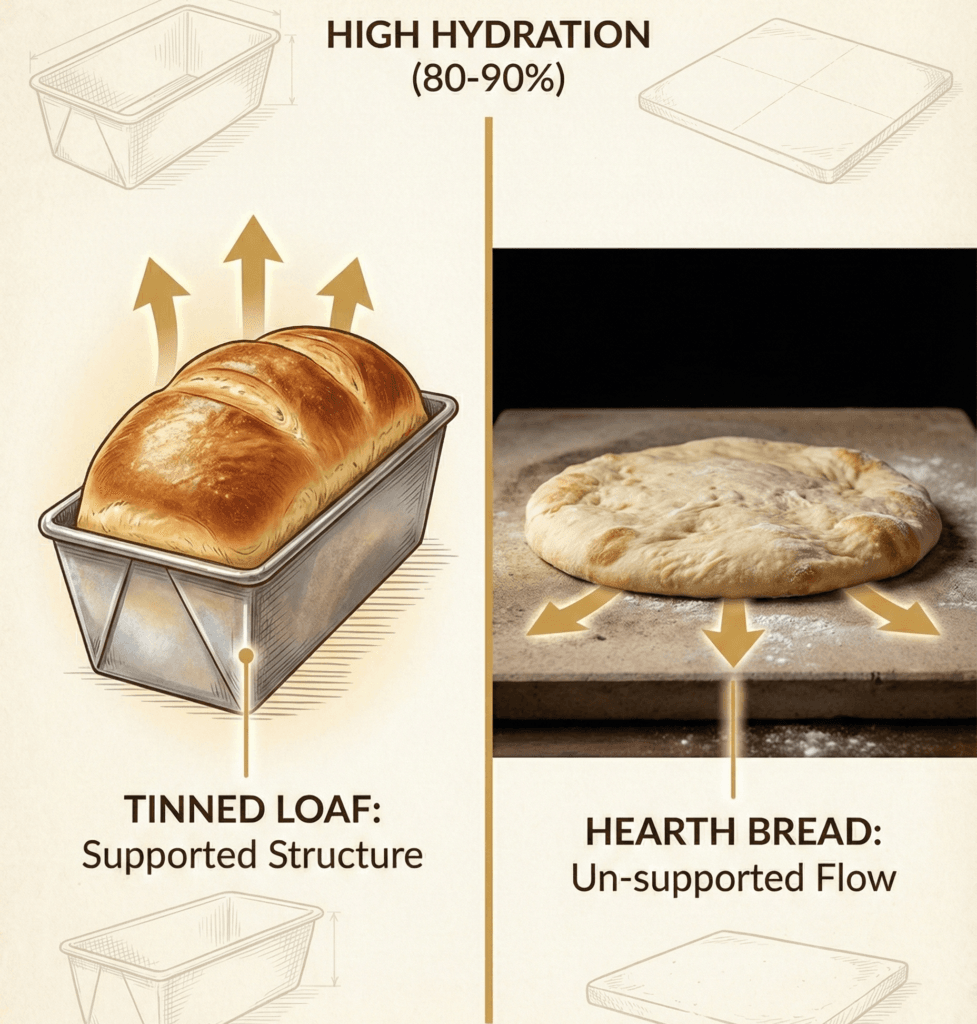
The risks of extreme hydration (80-90%) manifest most clearly in the final shape of the loaf.
- Tinned Loaves: High-water doughs can succeed here because the tin acts as an exoskeleton, supporting the weak structure.
- Hearth Breads: For free-standing loaves (like bloomers or batards), excess water is detrimental. Without a container, the dough flows outward rather than upward, resulting in a flat, unattractive disc rather than a bold, voluminous loaf.
The Baguette Exception
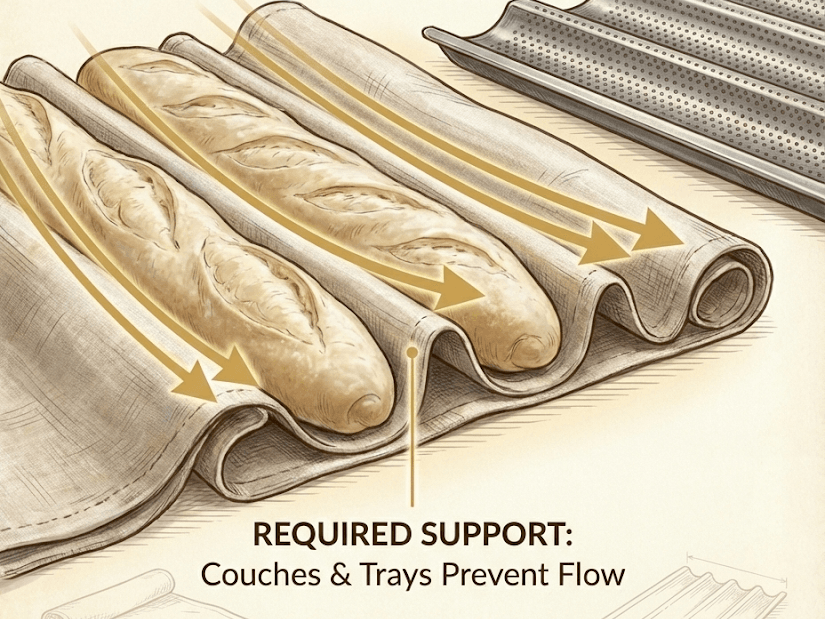
There are specific exceptions, such as the traditional French baguette, where hydration often exceeds the theoretical absorption limits to create that signature open crumb.
However, this is not “performative”—it is calculated.
- Required Support: Success here relies on using couches or curved baguette trays during fermentation to physically prevent the dough from flowing flat (see Figure 4.18 in technical literature).
- Expert Handling: Without these tools and high-level shaping skills, the average baker is simply left with a puddle of dough.
Technical Defects: The Hidden Costs
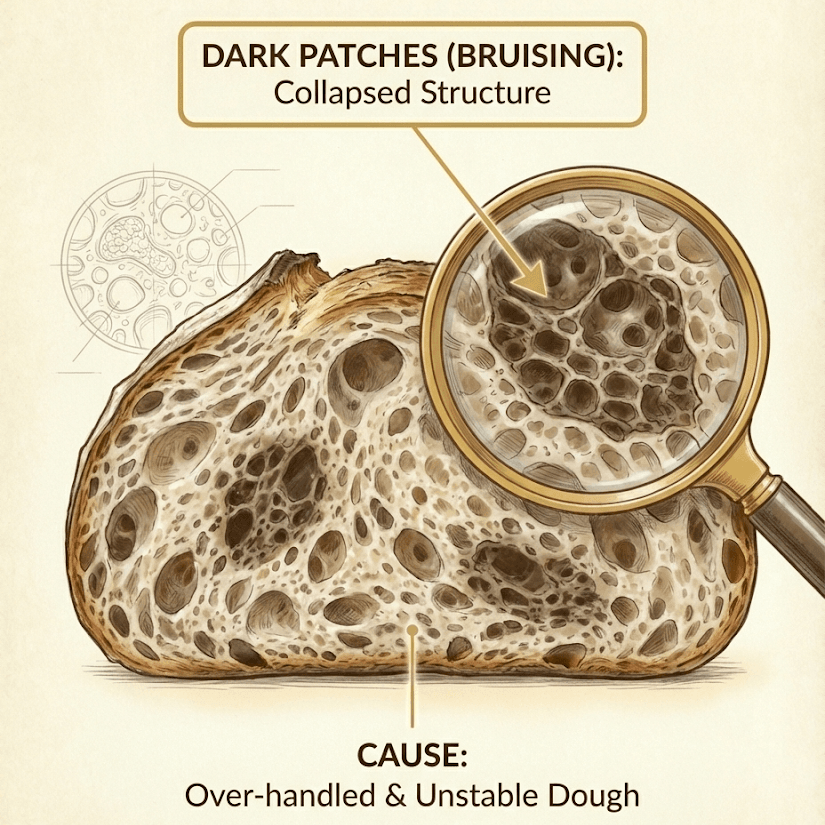
“Performative hydration” often forces bakers to over-handle the dough to combat its stickiness, leading to specific internal defects:
- Dark Patches (Bruising): If a dough is chemically unstable due to excess water, or if it is mechanically abused during shaping to get it under control, you may see dark, dense patches in the crumb (Figure 4.3). This is a sign of collapsed gas cells and damaged structure.
- False Stickiness: Often, a dough that feels impossibly sticky isn’t just “too wet”—it’s under-developed. Attempting to hydrate to 85% without perfect gluten development is a guaranteed failure.
A Return to Moderation (60-70%)
Revisiting the 60-70% hydration range is not a regression; it is a strategic move toward consistency.
- Shape Retention: A firmer dough holds tension, crucial for “hearth” styles.
- Crust Integrity: While a dry dough might tear (ragged cracks), a balanced dough allows for controlled expansion without the “shelling” or collapse associated with hydration extremes.
- Whole Wheat Management: High-fiber flours absorb more water, but they also stiffen quickly. The solution is careful adjustment, not blind addition of water, which renders them un-moldable.
😊 Thanks for reading!
Sources:
- Cauvain, S.P. (2001). Baking Problems Solved. Woodhead Publishing.
- “Dark Streaks and Patches with a Coarser Cell Structure in Bread Crumbs: Diagnosing and Solving”, Bakery Industry Insider, accessed February 2026.
- “Water Absorption”, American Society of Baking, accessed February 2026.