
Lessons from the 1967 “Modern” Bakery
Scaling production without sacrificing quality is a constant battle. You might struggle with inconsistent crumb structures or bottlenecks at the enrober. The solution isn’t always more labor; it is optimized flow. Let’s look at a 1967 case study to see how foundational automation shaped modern efficiency.
The footage of this mid-century industrial bakery offers a fascinating retrospective for today’s technical directors. While the black-and-white aesthetic feels distant; the fundamental engineering challenges displayed (and the solutions implemented) remain strikingly relevant to current operations.
The Batch vs. Continuous Dilemma
The video opens with massive vertical planetary mixers in action. In 1967; this was the standard for high-volume production.
- Batch Constraints: Relying on large batch mixing; as seen in the footage; creates a “residence time” variable. The batter at the bottom of the bowl sits longer than the batter at the top. This may lead to variations in specific gravity and aeration.
- The Modern Fix: Today’s lines often favor continuous mixing systems. These dose ingredients in real-time just before depositing; ensuring the chemical leavening reaction is identical for every single unit.
Precision in Depositing
Watch the mechanical depositors filling the round tins. They utilize a piston-driven system that relies on volumetric displacement.
- Mechanical Limitations: These older systems were robust but often lacked “suck-back” technology. This could result in drips or “tails” on the batter; which might burn during baking or create uneven surfaces.
- Servo Control: Modern depositors typically use servo motors to control the piston stroke profile precisely. This allows for a clean cut-off of viscous batters; reducing waste and ensuring uniform weight control that 1967 engineers could only dream of.
The Enrobing Line
The chocolate enrobing section is perhaps the most recognizable. The cakes pass through a curtain of chocolate and over a wire mesh belt.
- Coating Thickness: In the video; the coating appears quite thick. Without modern air-knives or variable-frequency blowers; controlling the “giveaway” (excess chocolate) was difficult.
- Tempering: While not visible; the tempering units of this era required constant manual adjustment. Modern solenoids and sensors now monitor crystallization curves automatically; preventing the “bloom” that can plague chocolate products during storage.
Labor and Inspection
You will notice the high number of staff in white coats visually inspecting the product at every transfer point.
- Visual QA: In 1967; the human eye was the primary quality assurance sensor.
- Automated Rejection: Today; vision systems and x-ray machines have largely taken over this role. They can detect misaligned cakes or foreign objects at speeds human inspectors cannot match; allowing you to reallocate labor to more critical tasks like maintenance and oversight.
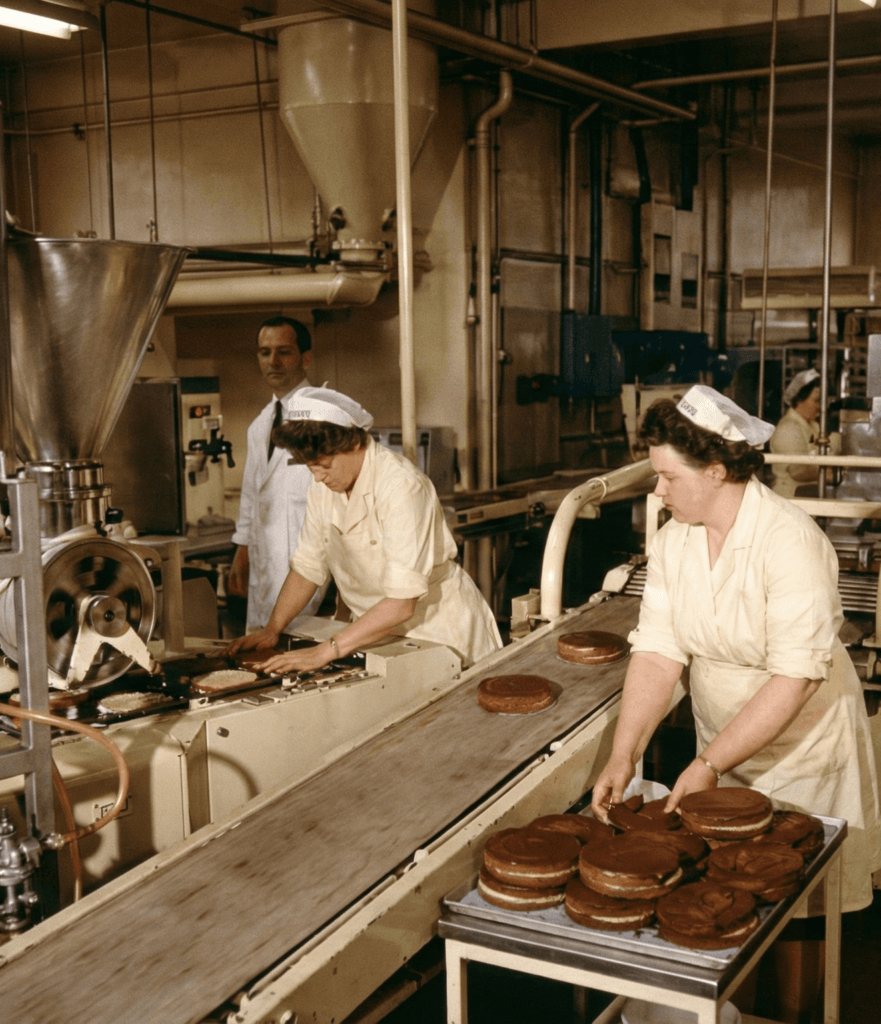
This 1967 line proves that the principles of flow and mechanization are timeless.
However; the shift from mechanical timing to digital sensing is what defines the modern competitive edge.
😊 Thanks for reading!
Sources:
- [1] British Pathé, “Modern Bakery (1967)”: https://www.youtube.com/watch?v=mvYyHXCzXrY
- [2] Sobatech, “Batch Mixing vs Continuous Mixing”: https://www.sobatech.com/news/batch-mixing-vs-continuous-mixing
- [3] Masco Group, “The Evolution of Industrial Automation”: https://www.mascogroup.com/the-evolution-of-industrial-automation
- [4] BIAI, “The Evolution of Industrial Automation”: https://biai.ca/the-evolution-of-industrial-automation/
- [5] Varomachinery, “Decoration Robot”: https://www.varomachinery.com/food/decoration-robot/