Innovation: Unlocking In-Situ Emulsification Without Sensory Defects.
Eliminating chemical emulsifiers often leads bakers into a trap; gaining clean labels but sacrificing flavor due to enzymatic side effects. Traditional lipases can trigger rancid or soapy notes, limiting their use in sensitive applications. Emerging high-ratio galactolipase technology offers a targeted biochemical solution, securing dough stability without the organoleptic risks.
The transition to “clean label” baking is rarely straightforward.
When removing emulsifiers like DATEM or Sodium Stearoyl Lactylate (SSL), bakers frequently turn to enzymes.
However, a detailed analysis of recent patent literature, specifically WO2024213600A1, reveals a sophisticated leap in enzymatic selectivity that addresses the industry’s longest-standing complaint: off-flavors.
The “Small but Mighty” Role of Flour Lipids
To appreciate this innovation, one must understand the substrate.
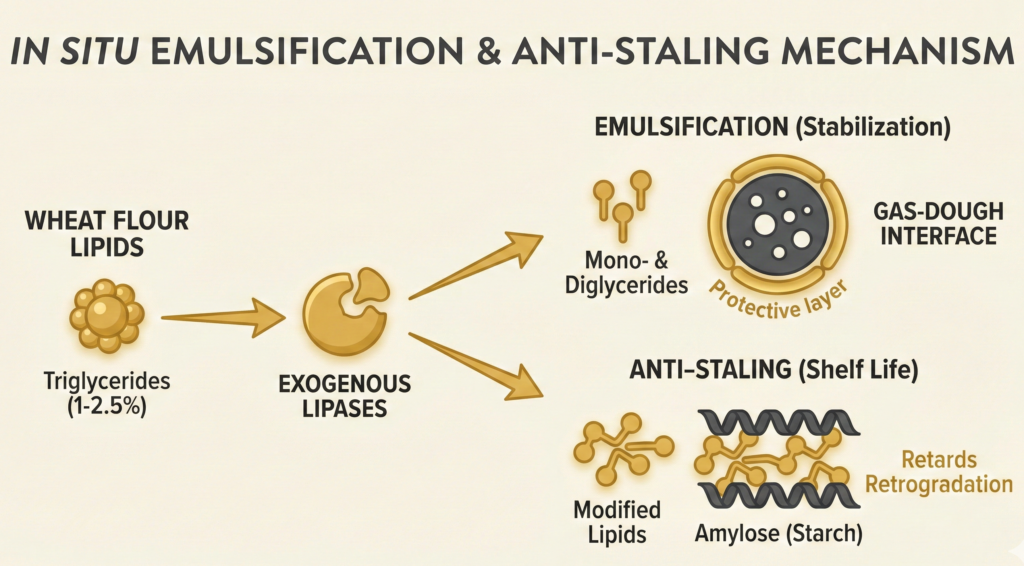
Wheat flour contains a relatively low lipid content, typically ranging from 1% to 2.5%. Despite this small percentage, these components exert a disproportionate influence on bread quality.
Historically, the strategy involved adding exogenous lipases to hydrolyze these endogenous lipids.
This process creates a functional transformation in situ:
- Emulsification: The hydrolysis converts triglycerides into mono- and diglycerides. These byproducts act as natural surfactants, stabilizing the gas-dough interface.
- Anti-Staling: These modified lipids may form complexes with amylose in the starch. This interaction retards retrogradation, potentially delaying the staling process and extending shelf life.
The Innovation: Extreme Selectivity
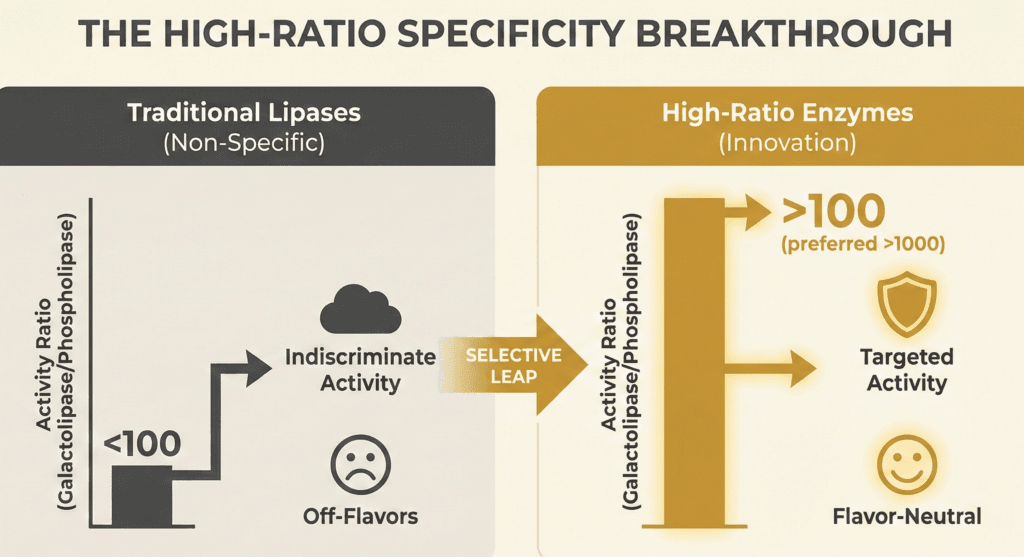
The core of the recent Puratos invention lies in “High Ratio” specificity.
The patent describes enzymes where the ratio of galactolipase activity to phospholipase activity exceeds 100.0, with preferred realizations surpassing 1000.0.
This is not merely a numbers game; it is a targeted functional strategy.
By directing activity specifically toward galactolipids and phospholipids, the enzyme maximizes the production of stabilizing polar lipids.
This mimics the strengthening effects of traditional commercial emulsifiers without the regulatory “E-number” baggage.
Solving the Off-Flavor Crisis
The historical barrier to widespread lipase use has always been sensory deterioration, specifically hydrolytic rancidity. First and second-generation lipases were often too “promiscuous”, attacking triglycerides indiscriminately.
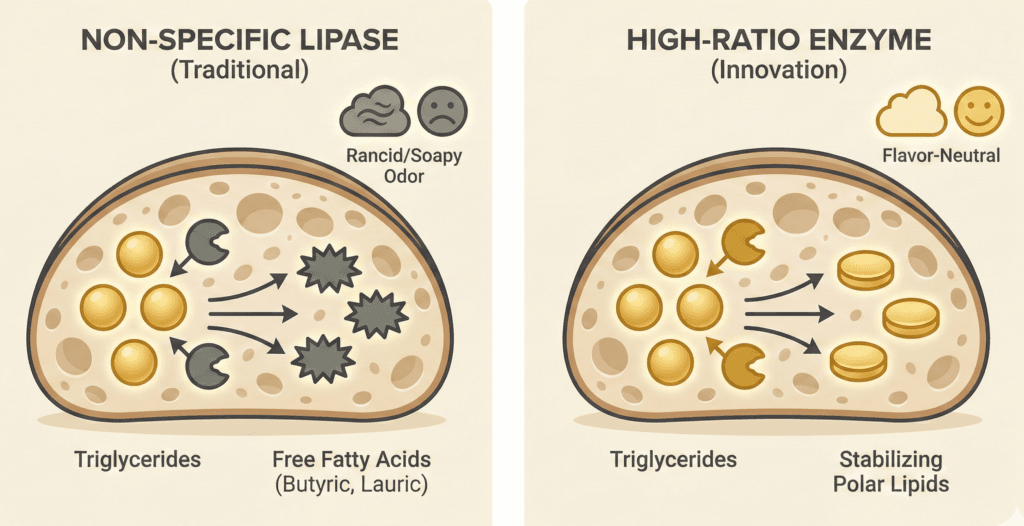
When an enzyme lacks specificity, it releases free fatty acids that ruin the flavor profile:
- Short-Chain Risks: The release of short-chain acids, such as butyric acid, can generate volatile odors described as rancid, cheese-like, or even vomit-like.
- The “Soapy” Defect: If the formulation includes fats high in lauric acid (like palm kernel or coconut oil), non-specific lipases can liberate these acids, resulting in a distinctive and unpleasant soapy taste.
The new high-ratio technology mitigates this by maintaining a galactolipase/lipase ratio superior to 150.0.
By severely restricting activity on triglycerides, the enzyme avoids the accumulation of these volatile fatty acids.
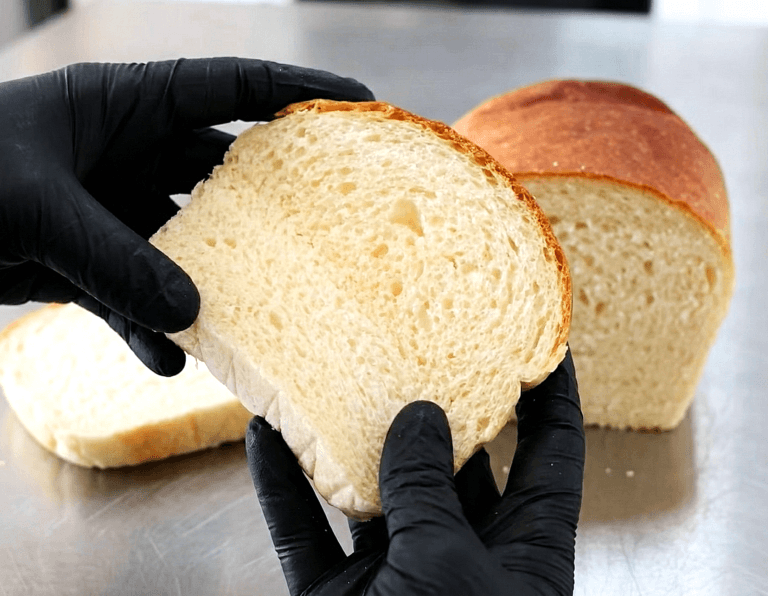
This breakthrough allows for the production of flavor-neutral white breads and brioches that benefit from enzymatic strengthening, without the risk of soapy or rancid aftertastes.
😊 Thanks for reading!
Sources:
- WO2024213600A1 – Galactolipase defined by ratio of galactolipase/phospholipase and/or galactolipase/lipase activity and its application in bakery – Google Patents, accessed January 20, 2026, https://patents.google.com/patent/WO2024213600A1/en
- Improvement of cake baking properties by lipases compared to a traditional emulsifier, https://pmc.ncbi.nlm.nih.gov/articles/PMC9532760/
- Lipases and Their Functionality in the Production of Wheat-Based Food Systems, https://www.researchgate.net/publication/262224938_Lipases_and_Their_Functionality_in_the_Production_of_Wheat-Based_Food_Systems