An Invisible Preservative: Find Why Bags Can Do the Work, Not Your Dough.
Moldy bread is the bakery industry’s silent revenue killer. Consumers demand “clean labels” free of calcium propionate, but they also refuse to buy a loaf that spoils in three days. The solution isn’t in the dough; it’s in the bag. New “Active Film” technology is solving this paradox without altering your recipe.
We all know the struggle.
You spend hours perfecting the crumb structure and acidity of a sourdough, only to have it face the “mold clock” the moment it leaves the oven.
For years, the industry standard has been direct additives; preservatives sprayed on the surface or mixed into the dough.
But with the “clean label” movement growing, ingredients like sorbates and propionates are becoming a liability.
Enter Active Film Technology.
It’s not just a bag; it’s a functional part of your preservation strategy.
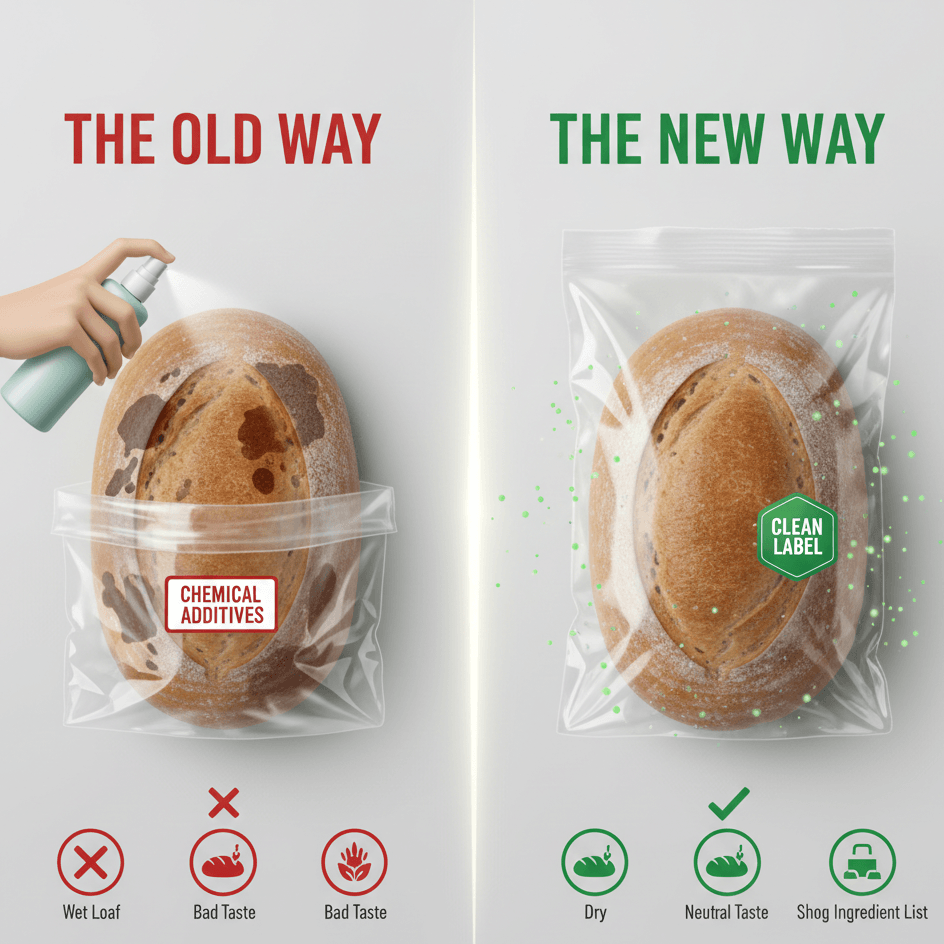
The Old Way vs. The New Way
- Old Way: Spray ethanol or preservatives directly onto the crust. Result: Wet spots, chemical aftertaste, and label declarations.
- New Way: Embed natural antifungal agents into the plastic film itself. Result: Dry crust, clean label, and active protection.
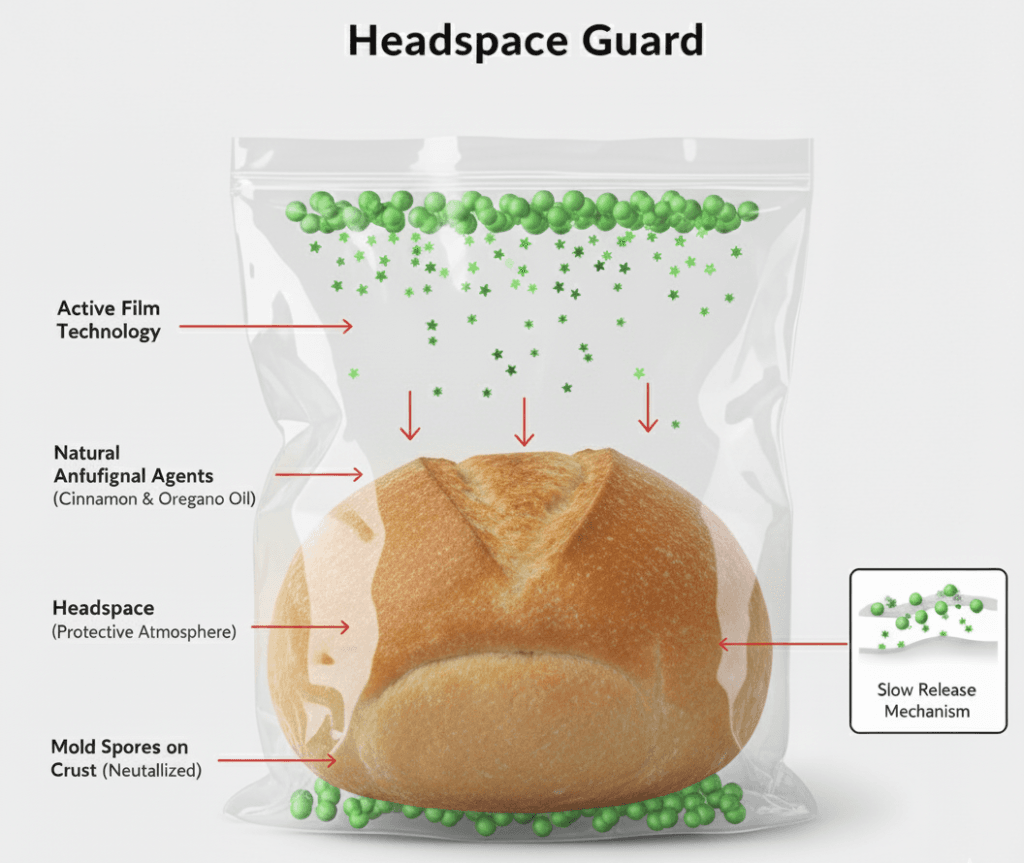
How It Works: The “Headspace” Guard
Recent patents (like CN102585412A) and studies have focused on integrating Essential Oils (EOs); specifically compounds like cinamaldehyde (cinnamon) and carvacrol (oregano); into biopolymers or polyethylene matrices.
Here is the genius part:
The film doesn’t just sit there. It slowly releases these volatile compounds into the “headspace” (the air gap between the bread and the bag).
This creates an inhibitory atmosphere that targets surface molds like Penicillium and Aspergillus right where they start—on the crust.
The Problem: “Why does my toast taste like Pizza?”
The historical hurdle with Essential Oils has always been sensory impact.
To kill the mold, you needed a concentration so high that a slice of white bread would end up smelling like a spice cabinet.
The Solution: The “Molecular Cage” (Cyclodextrins)
This is where the real tech comes in.
Researchers are now using Cyclodextrins to solve the smell issue.
Think of a Cyclodextrin as a microscopic “doughnut” or cage.
- The Trap: The essential oil molecule is trapped inside this cage (forming an “inclusion complex”).
- The Release: Instead of dumping all the aroma at once, the cage releases the volatile compounds slowly and only under certain conditions (like humidity changes inside the pack).
Why this matters for your bakery:
- Sustained Release: The antifungal effect lasts for weeks, not just days.
- Sensory Neutrality: It keeps the volatile count low enough to kill mold but below the threshold where customers can taste it.
- Stability: It protects the delicate oils from degrading during the high-heat film extrusion process.
Active packaging allows you to remove preservatives from your ingredient list while maintaining (or even extending) shelf life. It moves the “chemical work” from the food to the package, giving the consumer exactly what they want: bread that lasts, with a label they can read.
😊 Thanks for reading!
Sources:
- CN102585412A – Active packaging film based on essential oil/beta-cyclodextrin inclusion compound. Google Patents. Link
- Standardization of Active Packaging Technologies, Biopolymer Matrices and Volatile Release Mechanisms.
- Cyclodextrin Inclusion Complexes in Food Packaging, Recent Industry Reviews.