Wet, Dry, or Just Right: The Battle for Humidity Inside the Industrial Oven
From empirical guesswork to intelligent control why hygrometry is the next frontier in large-scale bread production.
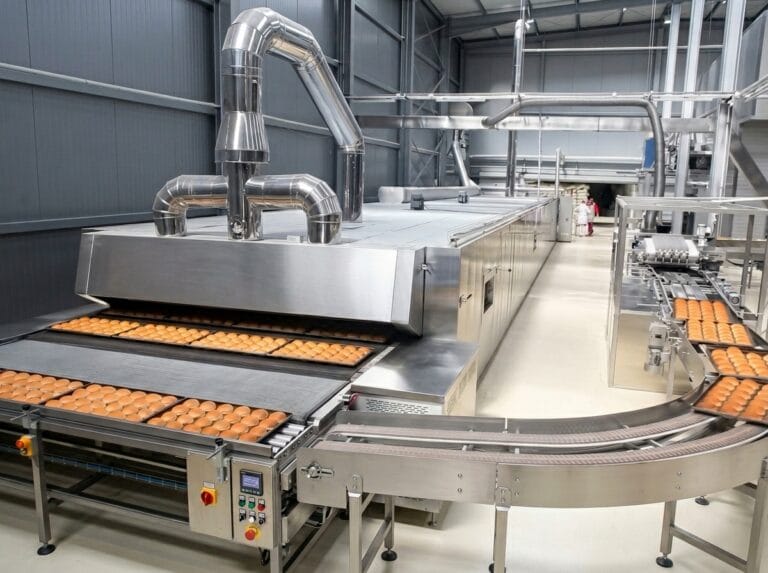
Modern industrial bakeries are remarkable feats of engineering (robotic depositors, precision proofing chambers, computer-controlled tunnel ovens running around the clock.
And yet, one of the most impactful variables in the entire process, the humidity inside the baking chamber, is often the last to receive the same level of systematic attention. That is beginning to change, and the reasons why are as much about energy bills and sustainability targets as they are about the perfect crust.
What Is Hygrometry and Why Does It Matter?
Hygrometry refers to the measurement and management of moisture (specifically relative humidity) within an enclosed environment.
In an industrial oven, that environment is the baking chamber, and the moisture inside it comes from three main sources:
- steam injected deliberately at the start of the bake,
- water vapor released by the products themselves as they heat up, and
- ambient air that enters through vents, valve gaps, and loading openings.
Getting the balance right is not just an aesthetic concern.
Moisture directly affects heat and mass transfer at the product surface, the gelatinization of starch inside the crumb, the formation and browning of the crust, and ultimately the shelf life of the finished loaf. When humidity is wrong (in either direction) the consequences cascade through the entire product.
The Science Behind the Crust and the Crumb
The first minutes inside the oven are critical.
During the oven spring phase (when the dough rapidly expands before the crust sets) the surface must remain pliable. Steam injection creates a thin condensation film on the dough, transferring latent heat and delaying surface hardening.
This is what allows the loaf to reach its full volume. Without adequate early moisture, the crust forms too soon, the dough cannot expand, and the result is a dense, cracked product.
Deeper inside the crumb, starch gelatinization is taking place between roughly 55 and 65 degrees Celsius. This is the process that transforms raw dough into the stable, open matrix we recognize as bread.
It requires both heat and free water. If the baking environment is too dry, moisture migrates too quickly from the crumb to the surface, cutting short the gelatinization process and producing a dense texture with a shorter shelf life, because a poorly gelatinized starch network retrogrades faster.
In the final phase of baking, the logic flips.
Excess humidity must be extracted to allow the Maillard reactions (the non-enzymatic browning that produces color, aroma, and crust crunch) to proceed efficiently. These reactions accelerate above 105 degrees Celsius and require a relatively dry surface. Too much residual steam in the chamber at this stage suppresses browning and softens the crust.
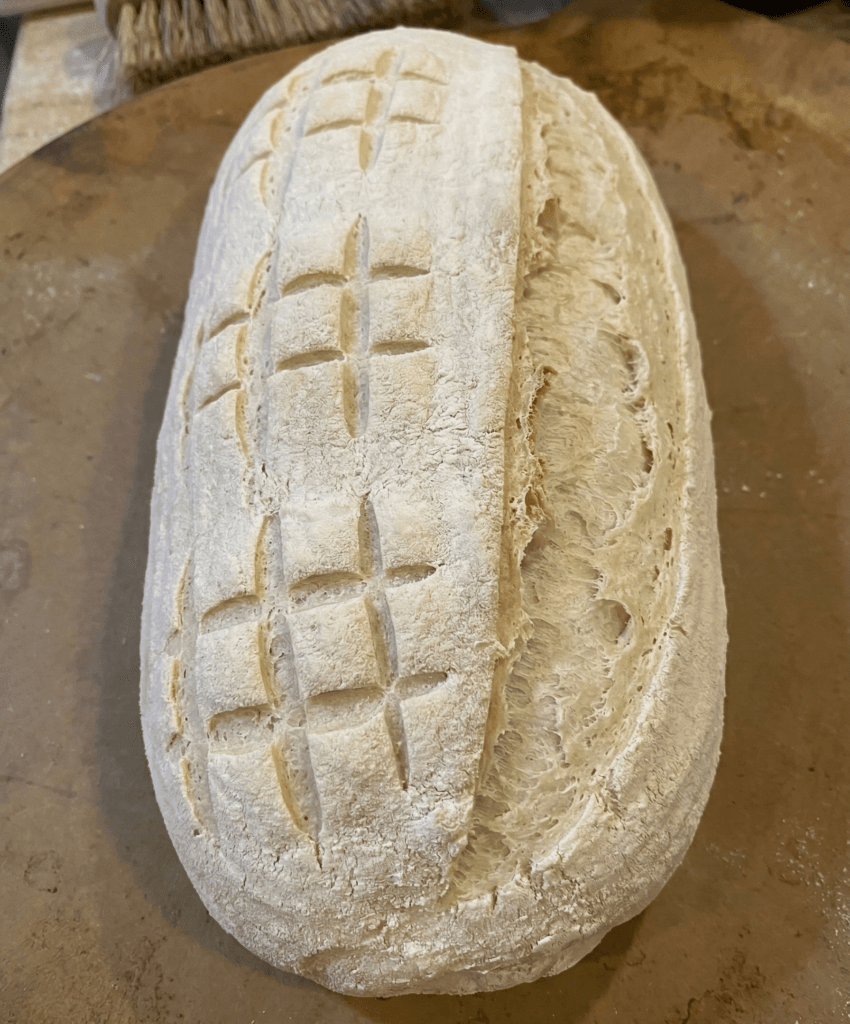
A crust that is too thick and cracked signals a dry early bake. A pale, wrinkled surface that collapses suggest steam was never removed.
Either defect can be traced back to poor hygrometric control, and both are entirely preventable with the right technology.
The Industrial Challenge: Why Automation Is Hard
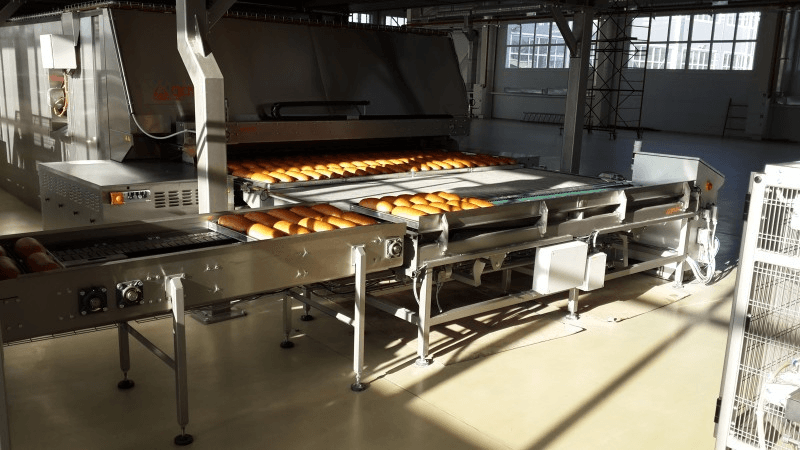
In a small artisan bakery, a skilled baker reads the oven with experience and adjusts the damper manually. At industrial scale (with tunnel ovens running tens of meters long, throughputs of several thousand units per hour, and shifts that continue regardless of whether it is January or August) that human feedback loop breaks down completely.
The core difficulty is the number of interacting variables.
Relative humidity inside the baking chamber is not a single dial. It is the net result of steam injection rate, exhaust valve aperture, product load (more products means more evaporation), ambient conditions outside the plant, and oven temperature zone by zone.
A cold winter day pulls more ambient air through every gap. A high-load run generates more internal evaporation. Even a change in raw material hydration can shift the curve.
When operators set exhaust valves empirically (and keep them fixed throughout the shift) they are essentially accepting a compromise.
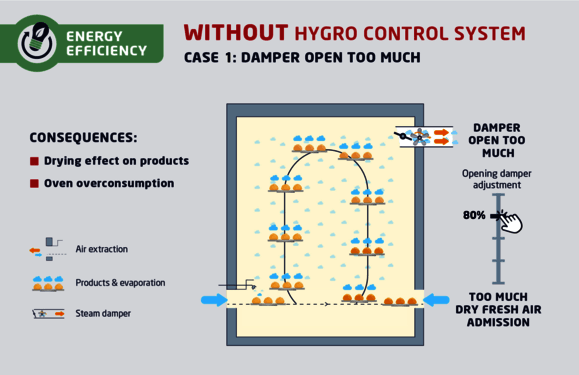
If the valves are open too wide, cold external air floods the chamber, and the oven must burn more fuel to recover temperature.
If they are too closed, humid air migrates into the plant, inflating HVAC costs and creating condensation problems. Estimates suggest these inefficiencies can represent a meaningful share of total energy consumption in a medium-sized production facility.
The Machinery Making It Possible
The industrialization of hygrometric control has become technically feasible thanks to a convergence of sensor miniaturization, real-time data processing, and oven engineering.
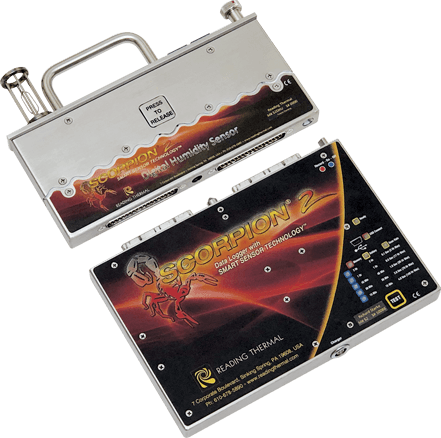
Several equipment manufacturers have moved to integrate these capabilities directly into their platforms.
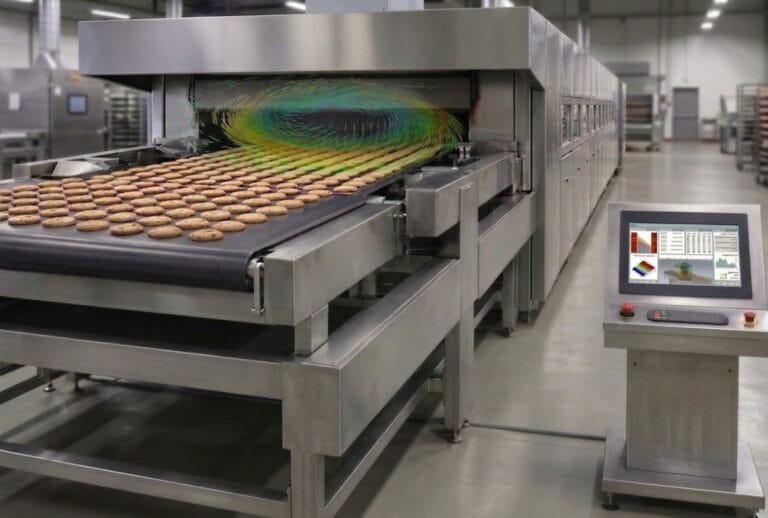
French industrial oven specialist Mecatherm has developed its Hygro Control System, an award-winning automated hygrometry management solution launched at IBA 2025.
The system uses digital sensors positioned along the baking tunnel to measure dew point and absolute humidity continuously.
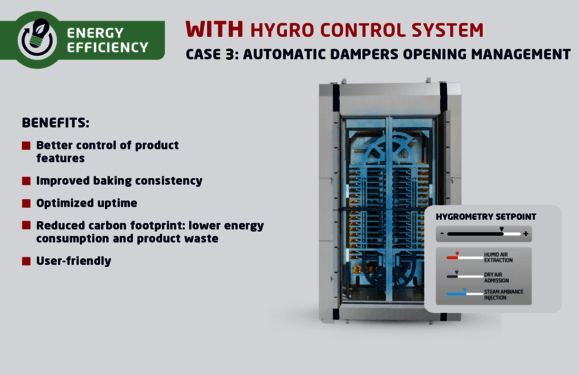
Based on those readings, it dynamically modulates three variables in real time: steam injection rates at the entry zone, exhaust valve aperture at each extraction point, and controlled dry-air intake to maintain thermodynamic equilibrium across the chamber.
The architecture is zone-based.
Rather than treating the entire oven as a single environment, independent control loops manage each section of the tunnel separately, allowing engineers to design precise baking curves, high moisture in the early zone to support oven spring, then a controlled extraction phase to drive Maillard browning, all without manual intervention and without being affected by external climate swings.
Beyond Mecatherm, broader trends in industrial baking equipment point in the same direction.
Modern high-performance tunnel ovens increasingly feature modular baking zones with independent steam and extraction circuits, integrated IoT connectivity for process data logging and remote diagnostics, and PLC-based or cloud-connected control interfaces.
Manufacturers such as Rademaker, Reading Bakery Systems, and Wachtel have all developed platforms that expose humidity-related parameters through operator interfaces, even if fully automated closed-loop control of the kind Mecatherm is proposing remains the leading edge.
What Comes Next
The industrialization of hygrometric control is at an inflection point.
The underlying science has been understood for decades. The sensor technology is mature.
The processing power required for real-time modulation is cheap and readily available. What has been missing is the integration, packaging everything into a robust, food-grade system that operators can trust and maintain, and that delivers consistent results across the variable conditions of real industrial production.
The next few years are likely to see a rapid expansion of zone-based automated baking control, increasingly connected to broader manufacturing execution systems that track product quality, energy consumption, and OEE in a unified dashboard.
For industrial bakers, the message is clear: humidity is no longer a variable to be tolerated ,it is one to be engineered.
SOURCES.
- https://www.mecatherm.fr/en/news/mosaique/details/control-hygrometry-and-optimize-energy-efficiency.html
- https://bakerpedia.com/processes/oven-humidity/
- https://bakerpedia.com/processes/starch-gelatinization/https://mbico.com/blog/temperature-and-humidity-in-ovens/
- https://www.mecatherm.fr/fileadmin/RSE/CP_iba_2025_Sustainability_Final_version_EN.pdf
- https://www.mecatherm.fr/en/news/mosaique/details/interviews-the-importance-of-hygrometry-in-the-bakery-production-process.html
- https://www.mecatherm.fr/en/news/mosaique/details/control-hygrometry-and-optimize-energy-efficiency.html
- Tunnel ovens and complete lines for industrial baking – YouTube
- https://youtu.be/kIZDLZf3rBQ?si=q3S83SIm65Ae_QUg