Why Some Bread Crumbs Are Too Soft for Slicing, and Why Loaf Sides Collapse
Crumb firmness during cooling is essential for maintaining slicing performance and final product quality. When loaves show excessive softness or their sides collapse inward, the root causes often lie in starch retrogradation dynamics, moisture migration, and formulation variables.
What Happens Inside the Loaf During Cooling
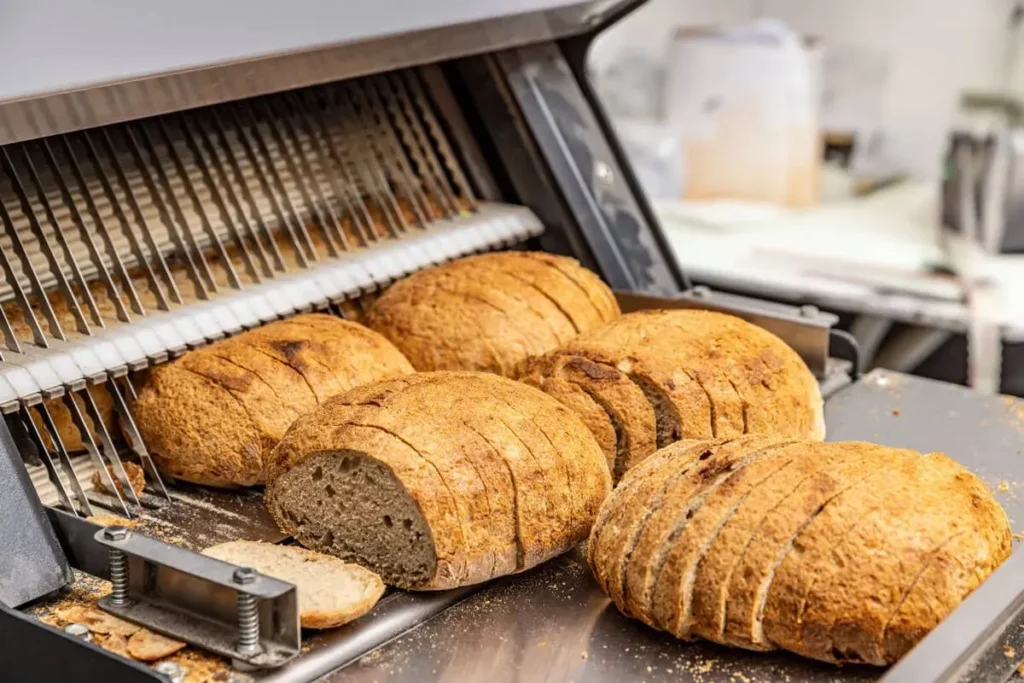
Once bread exits the oven, its crust is already firm, but the crumb remains soft. During the first minutes of cooling, critical physical transformations occur:
- Amylose molecules begin retrograding, forming crystalline regions that increase crumb firmness.
- Amylopectin retrogradation happens later, creating the long term firming associated with staling.
Mechanical slicing requires the crumb to reach an internal core temperature of roughly 27 to 30°C, the point where amylose has crystallized enough to support blade pressure without tearing.
Why the Crumb May Be Too Soft for Slicing
Several factors can prevent sufficient early firming:
1. Insufficient Amylose Retrogradation
If cooling is too slow or the loaf retains too much moisture, amylose crystallization may be delayed. This causes a soft, compressible crumb at slicing.
2. Excess Moisture in the Crumb
Higher moisture content improves softness, but it reduces sliceability. When moisture loss during cooling is intentionally minimized, the crumb may remain too tender.
3. High Levels of Anti-Staling Enzymes
Maltogenic amylases are widely used to improve softness and extend shelf life. However, excessive addition can produce a crumb that is too soft at the slicing stage.
- Overactive enzymes reduce starch firmness.
- Loaf sides can weaken structurally, contributing to collapse.
4. Low Flour Falling Number
A low Falling Number indicates high endogenous amylase activity, which promotes excessive starch breakdown. This softens the crumb and diminishes structural resilience.
Why Loaf Sides Collapse Inward
Inward collapse is often related to moisture and enzymatic factors:
- Excessive moisture loss in cooling causes contraction of the crust, pulling the sides inward.
- Excess amylase activity weakens cell structure and reduces the crumb’s ability to support its shape.
- Poor internal starch gel strength leads to deformation during cooling.
These effects become more pronounced when bread formulas aim for very soft eating quality.
Formulation Factors
Small formulation adjustments can significantly influence crumb firmness, structural strength, and sliceability. Two key areas to examine are fat addition and enzyme systems, since both directly affect starch behavior, moisture distribution, and internal loaf stability.
1. Fat Addition
Fat coats gluten strands, reducing friction between them and limiting the formation of very strong gluten bonds. Small amounts of fat produce two important effects:
More extensible dough
Because the gluten network becomes less stiff, it stretches more easily during fermentation and oven spring.
- Gas cells expand more uniformly
- The loaf reaches greater volume
- The crumb becomes more tender and regular
This directly improves sliceability as long as crumb firmness develops properly during cooling.
Better gas cell stability
Fat migrates to gas cell interfaces, strengthening the bubble walls in combination with proteins and emulsifiers. This provides:
- Stronger gas retention
- Thinner, more uniform cell walls
- A softer but structurally supported crumb
This makes the dough easier to expand during oven spring.
When fat is too low, gas cells do not expand enough, resulting in a denser crumb that firms quickly and can cause smearing and deformation during slicing.
2. Enzyme Systems
Enzymes, especially maltogenic amylases, have a strong impact on starch retrogradation and crumb behavior. Their primary function is to slow staling by modifying starch structure, but improper dosing can lead to excessive softness.
Additional explanation in clearer paragraphs:
- Maltogenic amylases shorten amylopectin chains, reducing the long term firming normally associated with staling. However, too much activity can also reduce early amylose crystallization, leaving the crumb fragile and overly soft during slicing.
- Excess enzyme activity weakens internal cell walls, reducing the loaf’s ability to maintain shape as it cools. This can contribute directly to inward collapse of the sides.
- If the flour Falling Number is low, indicating natural amylase activity is already high, adding a full improver dosage can push enzyme levels beyond the optimal range.
Cooler Conditions to Review
Even when you believe cooler settings have not changed, small variations can impact sliceability:
- Air speed controls moisture loss from the crust.
- Cooler temperature affects crystallization rate.
- Residence time determines whether crumb temperature reaches the slicing range.
👉 Thanks for reading! 💬 Any experiences to share with us?? – We’d love to hear your story!
Source: https://tinyurl.com/uks8jyvx