Solid-State Enzymatic Engineering: Redefining Logistics
Inconsistent dosing and airborne dust plague industrial bakeries, complicating production and endangering health. Solid-state enzyme technology offers a precise solution. By compressing active ingredients into dissolvable units, accuracy improves while logistical footprints and respiratory risks shrink significantly.
The End of the Powder Era
The most disruptive innovation in mass improvers recently is the global expansion of Cubease by Puratos. This development represents a quantum leap from traditional powders, addressing challenges in precision, ergonomics, and sustainability simultaneously.
Engineering the Solid Format
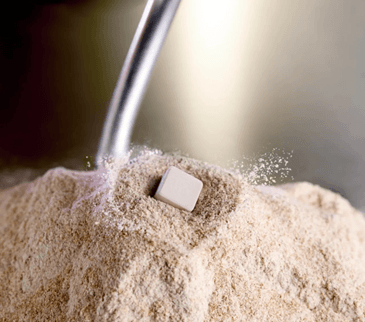
Technically, this is not just a compressed improver; it is a re-engineering of the excipient matrix. Documentation reveals that the formulation dispenses with calcium carbonate fillers or excessive flour. Instead, it uses a sugar matrix as a functional carrier that guarantees enzyme stability in a solid state.
The engineering challenge here lies in dissolution kinetics: the solid cube must disintegrate and disperse its enzymatic assets homogeneously into the aqueous phase of the dough during the first few minutes of kneading. This prevents residues or “hot spots” of enzymatic activity without requiring mechanical crushing.
Operational Precision
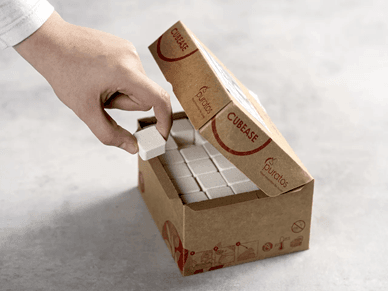
Performance data is compelling. The extreme concentration of active ingredients allows a single small cube to treat 50 kg of flour efficiently (with variants for 10 kg). This eliminates the need for weighing in the plant.
- Error Eradication: It removes human error in dosing, a frequent cause of inconsistency in industrial production.
- Process Standardization: The adoption of this technology in markets from Ethiopia to the US suggests a global standardization strategy by major industrial groups.
Sustainability and Health Impact
From a logistical and environmental perspective, the implications are profound:
- Volume Reduction: A reported decrease of 95.6% in required storage volume compared to powder improver sacks, freeing up critical space in climate-controlled warehouses.
- Carbon Footprint: Lifecycle analysis indicates a tenfold reduction in CO2 impact, derived from optimized transport and the elimination of non-recyclable plastics in favor of recyclable cardboard.
- Occupational Health: By eliminating suspended dust, it significantly mitigates the risk of “baker’s asthma,” a chronic occupational health issue caused by sensitization to flour and enzyme dust.
😊 Thanks for reading!
Sources:
- Puratos. “Cubease.” Accessed January 20, 2026. https://www.puratos.ie/en/bakery/categories/bread-improvers/cubease
- Puratos. “Puratos brings a trio of transformative innovations to iba 2025.” Accessed January 20, 2026. https://www.puratos.com/press/press-release/puratos-brings-a-trio-of-transformative-innovations-to-iba-2025
- Puratos Ethiopia. “Cubease.” Accessed January 20, 2026. https://www.puratos-ethiopia.com/en/products/cubease
- Milling Middle East & Africa. “Puratos unveils three new ingredient innovations.” May 15, 2025. https://millingmea.com/puratos-unveils-three-new-ingredient-innovations-2/