Stop fighting your high-hydration dough; let the enzymes do the mixing for you.
High-hydration doughs often feel unmanageable and sticky, ruining production efficiency. A strategic autolyse rest solves gluten development issues, transforming batters into structured, easy-to-handle masterpieces with minimal mechanical effort.
High-hydration doughs are the hallmark of artisanal excellence, yet they remain a frequent source of frustration for production consistency.
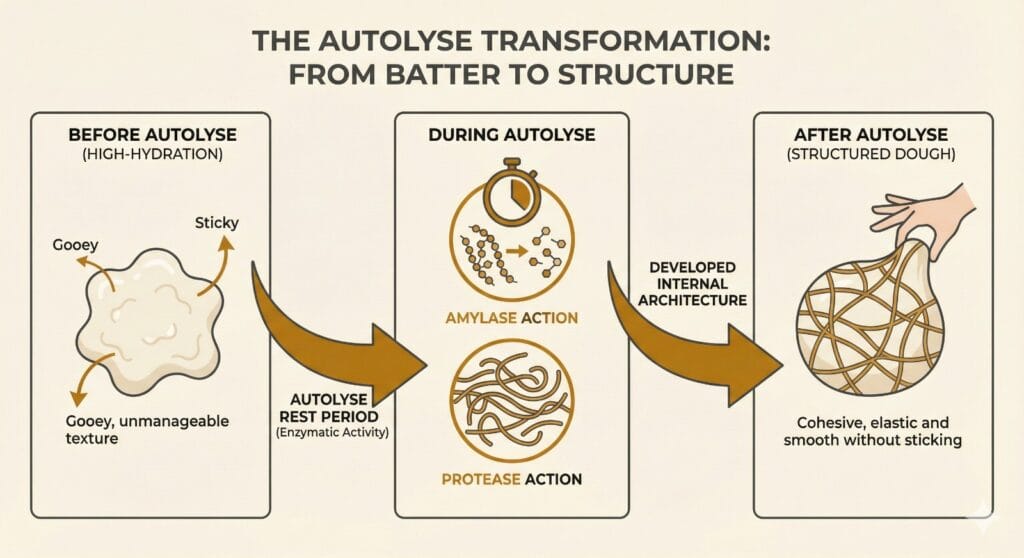
When water levels climb past the 85% mark, the line between a manageable dough and a sticky, unworkable batter virtually disappears.
Many bakers try to compensate for this slackness with excessive mechanical mixing, but that approach often backfires, leading to over-oxidized dough and a loss of the precious yellow carotenoid pigments that carry the bread’s aroma and flavor.
The secret to mastering these fluid ratios lies in the autolyse phase, a simple but powerful rest period that lets chemistry do the heavy lifting before the mixer even picks up speed.
By mixing only the flour and water and allowing them to rest before adding salt or yeast, you trigger a biological transformation. This is not just a pause in the workflow; it is the exact moment when the dough builds its own internal architecture.
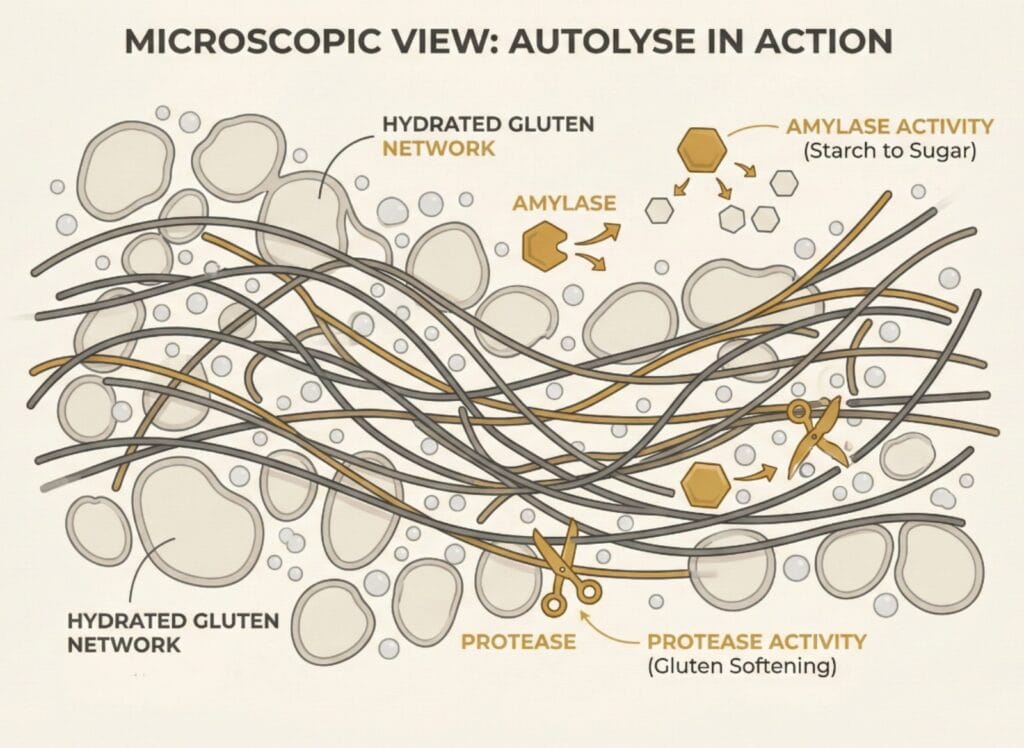
During this rest, natural enzymes like amylase and protease become the primary workers.
Amylase begins the process of converting complex starches into simple sugars, providing fuel for later fermentation.
More importantly, protease enzymes begin to slightly soften the gluten bonds.
While “softening” might sound like a weakness, it is actually the key to extensibility. This enzymatic activity allows the dough to stretch without immediate tearing, a critical factor when handling doughs that behave more like liquids than solids.
For those that operate commercial lines, the technical benefits of autolyse are multifaceted:
- Accelerated Gluten Development: Gliadin and glutenin proteins hydrate fully and begin to align without the need for intense mechanical friction. This reduces total mixing time, often by as much as 30% or 40%, which keeps the dough temperature lower and preserves the integrity of the flour.
- Increased Extensibility: At 90% hydration, dough is notoriously fluid. Autolyse provides the elasticity required to move through automated dividers or withstand folding techniques without the surface tension snapping.
- Inherent Structural Strength: A well-rested dough organizes its gluten network early. This creates a foundation that can hold its shape during the final proof, even when the water content is pushing the physical limits of the flour’s absorption capacity.
- Optimized Gas Retention: A cohesive and relaxed gluten network retains fermentation gases more effectively. This is what produces that sought-after open crumb structure, characterized by large, irregular air pockets rather than a tight, uniform sponge.
- Superior Machinability: Autolyse significantly reduces the stickiness of the dough. This leads to cleaner releases from machinery, such as the high-precision dividers and rounders used by industry leaders like Empire Bakery Equipment, ensuring that pinpoint accuracy is maintained even at high speeds.
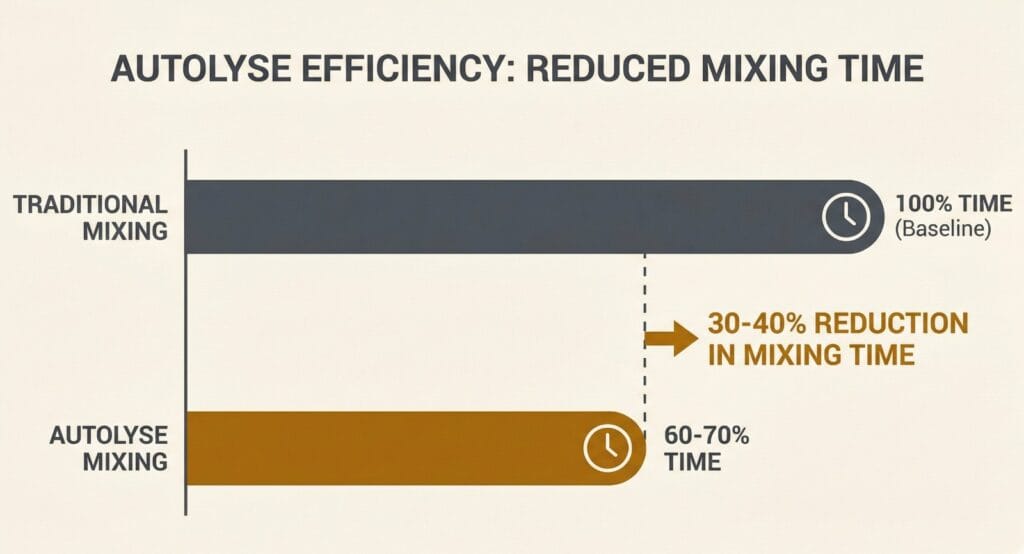
When you observe a professional production line accurately dividing high-hydration dough, you are seeing the result of precise hydration management. The autolyse ensures the dough is not just wet, but structured. It transforms a difficult, slack mass into a resilient and predictable material that responds perfectly to the touch, whether that touch is a baker’s hand or a stainless steel divider.
#autolyse #bakeryscience #breadmaking #artisanbread #highhydration
👉 Thanks for reading! 💬 Any experiences to share with us? – We’d love to hear your story!
Sources: Empire Bakery Equipment