The Variable That May Be Destroying Your Gluten Network (It’s Not Over-Mixing)
Mastering buffering capacity and proteolysis is the only way to prevent the dreaded “soup” texture during scale-up.
Switching from white to whole wheat flour often destabilizes a perfectly healthy sourdough culture, leading to structural collapse.

This isn’t just about hydration; it is a fundamental shift in microbiology and enzymatic kinetics.
Transitioning a formula or starter from refined flour to whole wheat is not merely a nutritional upgrade; it is a complete alteration of the selective ecosystem.
Recent data suggests that the flour substrate, rather than the feeding schedule, is the primary driver of bacterial population dynamics.
1. Substrate-Driven Microbiological Shifts
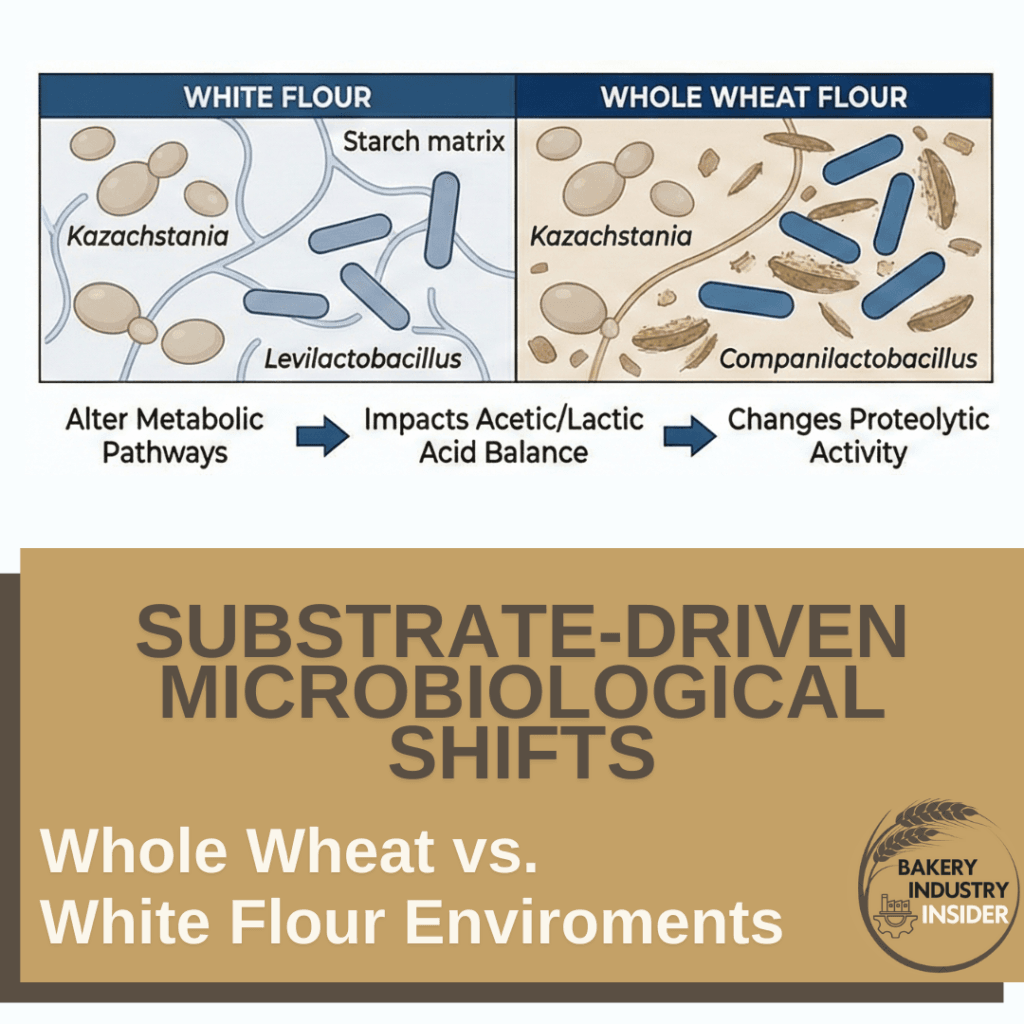
Research published in late 2025 confirms that while the dominant yeast strains like Kazachstania tend to remain stable, the Lactic Acid Bacteria (LAB) community undergoes a radical shift.
- The Shift: White flour environments typically support Levilactobacillus, whereas whole wheat substrates significantly favor the proliferation of Companilactobacillus.
- Technical Impact: This shift alters metabolic pathways. Companilactobacillus impacts the acetic versus lactic acid balance and proteolytic activity, requiring a recalibration of fermentation timelines to avoid off-flavors.
2. The Buffering Capacity Trap
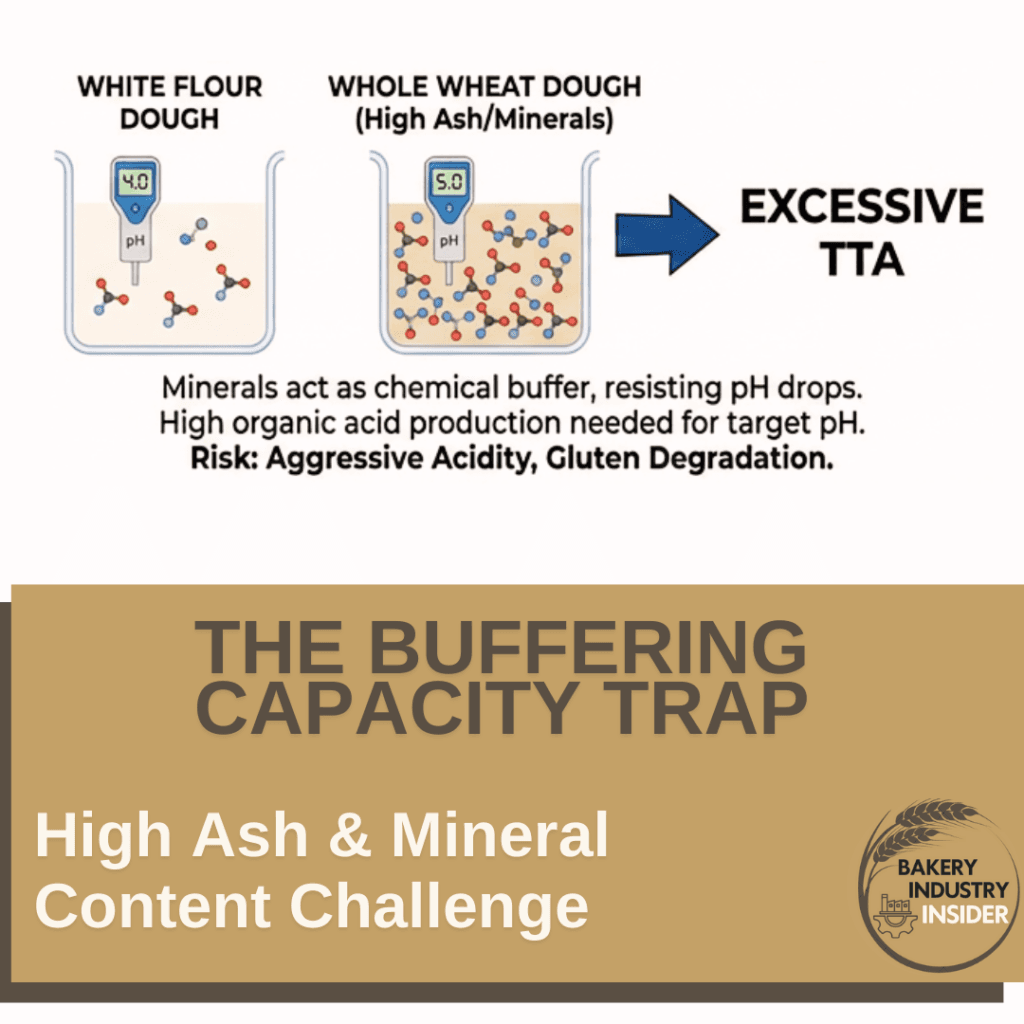
The most critical physical-chemical challenge in reformulation is the high concentration of ash and minerals found in the bran. These minerals act as a potent chemical buffer.
- Dissociation of pH and TTA: In a whole wheat medium, the mass resists pH drops. To achieve the same pH reduction (e.g., from 5.0 to 4.0) observed in white flour, bacteria must produce a significantly higher volume of organic acids.
- Production Risk: If a baker waits for the pH to hit a “standard” target like 3.8, the Total Titratable Acidity (TTA) will be excessive. This results in aggressive perceived acidity and severe degradation of the gluten network.
3. Enzymatic Kinetics and Proteolysis
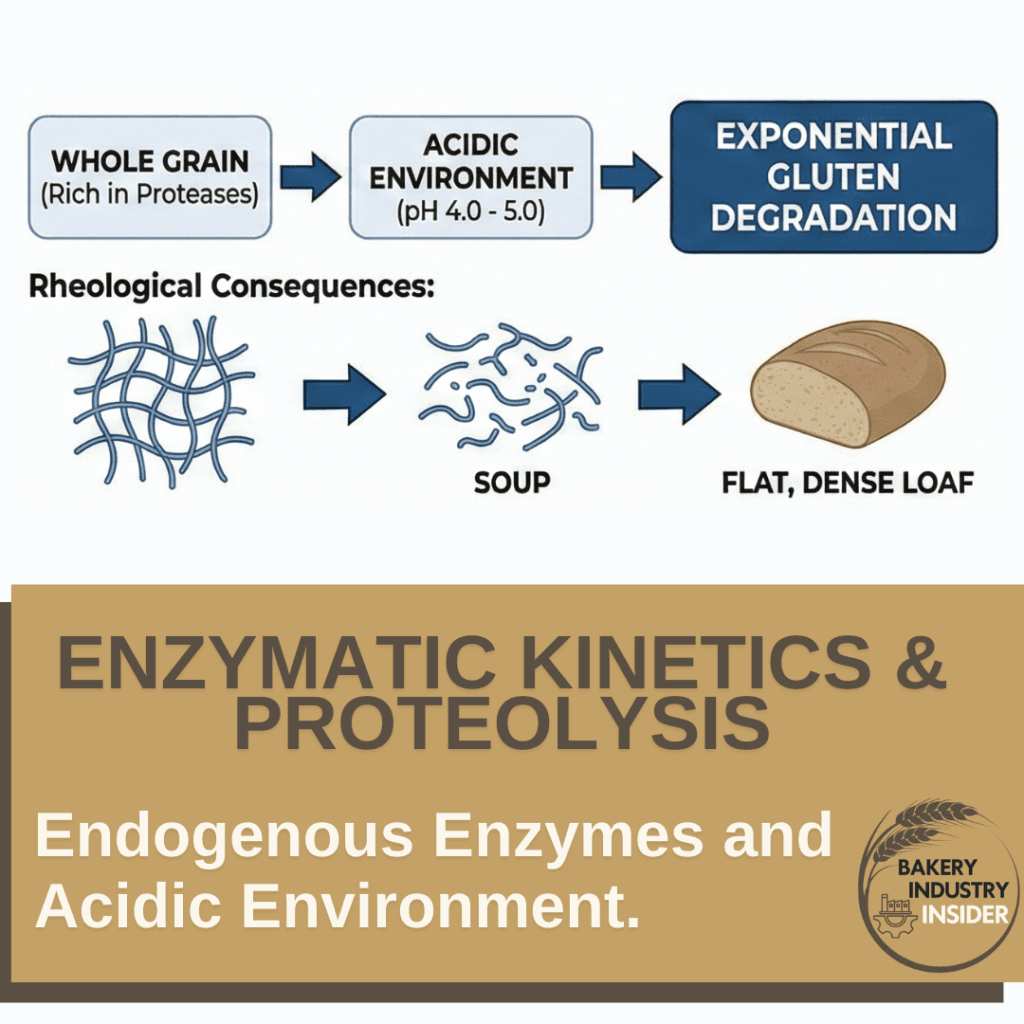
Whole grain introduces an endogenous enzymatic load absent in refined flour. Bran is rich in proteases, enzymes specifically designed to break down proteins.
- The Compound Effect: Protease activity increases in acidic environments (pH 4.0 – 5.0). By combining the higher acidity required to overcome the buffering effect with this native protease load, gluten degradation accelerates exponentially.
- Rheological Consequences: Without specific reformulation, such as reducing hydration, shortening bulk fermentation, or lowering temperatures, the dough loses tenacity. It effectively turns into a “soup,” yielding flat, dense loaves.
4. Metabolic Acceleration
Whole wheat acts as high-octane fuel for microbial life. It provides an abundance of free sugars, amino acids, and micronutrients like manganese and magnesium that act as growth cofactors.
- Reduced Lag Phase: The time between feeding and activity reduces, and the exponential growth phase accelerates.
- The Window: A whole wheat starter peaks much earlier than a white one. If not fed immediately upon peaking, it rapidly enters the death phase and begins autolysis.
👉 Thanks for reading!
Sources:
- Microbiology Spectrum (ASM Journals, Nov 2025): https://journals.asm.org/doi/10.1128/spectrum.02380-25
- ResearchGate / Foods Journal (2025): https://www.researchgate.net/publication/394635467_Chemical_and_Nutritional_Characterization_of_Sourdoughs_Made_with_Sprouted_and_Unsprouted_Whole-Wheat_Flour_and_Their_Effects_on_the_Technological_Quality_of_Bread
- The Sourdough Framework: https://www.the-sourdough-framework.com/Wheatsourdough.html
- Cereal Chemistry: https://www.cerealsgrains.org/publications/cc/2005/March/Pages/82_2_144.aspx
- Does It Matter Which Flour You Preferment?: https://www.youtube.com/watch?v=tcw5MkP28T4