Streamlining Production with Automated Panning
Relying on manual tray loading creates inevitable bottlenecks that slow down the entire line; causing irregular spacing and wasted potential. Automated panning solves this by synchronizing dough placement with conveyor speed, ensuring perfect alignment without human intervention.
The video footage highlights a seamless transition from the dividing equipment to the proofing trays.
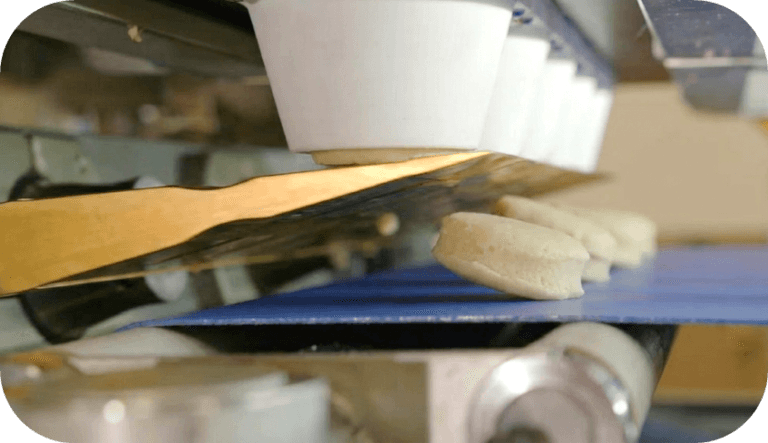
You can see the dough balls arriving in a continuous, multi-row flow; moving towards a dedicated panning station where empty trays are automatically indexed into position.
This setup eliminates the chaotic nature of manual handling.
The trays glide underneath the product stream on a lower conveyor, perfectly timed to receive the dough without stopping the line.
The Retractable Technology
The core technology at play is a retractable conveyor system.
Instead of dropping the dough from a height or relying on gravity alone; the upper belt extends fully over the target area of the tray.
Once in position, the belt retracts rapidly.
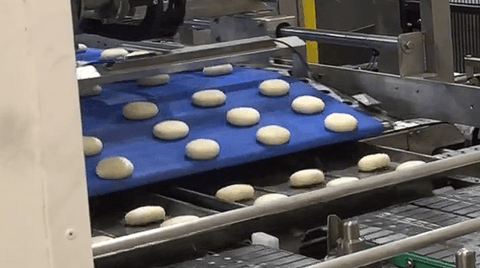
This “pull-back” motion deposits the entire row of dough pieces simultaneously and gently.
Technical Integration in the Makeup Stage
From an engineering perspective, this retractable system optimizes the critical “makeup” phase of production, where bulk dough is transformed into accurately molded pieces ready for the oven.
In a standard industrial line, dough passes through dividing and rounding stations to recover extensibility before reaching the panning station.
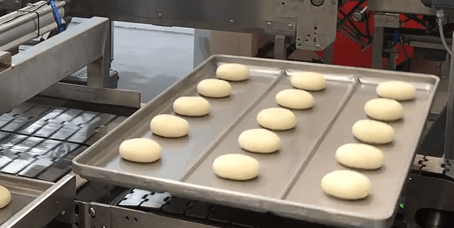
The precision of the automated retractable belt is technically vital; it ensures that dough pieces are deposited centrally with their seams facing the bottom of the pan, a specific orientation necessary to prevent the dough from opening up during the rapid expansion known as “oven spring”.
By synchronizing the deposit speed with the tray conveyor (similar to the mechanics of wire-cut depositors that move in synchronization with oven bands) the system maintains exact spacing.
This eliminates the variability of manual handling, which is essential in high-capacity plants to ensure the dough is transferred with minimal intervention, protecting the gluten structure established during earlier fermentation.
Key Features and Benefits
Domatic Sartori, a manufacturer with a long history in bakery automation, designs these systems to integrate into high-capacity lines like their SVI series.
Based on the machinery shown and the company’s standards, several key advantages stand out:
- Gentle Deposition: The retractable movement places dough rather than throwing it; which could improve the final volume and shape of the buns.
- High Throughput: Automated panning stations are generally capable of keeping pace with high-speed dividers, potentially handling thousands of pieces per hour without fatigue.
- Hygienic Construction: The equipment features a stainless steel open-frame design; enabling easier cleaning and adherence to food safety standards.
- Consistent Spacing: Electronic synchronization ensures every dough piece is aligned perfectly on the tray, maximizing oven capacity.
Automating the panning stage transforms a chaotic choke point into a smooth, rhythmic operation that enhances both productivity and product quality.
😊 Thanks for reading!
Sources: