Could Jiggly Cake Production Be Scaled? Technical Challenges
Transitioning the delicate, highly aerated meringue structure of Taiwanese Castella cake from artisan water baths to high-volume industrial lines risks massive structural collapse. Achieving this ultra-soft, jiggly texture at scale requires precise control over continuous steam injection, specialized depositing, and automated egg white whip systems.
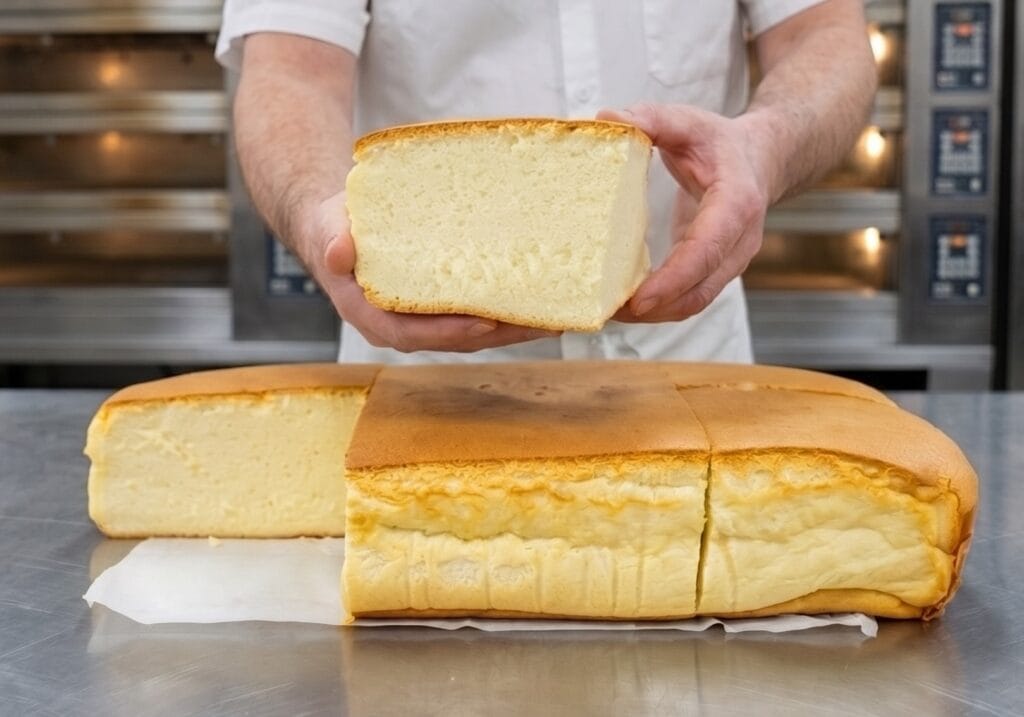
The Japanese soufflé cheesecake, popularly known as the jiggly cake, owes its global appeal to an incredibly airy, moist texture and characteristic rebound. While commercial franchise bakeries currently produce these cakes in semi-automated batches, scaling this delicate process to a high-capacity continuous line introduces severe physical and thermal challenges that can easily compromise product quality.
Foam Stability and Mechanical Shear in Continuous Depositing
The delicate microcellular structure of this cake relies on an unstable foam of whipped egg whites folded into an emulsion of cream cheese, egg yolks, milk, and flour. This gas-cell network is highly sensitive to external mechanical forces.
When transitioning to automated lines, several critical failures can occur during batter transport:
To prevent cell degradation, continuous production lines could replace traditional pumps with pressurized continuous mixing systems. These specialized systems inject nitrogen or air under controlled pressure directly into the flowing batter, ensuring a uniform distribution of micro-cavities that survive depositing and expand predictably during baking.
Thermal Dynamics: Replacing the Bain-Marie in Industrial Tunnel Ovens
In small-scale operations, the cake is baked using a water bath, or bain-marie, where the pan sits in water. Water evaporation acts as a thermal regulator, keeping the pan’s surface temperature near 100 °C. This controlled thermal transfer slows down egg protein coagulation and starch gelatinization, allowing the center of the cake to cook fully before the outer surface sets.
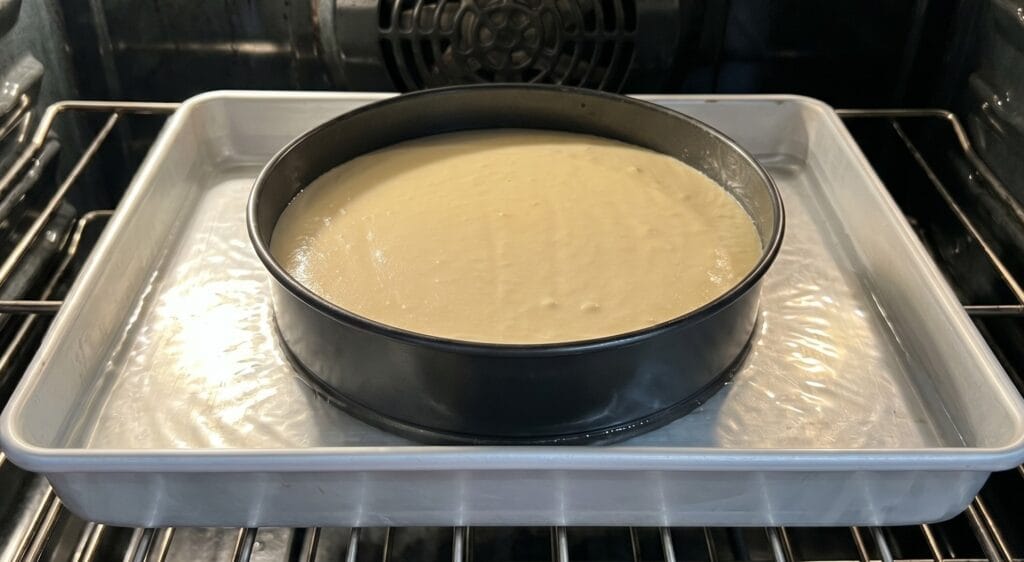
Replicating this environment in a continuous tunnel oven is highly inefficient and raises operational concerns:
High-output lines could solve this issue by utilizing specialized multi-zone tunnel ovens equipped with precise steam injection and humidity control. Saturating the atmosphere in the initial baking zone could prevents surface evaporation, keeping the top crust elastic and allowing the batter to rise uniformly without tearing.
Recommended Reading:

Handling Hot Product
Upon exiting the oven, the hot cake has extremely low mechanical strength due to its exceptionally high moisture content and light density. The cake cannot support its own weight without a rigid mold or immediate structural support.
Manual operators use a coordinated sequence of wooden boards and parchment paper to flip and unmold the hot cake. Automating this step presents major mechanical risks:
To safely scale this step, plants could implement soft-vacuum depanning systems or custom pneumatic grippers. These devices distribute lifting forces uniformly across the entire surface, avoiding localized pressure spikes and transferring the hot product to cooling conveyors without risking structural failure.
Shelf-Life Limitations and Elasticity Retention
The commercial viability of this product is heavily constrained by its short shelf life. The high water activity required to maintain its unique jiggly texture accelerates staling and mold growth, limiting room-temperature shelf life to less than 24 hours and refrigerated life to just three days.
Modifying the formula to extend shelf life introduces several technical compromises:
Ultimately, standard mass-scale industrialization remains financially unviable. The extreme fragility of the hot cake during high-speed packaging operations, combined with a highly restrictive three-day shelf life, would generate unsustainable logistical waste and product damage. Consequently, the high capital investment required for specialized, high-precision automated systems would fail to yield a positive return, making this product better suited for standardized batch-based commercial franchises rather than continuous high-volume production plants.
😊 Thanks for reading!
Sources:
- https://www.youtube.com/watch?v=GFEcOvs6YWk
- https://www.spatuladesserts.com/jiggly-japanese-cheesecake/
- https://www.nagase.com/discover/resources/treha-sponge-cake-baking-case-study
- https://www.kingarthurbaking.com/recipes/japanese-style-souffle-cheesecake-recipe
- ResearchGate (Food Science and Technology). Prediction of Specific Japanese Sponge Cake Volume Using Pasting Properties and Viscosity of Flour: https://www.researchgate.net/publication/249306643_Prediction_of_Specific_Japanese_Sponge_Cake_Volume_Using_Pasting_Properties_of_Flour