Bakery Fillings: How Its Rheology Controls Stability on Industrial Lines
Inconsistent filling viscosity causes nozzle clogging, weight variation, and post-bake blowouts on high-speed lines. Solving these failures requires understanding how sugars, hydrocolloids, emulsifiers, and fats interact to build matrices that remain pumpable, stable through thermal shock, and structurally intact on the shelf.
What a Filling Actually Does Inside the Product
Fillings are not passive flavor carriers. They function simultaneously as moisture reservoirs, structural supports, and thermal buffers within the baked matrix. A fruit gel inside a co-extruded bar controls water migration between filling and crust, preventing sogginess while keeping the crumb hydrated. An anhydrous fat cream in a sandwich cookie provides mechanical firmness at room temperature, yet melts cleanly at body temperature to deliver flavor. An oil-in-water emulsion injected into a donut supplies a non-greasy mouthfeel and rapid flavor release.
These distinct demands split industrial fillings into three broad families, each presenting unique formulation constraints, and each demanding a specific rheological profile to survive the production line:
| Filling Family | Continuous Phase | Typical Water Activity (aw) | Primary Applications |
|---|---|---|---|
| Fruit & Jam Matrices | Aqueous (Sugar-hydrocolloid gel) | 0.65 – 0.85 | Co-extruded bars, baked tarts, Danishes, toaster pastries |
| Anhydrous Fat Creams | Lipid (Crystalline fat matrix) | 0.20 – 0.50 | Sandwich cookies, wafer laminations, post-bake injected rolls |
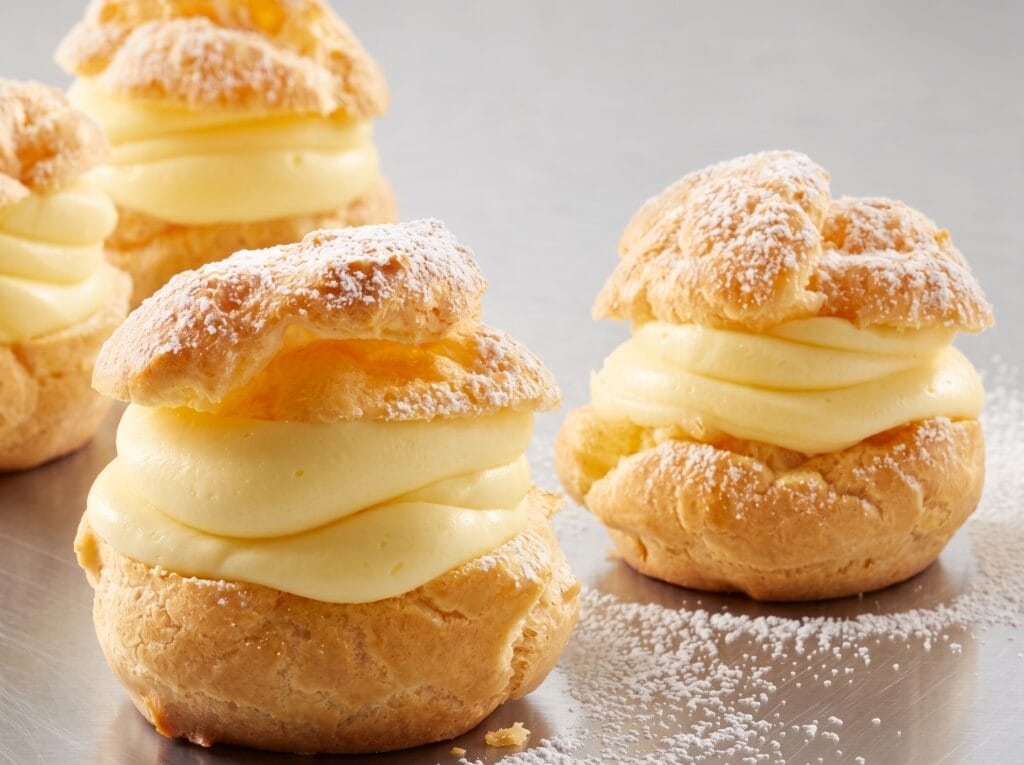
| Emulsion Creams (O/W) | Aqueous (Fat droplets in water) | 0.78 – 0.92 | Post-bake injected donuts, eclairs, cream puffs, chilled rolls |
What Sugar Really Does Inside a Filling
In water-based fillings, dissolved sugars perform critical structural work well beyond providing sweetness:
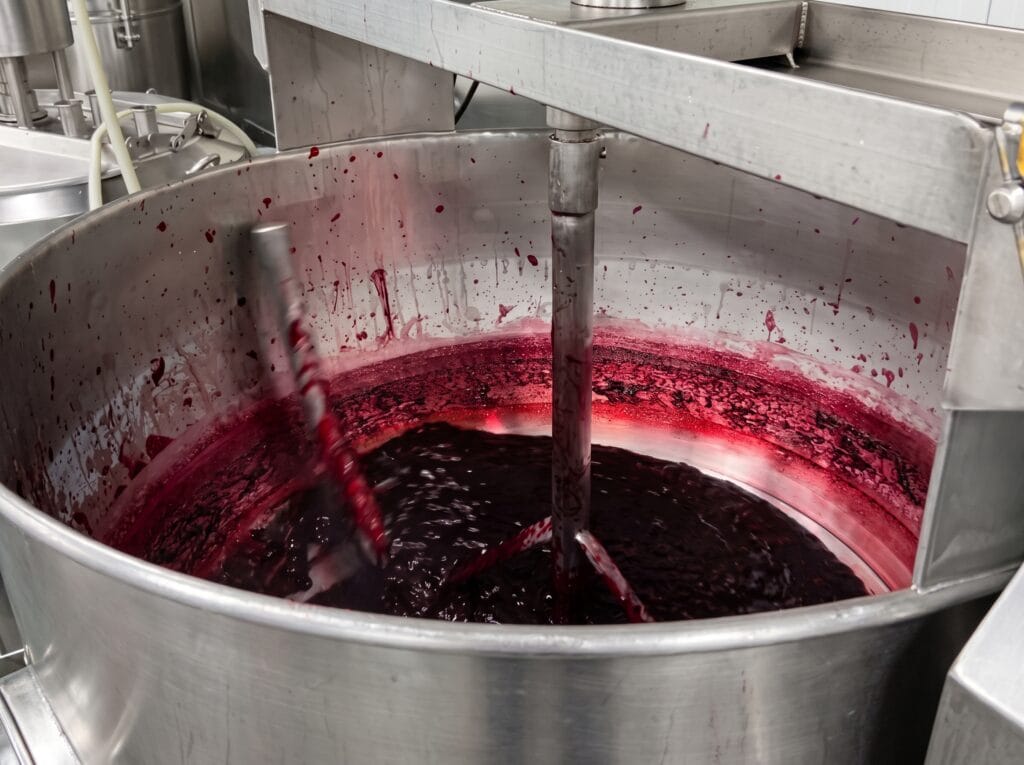
How Hydrocolloids and Emulsifiers Hold It All Together
Achieving bake stability at oven temperatures reaching 200 degrees Celsius requires specialized hydrocolloid blends. Each option brings a distinct advantage:
In fat-based fillings, crystal polymorphism determines everything. The target is the Beta-Prime crystal form: tiny needles (1 to 3 micrometers) that trap liquid triglycerides within a dense three-dimensional network, yielding smooth texture and zero oil exudation.
If crystals transform into the coarser Beta form, the filling may develop graininess and oil migration.
Sorbitan monostearate (SMS) and polyglycerol esters physically inhibit this transition, acting as crystal habit modifiers.
For emulsion-based systems, emulsifier selection follows the Hydrophilic-Lipophilic Balance (HLB) principle:
When a clean label declaration is required, plant-derived mono- and diglycerides, sunflower lecithin, and acacia gum can replace synthetic emulsifiers in many of these roles, although achieving equivalent thermal and shear stability often demands higher usage levels and closer process control.
Rheology: The Make-or-Break Factor on the Line
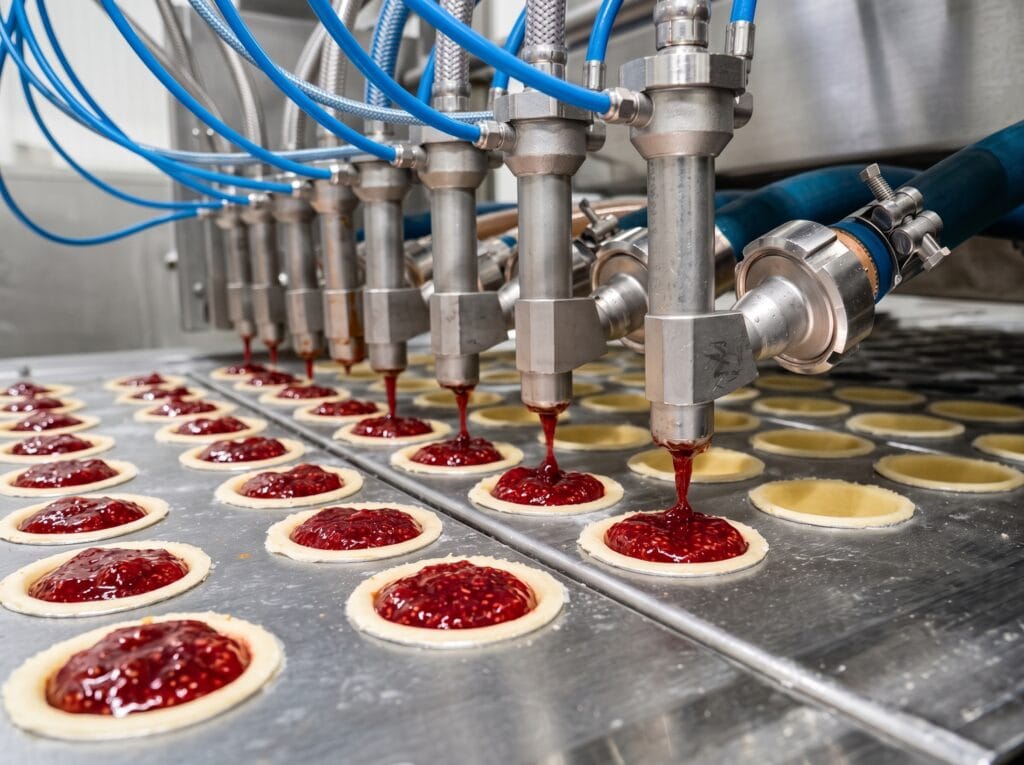
Every filling must pass through pumps, pipes, and depositing nozzles before reaching the product cavity. This journey imposes severe mechanical stress, and a filling that cannot handle it generates waste, downtime, and inconsistent weights.
Industrial fillings must exhibit specific flow behaviors to survive this journey:
Temperature adds another layer of complexity. A fruit filling formulated to deposit cleanly at 60°C may become unmanageably thick at 25°C, or dangerously fluid at 90°C inside the oven. Low-Acyl gellan gum provides heat-resistant yield stress that persists at baking temperatures, preventing boil-over and expansion.
For emulsion-based systems, emulsifier selection follows the Hydrophilic-Lipophilic Balance (HLB) principle:
- Water-in-oil creams require lipophilic emulsifiers (HLB 3 to 6).
- Oil-in-water systems need hydrophilic emulsifiers (HLB 10 to 16) paired with low-HLB co-emulsifiers to build dense interfacial films.
- Sodium stearoyl lactylate (SSL) simultaneously stabilizes emulsions and forms amylose-lipid complexes inside starch-thickened fillings, preventing retrogradation and syneresis during storage.
The choice of processing equipment matters equally, because each machine type imposes a different kind of stress on the filling:
Pumping. Positive displacement pumps force product through tight clearances, generating intense shear. A rigid High Methoxyl pectin gel may shatter permanently in this process and never recover its structure. Switching to shear-reversible LMA pectin or High-Acyl gellan fluid gels solves this, because these hydrocolloids rebuild their viscosity immediately after the filling exits the pump.
Cooking. Traditional batch kettles hold acidic fillings at high temperatures for extended periods, which can break down hydrocolloid chains and thin the filling irreversibly. High-Temperature Short-Time (HTST) systems and scraped surface heat exchangers (SSHE) reduce thermal exposure to seconds rather than minutes, preserving hydrocolloid integrity while still achieving pasteurization.
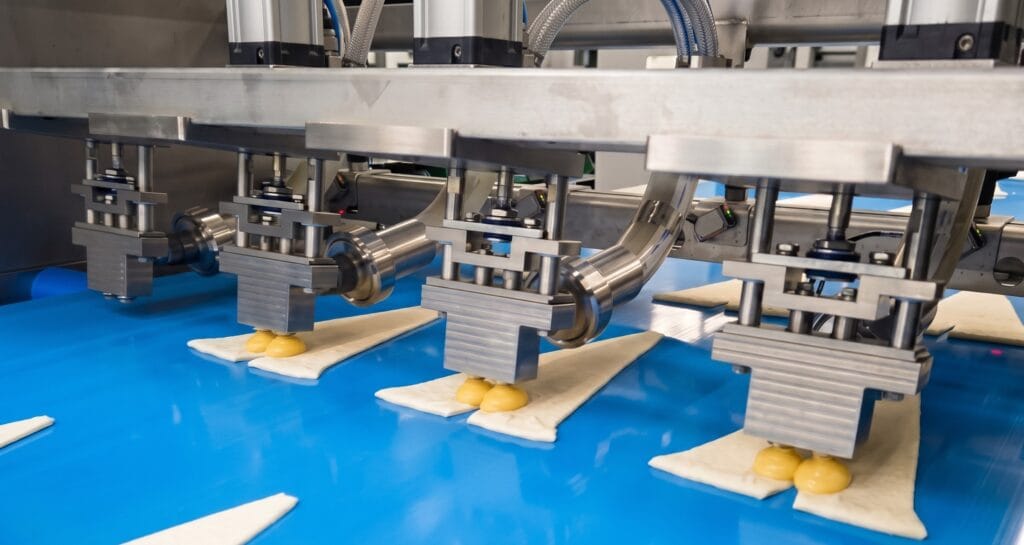
Depositing. Once the filling reaches the nozzle, it must flow cleanly, cut without tailing, and hold its shape the instant it lands in the cavity. All the upstream choices (hydrocolloid type, cooking method, pump selection) converge at this point.
😊 Thanks for reading!
Sources:
- Metarom Group. (2024). Technical Guidelines: Rheology and Stability of Industrial Bakery Fillings. https://www.metarom.eu
- Fontana, A. J., & Schmidt, S. J. (2007). Water Activity in Foods: Fundamentals and Applications. Blackwell Publishing.
- Imeson, A. (2011). Food Stabilisers, Thickeners and Gelling Agents. Wiley-Blackwell.
- McClements, D. J. (2015). Food Emulsions: Principles, Practices, and Techniques (3rd ed.). CRC Press.
- Marangoni, A. G., & Wesdorp, L. H. (2013). Structure and Properties of Fat Crystal Networks. CRC Press.
- Sato, K. (2001). Crystallization behaviour of fats and lipids. Chemical Engineering Science, 56(7), 2255–2265.
- Saha, D., & Bhattacharya, S. (2010). Hydrocolloids as thickening and gelling agents in food. Journal of Food Science and Technology, 47(6), 587–597.
- Cauvain, S. P., & Young, L. S. (2010). Bakery Food Manufacture and Quality. Wiley-Blackwell.
- Hasenhuettl, G. L., & Hartel, R. W. (2008). Food Emulsifiers and Their Applications. Springer.