7 Sandwich Biscuits Defects: Root Causes and How to Prevent Them
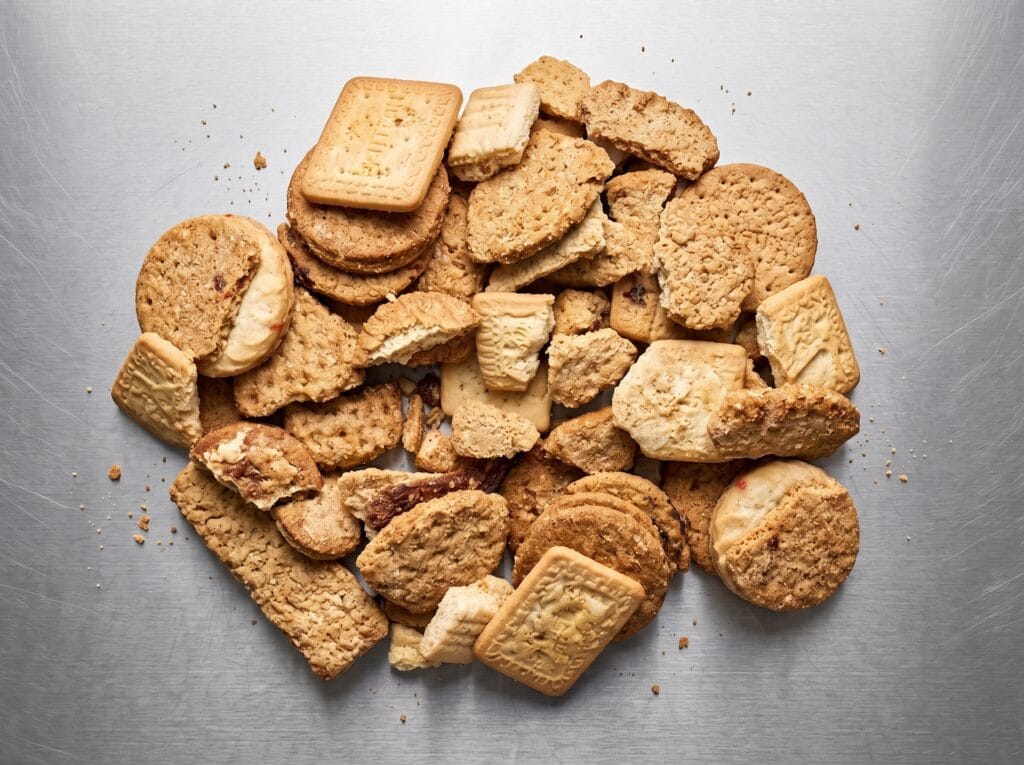
Sandwich cookies could fail for seven recurring reasons that share a single thread: the collision between moisture physics, fat crystallography, and mechanical precision on high-speed lines. Identifying where each defect originates, and correcting it before it cascades into waste, is the difference between a profitable run and a costly shutdown.
1. Checking: The Invisible Fracture
Checking is the spontaneous cracking of a baked shell hours or even days after it exits the oven. The fracture is rarely visible on the cooling conveyor, as it propagates later, inside the sealed package, reaching the consumer as a disintegrated product.
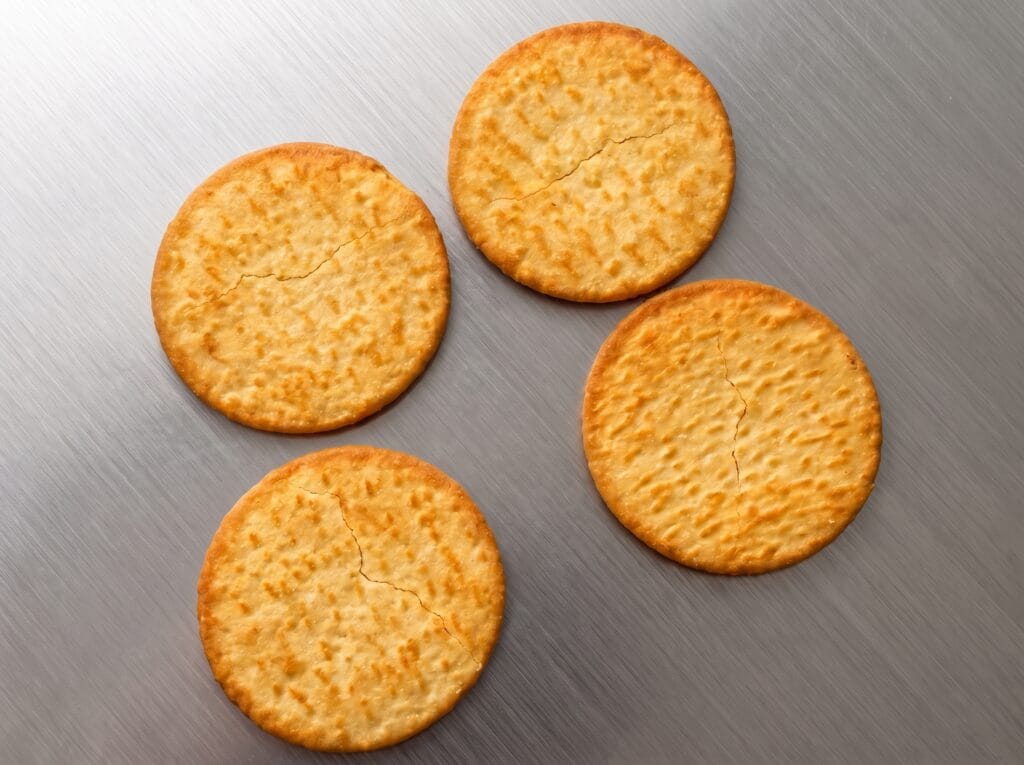
During baking, the outer crust dries faster than the core. Once the cookie leaves the oven, residual moisture trapped in the center migrates outward. The dry periphery absorbs this moisture and expands while the center contracts. The resulting hydro-mechanical stress exceeds the shell’s tensile strength, causing hairline cracks to appear.
Prevention hinges on controlling the moisture gradient:
2. Dimensional Distortion and Cupping
When a shell deviates from its nominal diameter, thickness, or flatness, the entire downstream assembly collapses:
- Cupped cookies, with concave or convex warping, will not seat correctly in the sandwiching station’s lanes.
- Oversized shells jam the stacker chutes, while undersized ones leave gaps in the package that invite breakage during transit.
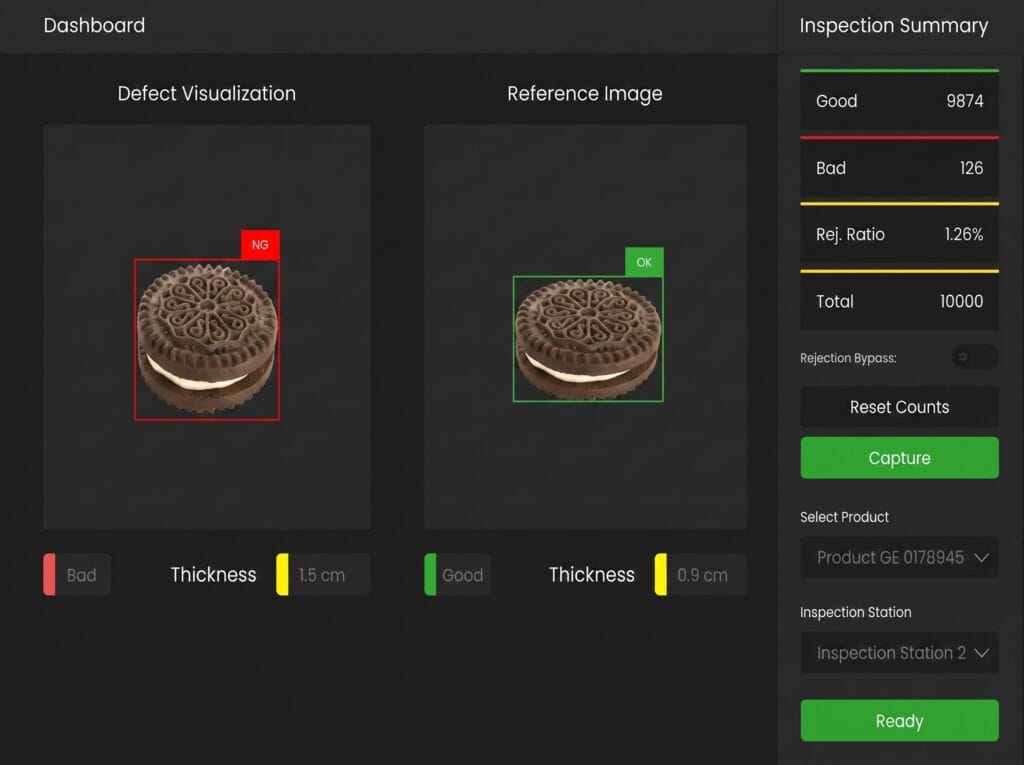
Uneven heat distribution across the oven band width is often the dominant cause. If one side of the tunnel runs hotter, shells on that edge expand and set their structure before those on the opposite side, resulting in a mix of diameters within the same row. Worn or misaligned gauge rolls compound the problem by feeding an inconsistent dough sheet into the rotary moulder.
Prevention starts at multiple control points:
3. Shell Misalignment and Cream Squeeze-Out
A top shell that lands off-center, or cream that oozes past the cookie edge, creates both an aesthetic rejection and a mechanical nightmare:
- Extruded cream fouls guide rails and contaminates sealing jaws.
- The line triggers emergency stops for manual cleaning.
The defect has two converging roots:

Prevention requires action on both fronts:
4. Cream Weight Deviation
Subdosing means empty zones between the shells and automatic rejection by the checkweigher. Overdosing means giving away expensive fat and sugar on every unit. Both scenarios erode margins, but the legal risk of subdosing is greater, as falling below the declared net weight may trigger regulatory seizure of entire lots.
Fluctuations typically trace back to:
- Air pockets trapped in the cream manifold.
- Inconsistent cream density caused by variable overrun (aeration) in the continuous beater-cooler.
- Temperature drift inside the dosing head, which shifts the volume displaced per piston stroke.
Prevention includes:
5. Moisture Migration and Textural Decay
This defect does not appear on the production line, as it develops silently inside the sealed package over weeks. Water molecules migrate from the cream, which has a higher water activity level, toward the dry shell, which has a lower water activity level, until equilibrium is reached. The shell absorbs moisture, undergoes a glass-to-rubber transition, and loses its crispness entirely, while the cream simultaneously dries out and hardens.
The critical variable is the water activity differential between components. When it exceeds approximately 0.05 units, the thermodynamic driving force for migration becomes significant. Shells baked to a residual moisture above 2.5%, or creams formulated with hygroscopic syrups like glucose or fructose instead of anhydrous fat bases, accelerate the process dramatically, potentially shortening a 12-month shelf life to under 3 months.
Prevention means controlling water activity at every stage:
6. Fat Migration, Bloom, and Shell Detachment
When the liquid fraction of the cream’s fat diffuses into the shell’s porous matrix, three visible consequences emerge:
- Translucent grease spots on the cookie surface.
- A white crystalline haze known as fat bloom.
- Complete loss of adhesion between cream and shell, causing the sandwich to fall apart under its own weight.

The cause is often a thermodynamic incompatibility, known as a eutectic effect, between the shortening in the dough and the fat in the cream, combined with a solid-fat content profile that leaves too much liquid fat at ambient storage temperature. Rapid cooling in the post-sandwiching tunnel may also trap the cream fat in unstable alpha polymorphic forms instead of the desirable beta-prime crystals, which later recrystallize and migrate.
Prevention starts with fat specification and thermal control:
7. Blistering and Scorching
Hollow blisters on the shell surface that burst and char during baking produce both a visual and a sensory defect: dark spots from excessive localized Maillard reaction and a bitter, burnt aftertaste. The blistered zones are also structurally weak and may collapse under the capper’s pressure.
The defect originates from two converging failures:
- Excessive radiant heat in the first oven zone forms a rigid surface crust before the internal steam has finished expanding, forcing the trapped vapor to lift the crust locally.
- Worn or clogged docker pins fail to perforate the dough sheet adequately, eliminating the steam-escape channels that docking is designed to create.
Prevention involves:
😊 Thanks for reading!
Sources:
- CAB International, Improved Understanding of Biscuit Checking: https://www.cabidigitallibrary.org
- ResearchGate, Analysis of the Failure of Cracked Biscuits: https://www.researchgate.net
- MT Royal, Common Biscuit Defects and Solutions: https://www.mtroyal.com.tr/en/biscuit-defects
- DPO International, Moisture Migration in Multi-Component Foods: https://www.dpointernational.com
- Wikimedia Commons, Chocolate Bloom Category: https://commons.wikimedia.org/wiki/Category:Chocolate_bloom
- Wikipedia, Chocolate Bloom: https://en.wikipedia.org/wiki/Chocolate_bloom
- Blommer Chocolate, Understanding Fat Bloom: https://www.blommer.com
- SPX Flow, Sandwich Biscuit Cream Production: https://www.spxflow.com
- Royal Society Publishing, Stress Analysis in Biscuit Structures: https://royalsocietypublishing.org
- Eversmart, Sandwich Biscuit Production Problems: https://www.eversmartbiscuitmachine.com