5 Baguette Defects That Could Ruin Your Production and Hox to Fix Them
The baguette is one of the most demanding products in baking. Its high surface-to-volume ratio magnifies any error in proofing, shaping or baking. These are the five defects that cause the most rejects, and what the science says about each one.
1. Blind Score: The Cut That Won’t Open
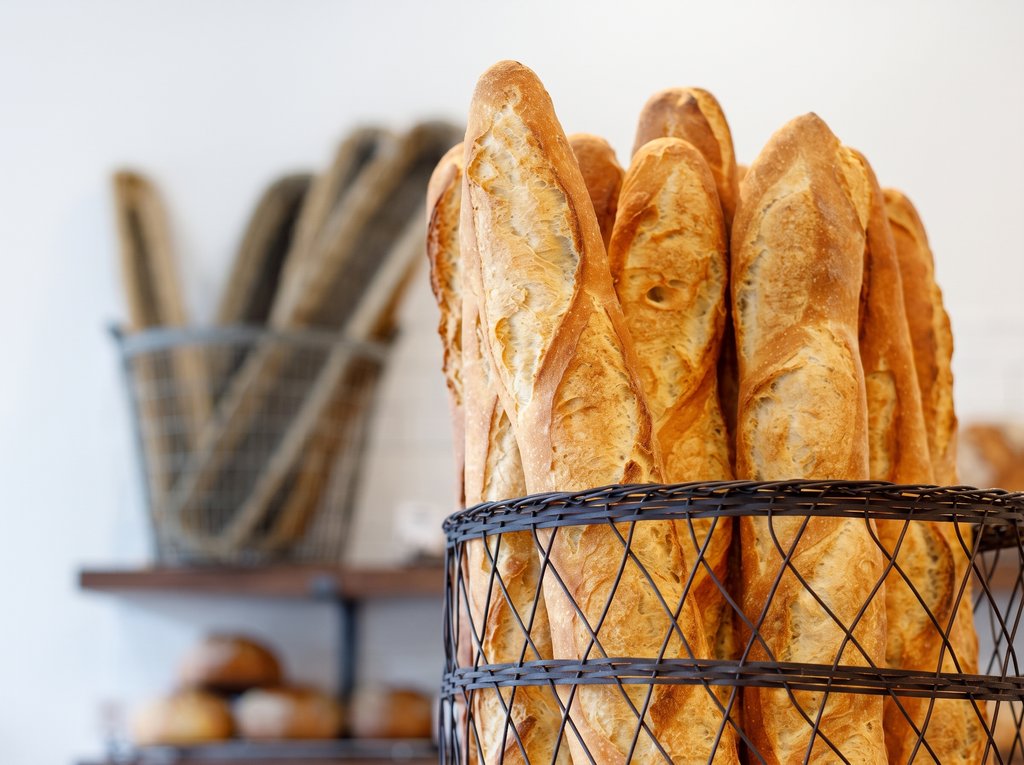
What happens: the score heals without lifting an ear (grigne or oreille), leaving a cylindrical loaf with less volume.
Main causes:
Solution: use an oblique blade angle of 30°–45°, a depth of 6 to 12 mm, a 20 – 33% overlap between strokes and 75 – 85% relative humidity during proofing. On the line, automated systems (ultrasonic, waterjet or robotic spray) remove operator variability.
2. Leathery Crust: Crisp for Only a Few Minutes
What happens: the baguette comes out crisp, but softens and turns rubbery as it cools.
The physics: when it leaves the oven, the crumb has a water activity (aw) of 0.95–0.98 and the crust only 0.30–0.50. Water migrates into the crust and plasticizes it. According to research from Wageningen University, crispness starts to decline at an aw of 0.55 and is lost completely around 0.70, when the crust shifts from a glassy to a rubbery state.
Main causes: not opening the damper (ouras) during the last third of the bake, ovens that are too hot with a short bake, too much initial steam, and packaging while the crumb is still warm.
Solution: open the damper in the last third of the bake, make sure the bake is complete, and don’t bag until the crumb center drops to 28–32 °C.
3. Tight Crumb: A Baguette That Looks Like Sandwich Bread
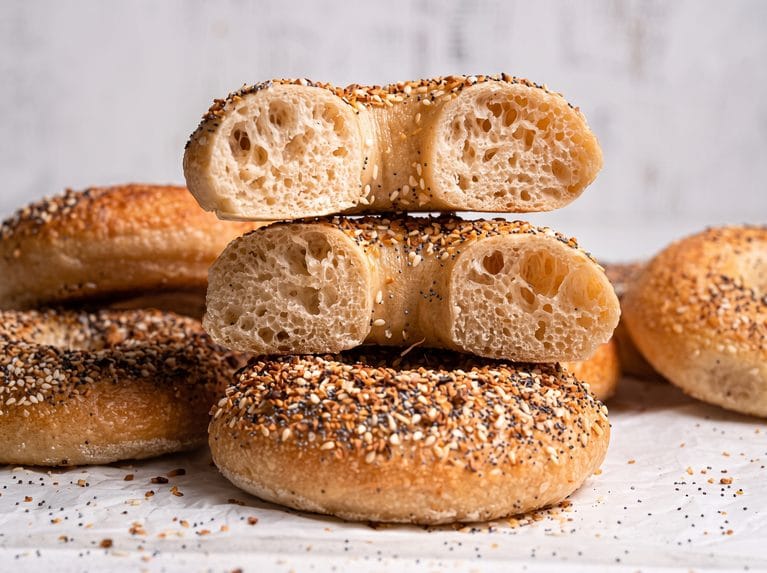
What happens: a dense, uniform crumb, far from the irregular open structure of a traditional baguette.
Main causes: yeast doesn’t create new bubbles, it only expands existing ones. A piston volumetric divider, sheeting rollers set too tight or no intermediate rest (détente) destroy the large cells and break them into uniform micro-bubbles.
Solution:
4. Side Blowouts: Pressure Escapes Where It Can
What happens: the dough tears along the side instead of opening at the top score. The result is misshapen or curved pieces that complicate packaging.
The physics: during the first minutes of baking, the baguette behaves like a thin-walled pressurized cylinder. Hoop stress is twice the axial stress, so any weak point yields first. If the seam (soudure) isn’t centered face-down on the tray, it becomes that weak point.
Main causes: a seam displaced to the side, too much dusting flour during shaping, an off-center pressure board, underproofing, or dough with excess strength.
Solution: seam centered face-down, shaper side guides with a 1 mm clearance, a check of pressure board parallelism and adequate proofing (apprêt). Some industrial patents use U-shaped slings to keep the piece from rotating during proofing.
5. Crust Flaking: The Crust That Peels Off in Sheets
What happens: the crust cracks and separates into flakes, which hurts presentation and creates waste. It is especially critical in par-baked frozen baguettes.
Main causes:
Solution: dose ascorbic acid precisely, use dry steam without liquid droplet carryover, and moderate air velocity in blast chillers and freezing tunnels.
😊 Thanks for reading!
Sources:
- Main sources: INBP (Supplément Technique N°105),
- Wageningen University (Van Nieuwenhuijzen, Primo-Martín et al., 2010),
- Zhang et al. (Foods, 2025),
- King Arthur Baking