Why the Elastic Modulus Matters When Working with High-Hydration Doughs
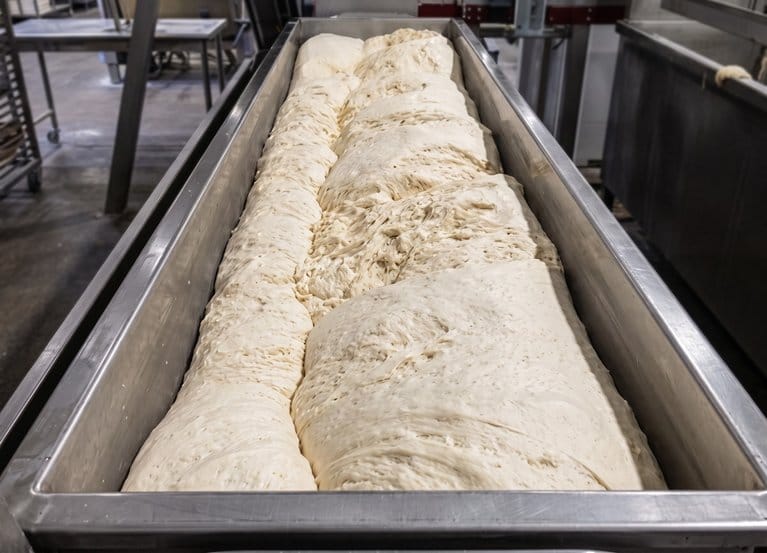
Above 75% hydration, free water tends to weaken the gluten network’s ability to store elastic energy, and lines often see slumping, sticky belts and collapsed crumb. Understanding the elastic modulus helps connect these defects to mixing, sheeting, fermentation and enzyme choices that keep wet doughs machinable.
What the Elastic Modulus Measures in Bread Dough
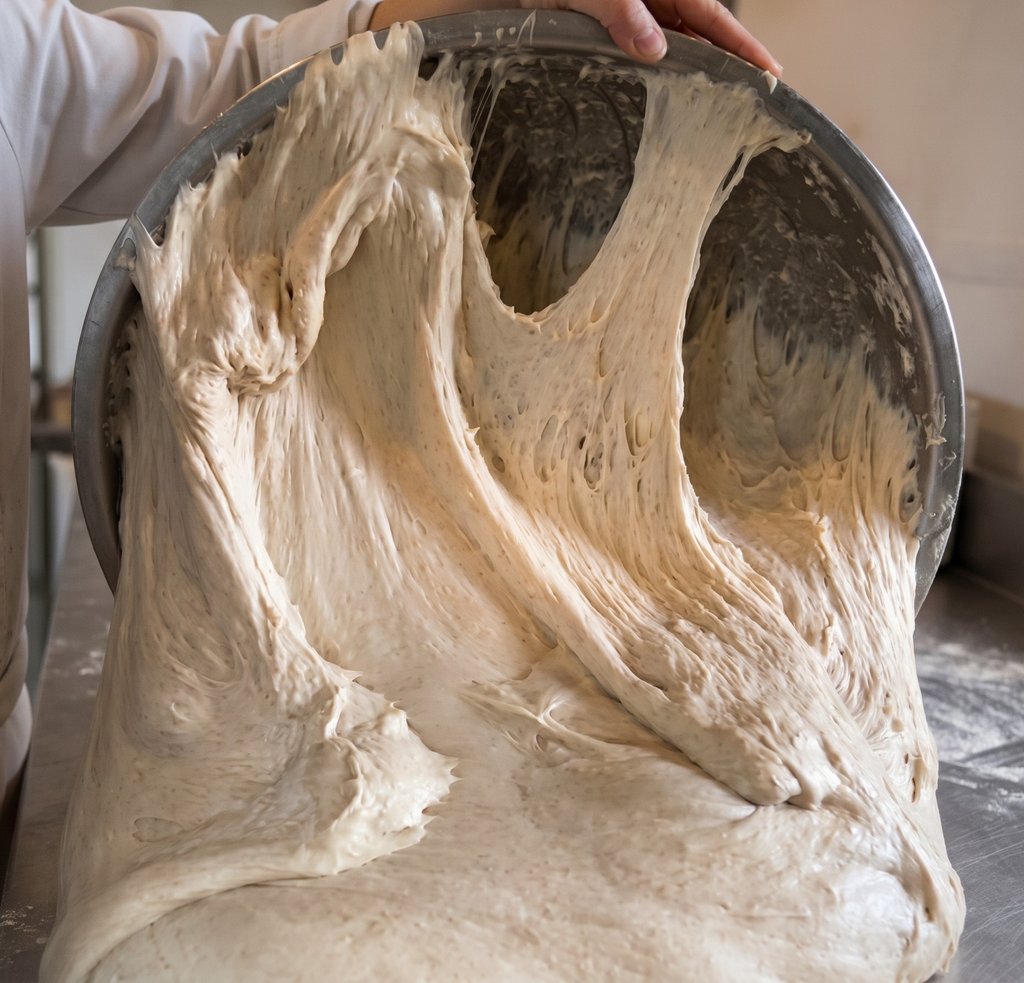
Wheat dough behaves partly as a viscous liquid and partly as an elastic solid. The elastic or storage modulus quantifies the energy the gluten network stores and returns after each deformation. The viscous or loss modulus describes the energy dissipated as chains and starch granules slide past each other.

On the plant floor, the elastic modulus relates to how well a dough piece holds its own height, cuts cleanly and resists spreading on the proofing belt. In functional doughs the elastic response stays above the viscous one. When the viscous response starts to catch up with the elastic one, the dough tends to lose surface cohesion and behave more like a sticky batter.
Elasticity originates in the two gluten fractions, which make up 80% – 85% of wheat flour protein:
Elasticity is rarely measured directly. Mills and bakeries rely on routine flour tests instead: the alveolab shows how much a dough resists stretching and how far it can expand, while the Mixolab shows how well the gluten holds up as the dough is mixed and heated.
How Hydration Above 75% Lowers the Elastic Modulus
When a formula moves from 56% – 62% water into the 75% – 90% range, free water starts to plasticize the matrix. Research tracking gluten during mixing points to four contributing mechanisms:
Elasticity and CO2 Bubble Stability
During bulk fermentation and early baking, the dough turns into a viscoelastic foam. The thin dough walls between cells, the lamellae, stretch under large biaxial deformation as CO2 and steam expand.
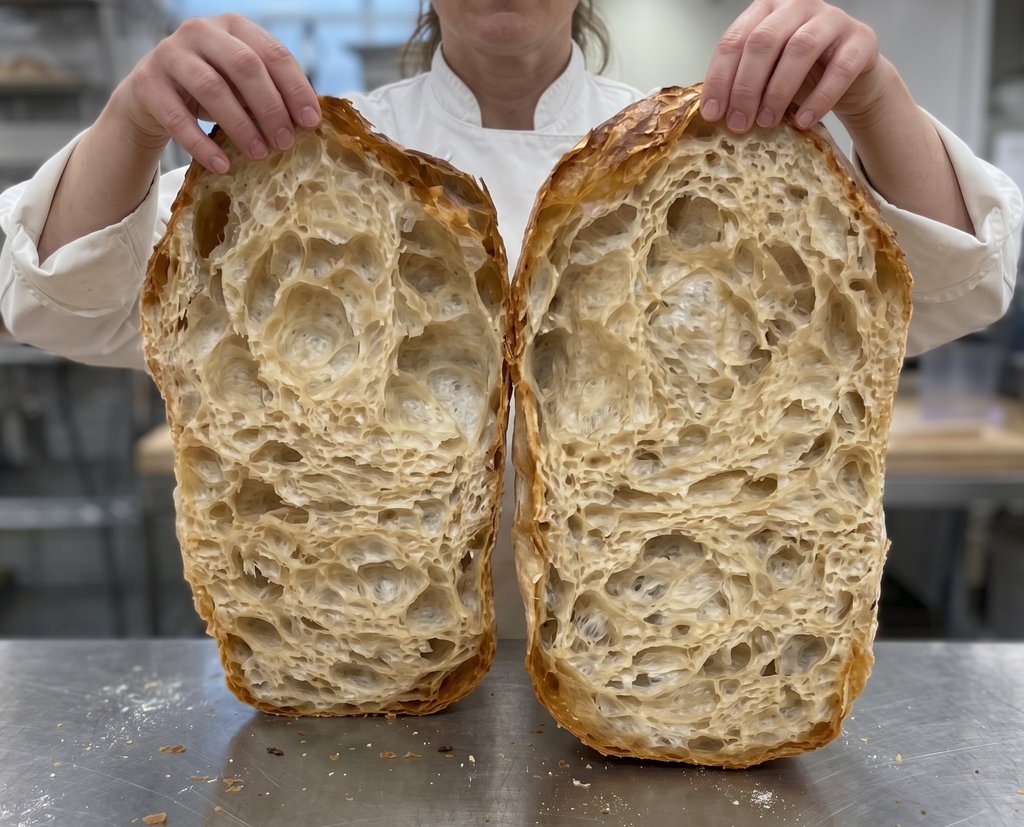
Smaller bubbles carry higher internal pressure than their larger neighbors, so gas tends to diffuse from small cells into large ones. A sufficiently elastic matrix resists this uncontrolled growth. At 80% hydration and above, where elasticity and elongational viscosity have fallen, liquid may drain from the cell walls, bubbles can rise and merge, and large cavities often form under the crust.
At large deformations, gluten drives the response through strain hardening: as a cell wall thins, aligned glutenin chains resist further stretching more strongly, shifting expansion to thicker zones. Without it, a thin spot can rupture and neighboring cells coalesce.
The oven adds a critical window:
Compensating Elasticity Through Flour and Mixing
Flour choice is usually the first variable plants review. Standard baking flours often struggle once hydration climbs well above 70%, so high-hydration breads such as ciabatta and pinsa typically rely on strong flours with a good balance between firmness and stretch (W 320 – 350). For the wettest doughs, or those going through long sourdough fermentations, millers often recommend very strong, Manitoba-type flours (W 380 – 420 and above).
Adding vital wheat gluten is another way to raise elasticity, although too much can make the dough tough and prone to shrinking back. One way around this, described in a patent for high-protein breads, blends vital gluten with a small share of lightly broken-down wheat protein, keeping the strength while making the dough easier to process on the line.
Bassinage, or double hydration, builds elasticity without changing the ingredient list:
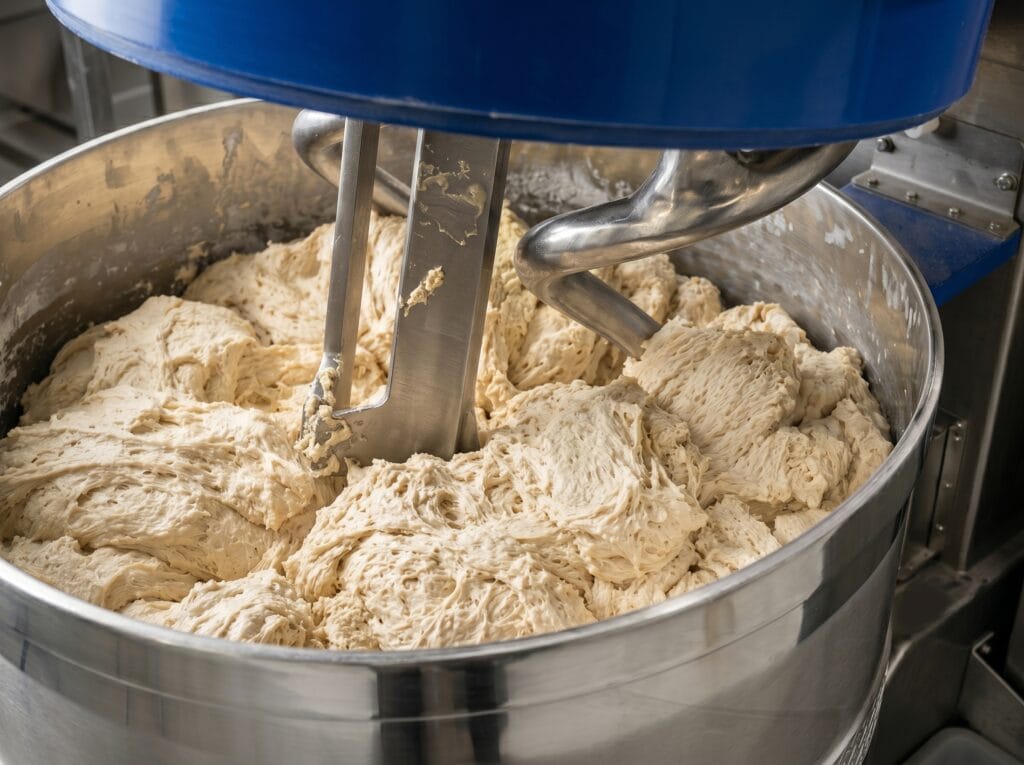
In industrial spiral mixers, automatic energy control can end phase one once the dough has received a set amount of mixing work. Second water at 2°C – 4°C helps keep dough below 24°C and limits GMP breakdown.
Compensating Elasticity Through Sheeting, Temperature and Enzymes
Piston and suction dividers compress dough beyond the shear wet gluten tolerates, which tends to tear lamellae. Stress-free dividers form a dough sheet without compression and portion it with gravimetric weighing rollers.
Sourdough and long fermentations add flavor but may reduce elasticity. At 30°C – 37°C, lactic acid bacteria can bring pH to 4.3 – 4.6, a range where flour proteases are active.
Retarding the dough below 6°C slows both protein breakdown and acid production, while also firming the matrix and keeping more CO2 dissolved. Keeping the final pH above 4.4 and selecting starters with milder protein-degrading activity further helps protect the gluten.
Enzymes and oxidants can rebuild elasticity chemically:
😊 Thanks for reading!
Sources:
- https://pmc.ncbi.nlm.nih.gov/articles/PMC9532874/
- https://journals.plos.org/plosone/article?id=10.1371/journal.pone.0282670
- https://pmc.ncbi.nlm.nih.gov/articles/PMC126681/
- https://newsletter.wordloaf.org/bath-time/
- https://www.novonesis.com/en/biosolutions/food-and-beverages/baking/affordability-and-flexibility/gluten-strenghtening
- https://www.novonesis.com/en/biosolutions/food-and-beverages/baking/affordability-and-flexibility/dough-conditioning/pentopan
- https://pmc.ncbi.nlm.nih.gov/articles/PMC5430195/
- https://pmc.ncbi.nlm.nih.gov/articles/PMC4837746/
- https://patents.google.com/patent/WO2003049545A1/en