How to Prevent Tunnel Holes in Muffins
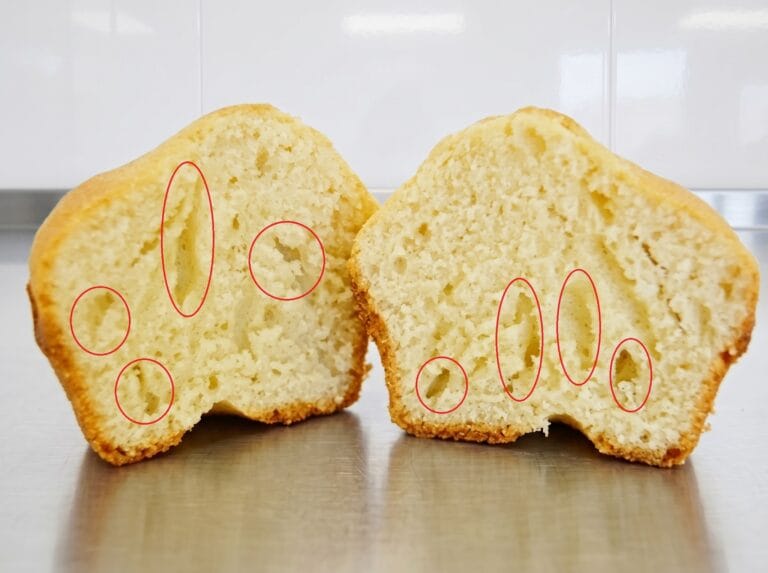
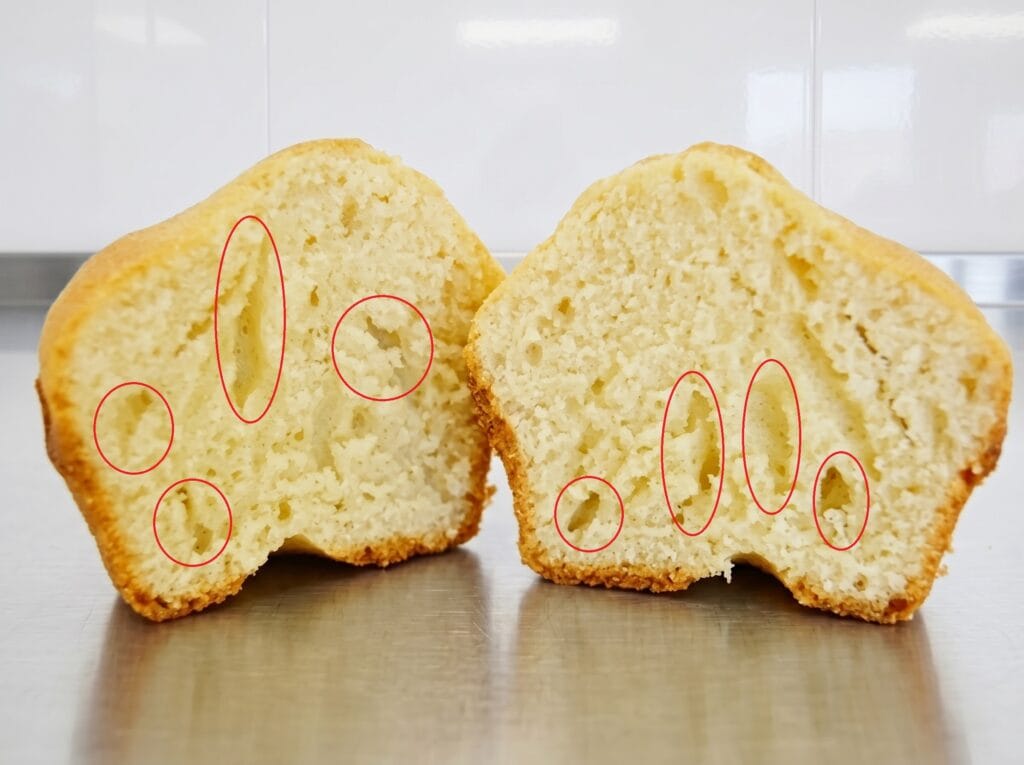
Though often accepted as part of muffin texture, they may not always be desirable, especially when a uniform crumb is the objective.These are large, elongated voids that stretch from the base toward the peaked top of the muffin.
1. What Causes Them?
As muffins bake, several simultaneous transformations take place:
- Starch Gelatinization and Batter Viscosity
When exposed to heat, starch swells and gelatinizes, especially at the edges of the batter. This increases viscosity in the outer zones, while the center remains more fluid. - Gas Expansion and Bubble Coalescence
Inside the muffin, steam and carbon dioxide from the leavening agent cause expansion. In partially gelatinized areas, small gas bubbles begin to merge into larger ones.
Tunnel Formation Dynamics
These larger gas pockets rise through the less viscous central batter. As the surrounding structure sets, the gas travels vertically and creates tunnels. These are eventually trapped as the crumb solidifies.
2. How to Reduce or Eliminate Tunnel Holes
You can address this defect by adjusting formulation and processing parameters:
3. Consumer Perception
Tunnel holes are sometimes considered a “signature” trait in muffins by consumers. Completely removing them may negatively affect product perception. Any formulation changes should be validated with sensory or consumer testing.
😊 Thanks for reading!
Source:
Cauvain, Stanley P. 2017. Baking Problems Solved. 2.ª ed. Cambridge: Woodhead Publishing.