How Important Are the Dough and Batter Temperatures in Cookies?
A temperature shift of ±5 °C at the mixer outlet or dosing hopper could alter cut weight precision, spread ratio, inclusion integrity, and final texture across an entire cookie production run. Understanding where these thermal thresholds sit for each forming method may help tighten process control and reduce off-spec output.
Cookie dough is a viscoelastic, non-Newtonian dispersed system where a solid phase of ungelatinized starch, flour proteins, undissolved sucrose crystals, and inclusions sits within a continuous plastic phase of fat and a supersaturated sugar syrup. Temperature changes in this system would primarily affect the solid fat content (SFC) of the shortening or butter fraction.
Above roughly 24 °C: The proportion of free oil tends to increase. This often leads to fat exudation (oiling out), softening of the dough mass, and weakened mechanical retention of inclusions such as chocolate chips or nut pieces.
Below roughly 16 °C: Triglycerides may crystallize excessively, raising the mechanical shear stress. In wire-cut operations, this could result in wire breakage and inconsistent cut weights. In rotary-molded short doughs, an overly rigid mass might fracture during extraction from mold cavities.
The practical window for most cookie dough types, then, tends to fall within the 16 °C to 24 °C range, though the exact target would depend on the forming method and fat system in use.
Spread Behavior and Initial Dough Temperature
During baking, a cookie typically goes through two sequential phases that determine its final diameter-to-thickness ratio:
Flow phase (first 3 to 5 minutes): As the dough temperature rises past the melting range of the fat (roughly 32 to 38 °C) and sucrose crystals dissolve into residual free water, viscosity drops sharply. The dough piece would then expand radially under gravity and surface tension.
Structure-setting phase: Once the internal temperature reaches approximately 65 to 75 °C, egg and flour proteins coagulate and starch begins partial gelatinization, arresting radial flow and consolidating the cookie’s height.
A cooler dough entering the oven would experience a longer thermal lag before the flow phase begins. This delay could allow the structural proteins and starch to set before the dough has spread as far, typically producing a thicker cookie with a softer, chewier center. Conversely, a warmer dough might spread more aggressively, yielding a thinner, crispier profile. Small shifts in mixer discharge temperature could therefore alter the spread ratio across an entire band, making consistent thermal control a practical prerequisite for uniform geometry.
Forming Method and Optimal Temperature Ranges
The target temperature window tends to vary with the forming equipment and dough rheology:
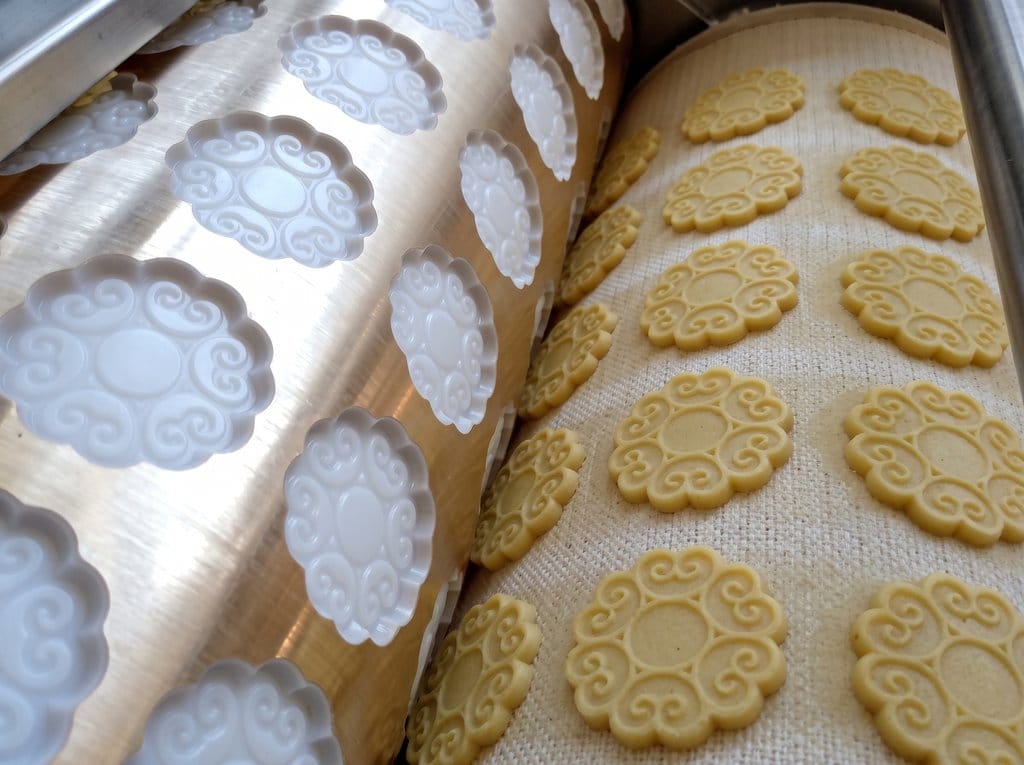
Short-dough (rotary molding), 18 to 22 °C: Maintaining this range would help minimize gluten hydration while preserving sufficient fat plasticity for clean mold release. Above 22 °C, the dough might become tacky and adhere to mold cavities. Below 18 °C, it could turn friable and lose cohesion, causing breakage at extraction.
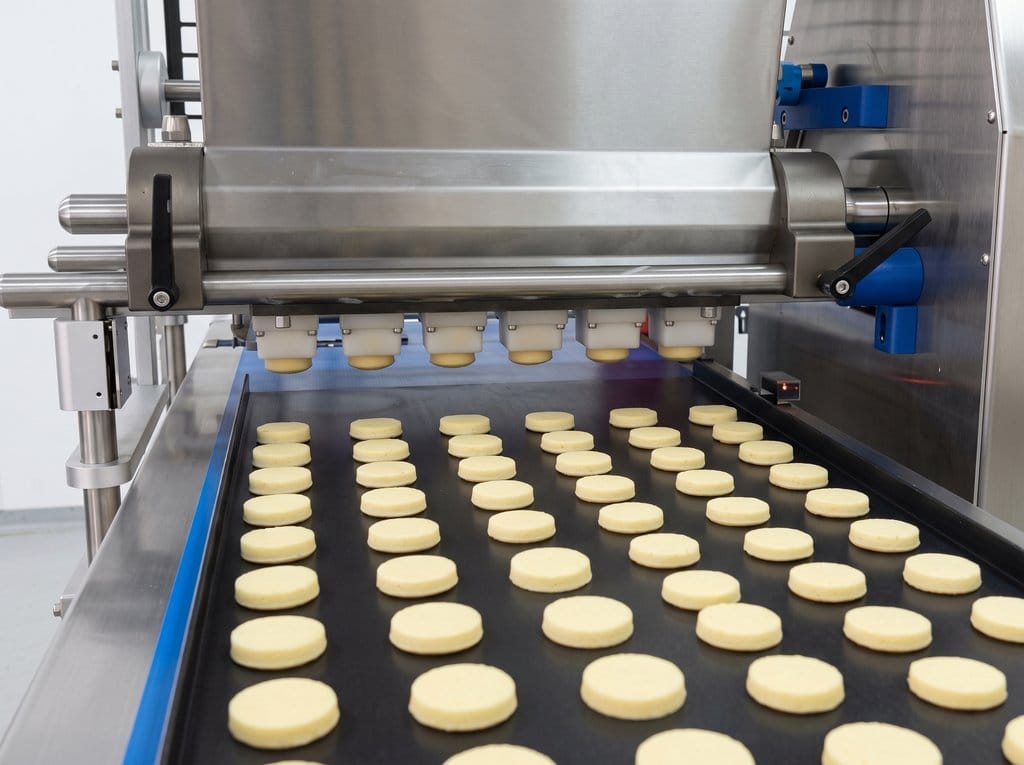
Wire-cut doughs with inclusions, 16 to 24 °C: Within this range, chocolate chips and similar inclusions would generally maintain their physical integrity. Above 24 °C, cocoa butter may begin to smear and bleed across the cut surface, while the dough itself could tail or drag on the wire. Below 16 °C, the increased rigidity might overload and snap cutting wires.
Deposited cookies (fluid batters), 16 to 24 °C: Batter viscosity at the nozzle would be sensitive to temperature in this range. Above 24 °C, chemical leavening agents could begin reacting prematurely in the hopper, releasing CO₂ before deposition and producing flat, dense cookies with poor lift. Below 16 °C, increased viscosity might cause uneven flow through nozzles and inconsistent deposit weights.
Frozen Cookie Doughs: Production Line and Bake-from-Frozen Variables
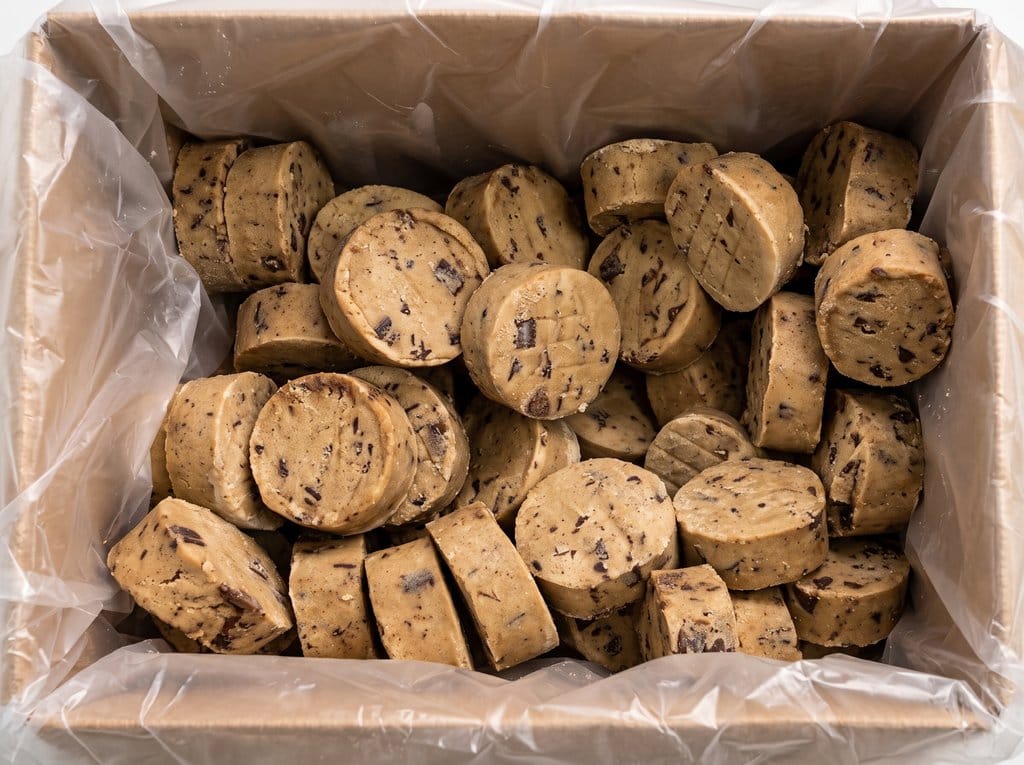
In plants manufacturing frozen dough pieces for subsequent bake-from-frozen applications, thermal management would typically follow a distinct sequence that extends from cold mixing through freezing tunnels to end-point baking.
Cold mixing and forming (16 to 19 °C): Formulations destined for freezing often benefit from exiting the mixer at slightly cooler targets, typically 16 to 19 °C. This lower temperature profile would help maintain piece rigidity and inclusion stability as dough portions pass through wire-cut heads before entering the freezer.
Rapid freezing tunnels (-35 to -40 °C): Formed dough discs would typically be routed directly into cryogenic freezing tunnels or forced-air spiral freezers operating between -35 and -40 °C. Rapid freezing tends to encourage smaller ice crystal formation, which may limit structural disruption to the gluten and lipid matrix.
Leavening stability during storage at -18 °C: During subsequent storage at typical frozen temperatures of -18 °C, an unfrozen cryo-concentrated water phase could still dissolve unencapsulated leavening acids and sodium bicarbonate, potentially dissipating up to 40% of leavening gas over three months. Microencapsulating these agents in lipid coatings with melting thresholds above 55 to 65 °C would help isolate reactants until baking occurs.
Sugar selection and freezing point depression: Excessive simple sugars such as fructose or high-fructose syrups might lower the freezing point more aggressively, maintaining a liquid fraction at -18 °C that could soften dough discs and risk deformation during bulk packing. Prioritizing sucrose with controlled particle size distribution may help mitigate this.
Direct oven behavior (Bake-from-frozen): When frozen pieces stored at -18 °C are baked directly without prior thawing, a steep thermal gradient would develop. Surface layers would absorb convective and radiant heat while the interior remains frozen. Reducing baking temperatures by 10 to 15 °C while extending residence times by 2 to 4 minutes, which often corresponds to a 20% to 40% increase in total bake time relative to fresh dough baselines, would generally permit internal thaw and sugar dissolution before exterior edges over-caramelize.
😊 Thanks for reading!
Sources:
Stanley P. Cauvain & Linda S. Young. Baking Problems Solved (2nd Ed.), Cap. 6, Inciso 6.1 (pp. 299–302). Elsevier / Woodhead Publishing. Elsevier Book Store
Amita Devi & B. S. Khatkar. Physicochemical, rheological and functional properties of fats and oils in relation to cookie quality: a review. J Food Sci Technol / PMC. PubMed Central PMC5147699
BAKERpedia. Maximize Your Yield By Monitoring Your Baking Temperature / Processes: Rheology. BAKERpedia