Sauce Temperature Could Drive Gum Line Risk in Industrial Pizza Lines
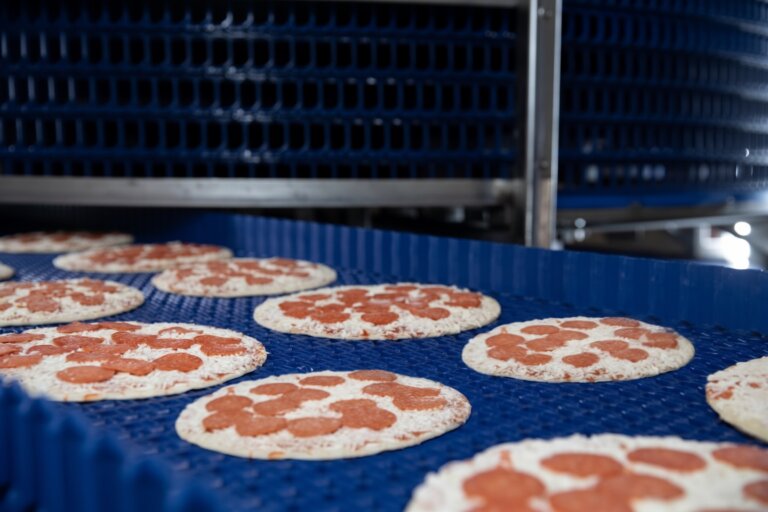
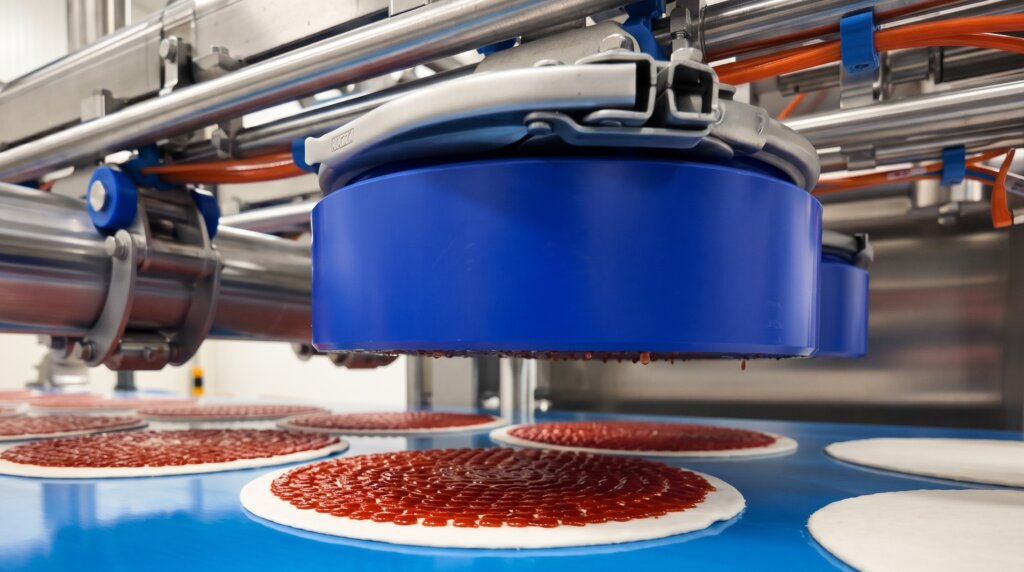
In continuous pizza lines, sauce temperature at the depositor affects dosing accuracy, dough integrity, gum line risk, hopper hygiene and energy load on ovens or spiral freezers. Raw dough and par-baked crusts respond differently, and a narrow hopper window tends to balance these demands.
The Hopper Temperature Trade-Off
Tomato pizza sauce is a shear-thinning fluid with a yield point: it needs a minimum force to start flowing, then thins as the piston moves it. Its consistency rises as temperature drops.
Depositing on Raw Fermented Dough
Raw dough is a living matrix that meets the sauce seconds before the oven.
Surface yeast reactivation
Warm sauce may heat the top layer of dough and speed up yeast activity right before baking. Gas escaping under the sauce could weaken the gluten skin and cause blistering.
Gum line formation
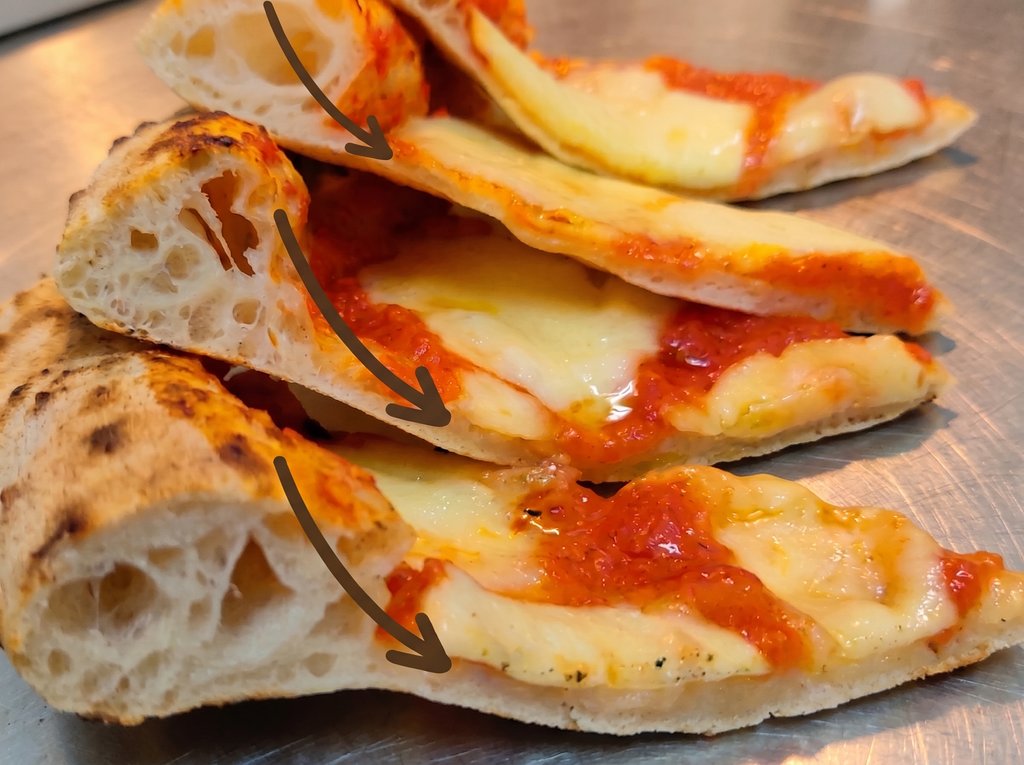
In a tunnel oven, the dough base receives direct heat from the hot band and sets quickly. The top is covered by a sauce layer that is mostly water, and evaporation keeps its surface well below oven temperature.
Cold sauce acts as a heat sink, delaying how fast the zone between sauce and dough warms up during a short bake. If that zone does not reach the temperatures starch needs to gelatinize and gluten needs to coagulate in time, while water keeps flowing in, a dense, translucent layer tends to form under the sauce, even when base and rim look fully baked.
Recommended Reading:
Free water migration
Sauce holds more free water than a well formulated raw dough, so water moves toward the dough and softens the surface of the gluten network. When depositing to oven entry exceeds 90 seconds, this softening may become irreversible.
Depositing on Par-Baked Crusts
In par-baked crusts, gluten has coagulated and starch has set during the first bake. Moisture risk shifts toward capillary flow and condensation.
Ambient Crusts at 18 – 22°C
Sauce tends to wick into open crumb pores, faster as viscosity drops and pores grow. Worn docking rollers can leave pores above 0.8 mm, and warm sauce may then drain into the crumb core and soften the final bake.
Frozen Crusts at -18°C
Recommended Reading:
Downstream Energy Load: Tunnel Oven vs. IQF
Sauce temperature carries over into the next thermal step.
Functional Operating Parameters
For most line setups, observations point to this window:
😊 Thanks for reading!
Sources:
- Rademaker Pizza Line & Topping Systems, Rademaker BV. https://rademaker.com/bakery-equipment/rademaker/pizza-line/
- IBIE 2025: Rademaker Highlights New Pizza Topping Line, Baking+Biscuit International. https://bakingbiscuit.com/ibie-2025-rademaker-highlights-new-pizza-topping-line/
- Dough Doctor Tom Lehmann Takes a Look at What Causes a Gum Line and How to Prevent It, Tom Lehmann. https://pizzatoday.com/news/dough-doctor-tom-lehmann-takes-a-look-at-what-causes-a-gum-line-and-how-to-prevent-it/130507/
- Pizza Gum Line Explained: Physics, Starch Chemistry and Solutions, PizzaTechHQ. https://pizzatechhq.com/pizza-gum-line-explained/
- The Pizza Gumline: Causes, Starch Gelatinization and Heat Transfer in Pizza Baking, Scott Wiener. https://www.scottspizzatours.com/blog/gumline/
- Pizza Troubleshooting Guide: Solving the Gumline Defect, Grande Cheese. https://grandecheese.com/troubleshooting/gumline/
- Temperature and Rheological Characteristics of Tomato Puree and Ketchup, Peter Hlavac, Monika Bozikova, Vlasta Vozarova. https://2019.tae-conference.cz/proceeding/TAE2019-030-Peter-Hlavac.pdf
- On-line Rheological Characterization of Pizza Sauce Using Tube Viscometry, Bayod et al. https://www.researchgate.net/publication/282363286_On-line_rheological_characterization_of_pizza_sauce_using_tube_viscometry
- Moisture Migration and Water Activity in Baked Crusts and Fillings, Food Crumbles. https://foodcrumbles.com/soggy-pie-crust-on-moisture-migration/
- Senius Industrial Tunnel Ovens for High Capacity Pizza Production, Senius. https://senius.dk/portfolio/pizza/
- Cryogenic and Mechanical Freezing Solutions for Industrial Pizza Processing, Linde US. https://www.lindeus.com/industries/food-and-beverage/pizza
- Industrial Spiral Freezer Thermal and Refrigeration Load Calculations, Elfarida Ice Engineering. https://elfaridaice.com