Industrial Tunnel Oven Flexibility: How Indirect Fired Cyclothermic Systems Handle Pan Bread, Hearth Bread, and Tray Products
As consumer demand for product diversity grows, industrial bakeries face up to 25% unplanned downtime when running multiple formats on dedicated lines. Discover how modern indirect fired cyclothermic tunnel ovens resolve these challenges, enabling seamless, automated transitions between pan bread, crusty hearth loaves, and tray products on one line.
The Flexibility Imperative in Modern Industrial Baking
Consumer demand for bakery diversity is not slowing down. Industrial producers are increasingly expected to deliver tin breads, crusty hearth loaves, and tray-baked rolls; often from the same facility, sometimes from the same shift.
The commercial pressure to diversify the SKU portfolio without multiplying capital investment is reshaping how plant engineers and production managers think about equipment procurement.
The traditional answer (dedicate a separate line per format) is no longer financially viable for most mid-to-large scale operations.
The cost of idle capacity, the energy overhead of maintaining multiple specialized ovens at temperature, and the scheduling complexity of separate production runs represent a compounding operational drag that erodes margin.

INSIGHT: Industrial bakeries running three or more bread formats face an average of 18–25% unplanned downtime per format when relying on single-product dedicated lines. Equipment versatility is increasingly cited as a top procurement criterion.
(Source: AIB International Industry Survey, 2023)
Why Different Formats Have Historically Demanded Different Equipment
The root cause of production line rigidity lies in thermodynamics and product handling physics.
Each bread format imposes fundamentally different requirements on the baking environment:
Traditional tunnel ovens (whether deck, rack, or single-mode convection) are optimized for one of these heat transfer modes. Switching formats requires manual damper adjustment, belt speed recalibration, and steam system reconfiguration, introducing recipe-to-recipe variability and significant changeover time.
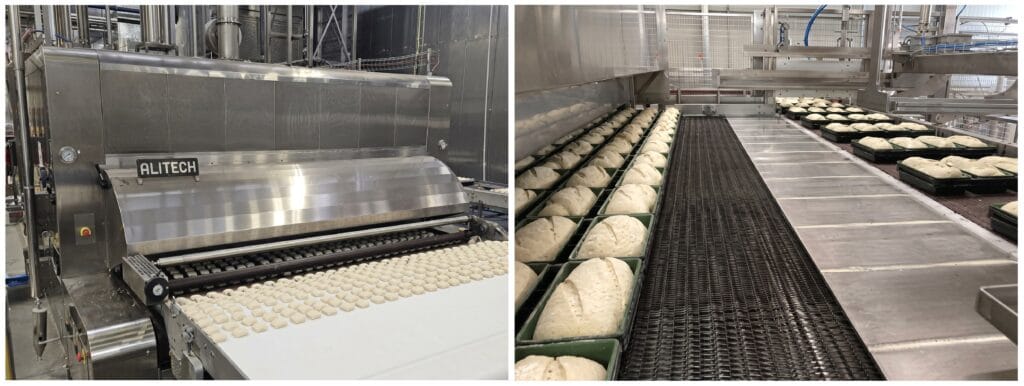
The Universal Cyclothermic Oven: Engineering Flexibility at Industrial Scale
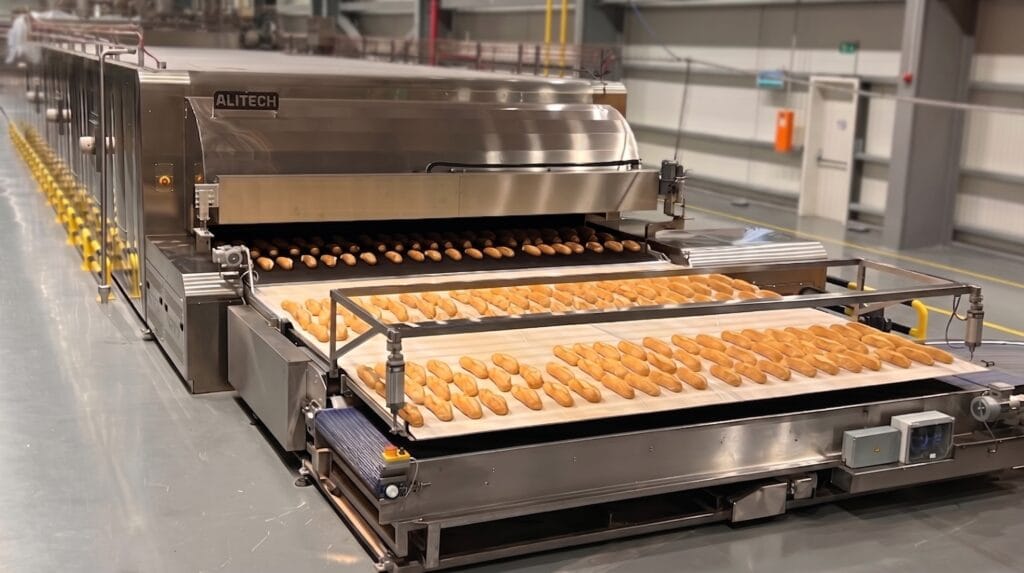
The Alitech Cyclothermic Indirect Fired Mesh Belt Tunnel Oven addresses this challenge through a heating architecture that decouples the combustion source from the baking chamber, enabling precise, format-agnostic heat delivery across the full oven width and length.
In a cyclothermic configuration, the burner fires into a sealed heating circuit.
Hot gases circulate through radiant tubes positioned above, below, and along the belt return path, creating three independent levels of heat delivery that can be individually modulated without altering the combustion environment:
Each zone is independently regulated via sliding dampers (motorizable as an option) that set heat flow within each radiator section. Side-heat adjustability via graduated handles corrects cross-width temperature gradients, a feature particularly relevant when baking full-width tray loads where edge-to-center differentials are common.

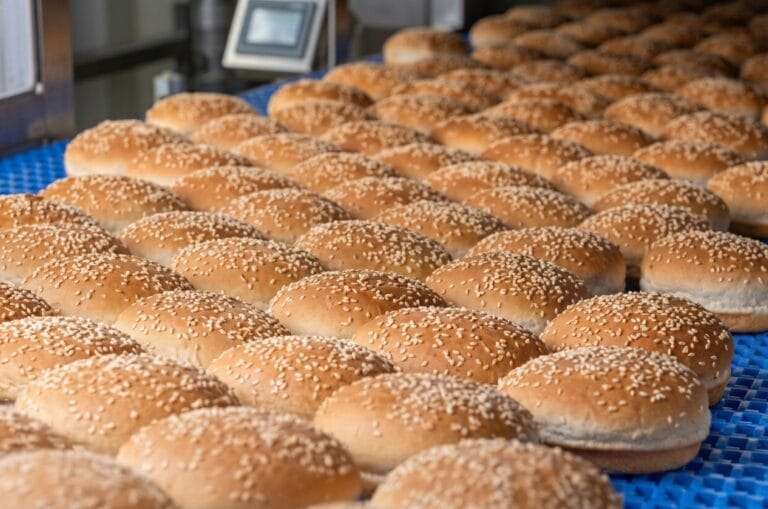
INSIGHT: Switching from a hamburger bun recipe to a ciabatta format on the Alitech system requires only a recipe recall from the HMI; damper positions, belt speed, turbulence direction, and steam parameters are all stored and re-applied automatically, with no manual mechanical intervention.
Turbulence: The Key to Multi-Format Heat Transfer
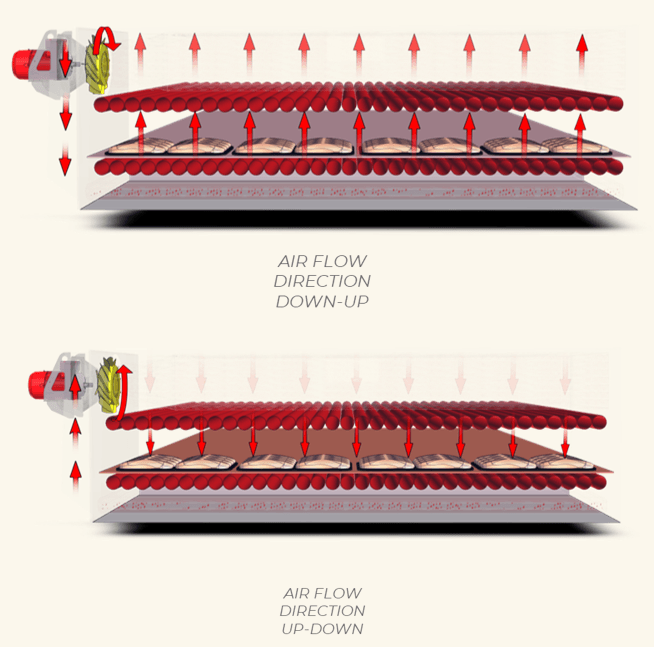
One of the critical enablers of format versatility in the oven is its turbulence section, a configurable baking zone where heated air is blown directly onto the product. The direction of airflow (top-down or bottom-up) is adjustable by reversing the blower motor.
For tin breads and lidded pans, turbulence is the mechanism that overcomes the thermal barrier created by the metal enclosure. Forced convection penetrates gaps between strapped pans, accelerating heat transfer to the product surface and speeding color development, a process that radiant heat alone cannot accomplish efficiently through metal walls.
For hearth or tray formats where turbulence would compromise crust texture, the turbulence section can be fully switched off, reverting to a neutral chamber with pure radiant and conductive heat. This on/off capability is what transforms a specialized baking zone into a universal one.
Steam Management: Precision Control for Crust-Critical Formats
Steam delivery and extraction are among the most format-sensitive parameters in bread baking. Hearth breads require a high-moisture environment in the first phase of baking to delay crust hardening and enable maximum oven spring.
Tin breads are more tolerant of steam variation but require it for surface gloss. Rolls and buns often need controlled steam reduction partway through the bake to drive crust coloration.
The Alitech system addresses this through a 5-pipe steam infeed architecture at the oven entrance. The first pipe is directionally adjustable to target specific areas of the baking chamber; the remaining four are fixed and paired to two control valves.
Feeding from both sides of the oven ensures uniform steam distribution across the full baking width, a technical prerequisite for consistent crust on wide-belt formats.
Steam infeed can also be automated by means of a control ramp with flowmeter and modulating valve, the volume of steam per hour can be set on the HMI and this value will adjust accordingly, this feature can be linked to a recipe.
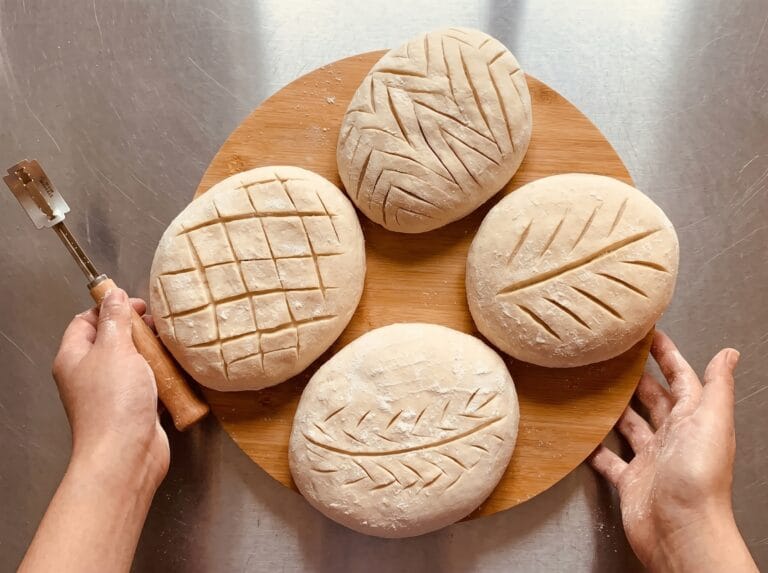
Steam extraction is managed by zone-specific outlet valves connected to a horizontal duct with chimney stacks. An optional radial blower at each chimney base enables active, variable-speed extraction, providing the fine-grained humidity control that artisan-style breads require to achieve the open crumb structure and scored surface associated with traditional production.
Combined Loading and Unloading: Multi-Format Handling Without Line Duplication
The oven’s internal flexibility is only half the equation. At the infeed and outfeed, format diversity creates handling challenges that dedicated single-product systems are not designed to resolve.
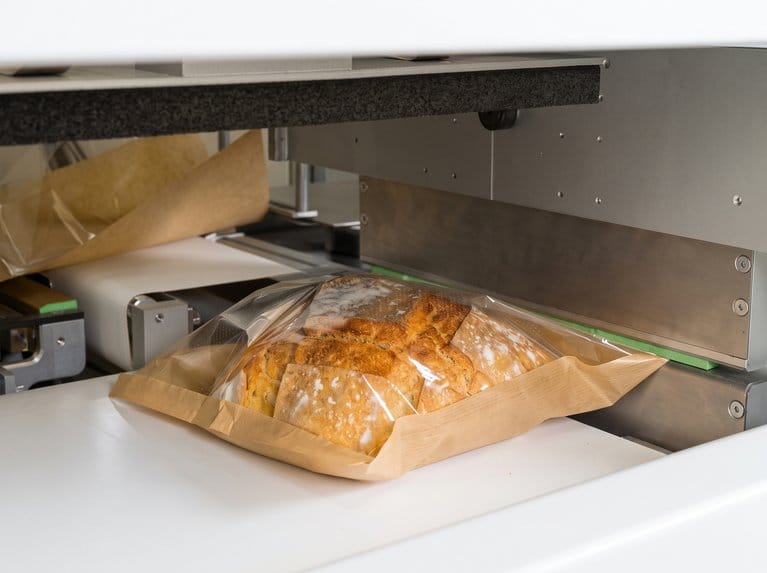
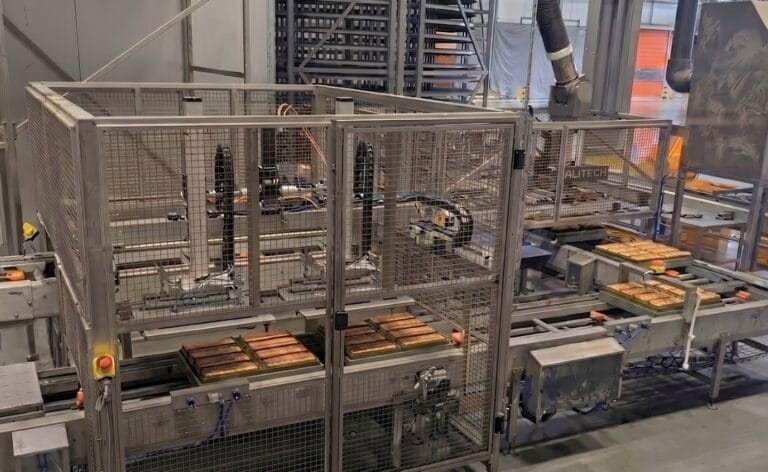
Alitech’s combined loader integrates two loading mechanisms into a single unit. A mesh conveyor handles inline loading of hearth breads or trays directly onto the oven belt.
A bar loading conveyor with cross-conveyor handles tray and pan formats, using a push-bar mechanism that travels on side guides and raises automatically on the return stroke. The combined unit can process peelboards and trays simultaneously, enabling split-format baking runs without a line stop or loader changeover.
On the discharge side, the combined unloader receives pans from the oven and transfers them via an accelerating cross-conveyor with up/down movement.
The belt material (nylon for high-temperature runs, steel for more demanding thermal conditions) is specified per installation. Like the loader, it is capable of handling hearth-baked bread and tray or pan formats in the same production cycle.
INSIGHT: The ability to run peelboards and trays through the same loader simultaneously eliminates the format-switchover downtime that can account for 12–20 minutes of lost production per changeover on conventional lines.
Automation and Recipe Management: Eliminating Manual Error at Format Change
The operational gains of a universal oven are only realized if the transition between formats is reliable and repeatable.
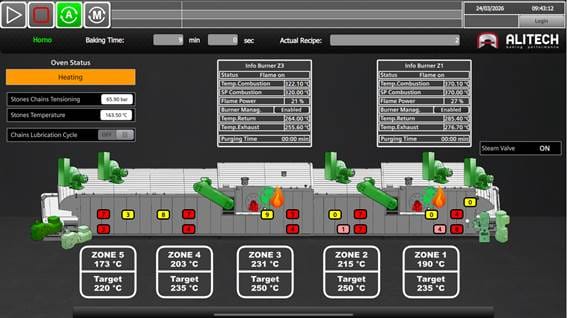
Alitech’s in-house HMI software centralizes all baking parameters (zone temperatures, belt speed, turbulence direction and speed, steam infeed volume, damper positions, and extraction rates) into stored recipes accessible from a single operator panel.
When an operator selects a new product recipe, the system automatically reconfigures all motorized dampers, adjusts burner power, and modifies belt speed without manual mechanical intervention.
The HMI provides real-time baking status, historical temperature trend graphs, alarm visualization with line position mapping, and a planned maintenance scheduler that tracks component wear and flags service intervals before failures occur.
Remote access to the HMI for maintenance or software upgrades reduces dependency on on-site technical resources, an increasingly relevant capability for operations in regions with limited specialist service coverage.
About The company

30 Years of Experience in Bakery Equipment and installations across Europe, North America, and beyond
Alitech SRL designs and manufactures Industrial Tunnel Ovens, Travelling Proofers, and Machines for bread, pizza, and baked goods at its facility in Rovereto, Italy. Alitech offers turn-key baking line solutions with output capacities exceeding 5 tons/hour. All ovens are built on demand to customer specifications.
Contact:
Viale Caproni, 15/17 38068 Rovereto (TN) – Italy info@alitechbaking.com alitechbaking.com
+39 0464 455400
References
- AIB International. (2023). Industrial Bakery Operations Survey: Equipment Flexibility and Line Utilization. AIB International Technical Reports.
- Alitech SRL. (2026). Cyclothermic Indirect Fired Mesh Belt Tunnel Oven, Technical Presentation and Product Flyer. Rovereto, Italy.