Short on Floor Space? Automate the End of Line in Bakeries Without Rebuilding the Plant
Manual labor at the end of the line can become a bottleneck as production rises. Yet in many bakeries, the floor plan leaves no room for bulky conventional equipment. End-of-line systems designed around each plant’s layout make automation possible within the space available.
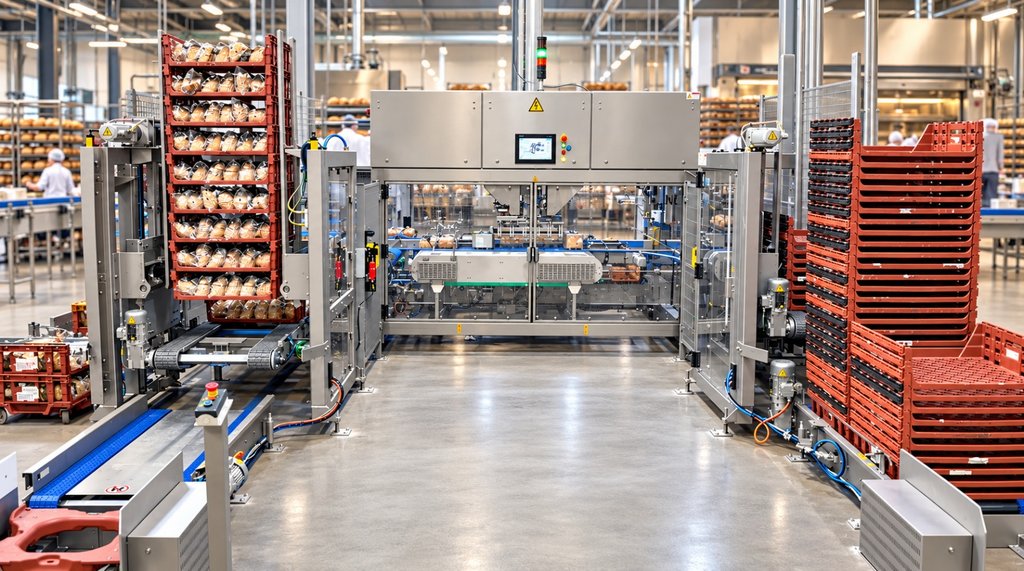
Industrial bakeries have spent decades automating the process side of the line. Mixing, proofing, baking and primary packaging now run largely under automated control, while the end of line often still depends on operators filling crates and stacking them by hand.
Even in bakeries where mixers and ovens are automated, intermediate transfers and final packaging are still typically carried out manually. As volumes grow, that manual section tends to become the point where the real capacity of the line is decided.

The decision to automate usually arrives later than the space to do it. In an existing plant, the floor was laid out years ago around the oven, the proofer and the cooler. When the bakery finally decides to automate crate filling and stacking, it often discovers there is nowhere to put the machines.
Why the Floor Runs Out
Bread lines are physically large. Industrial tunnel ovens often run for dozens of meters, and proofers and coolers claim another substantial share of the building. Because these are the core of the process, they are positioned first.
The end of line generally receives whatever space remains: a narrow strip between structural columns, electrical cabinets, walkways and loading docks. Conventional end-of-line equipment, by contrast, tends to be planned around open floor area.
Where conventional layouts consume space:
There are systems designed for exactly this situation. Endline, focused on end-of-line automation for industrial bakeries, builds its machines around each plant’s layout, formats and capacity. It supplies standalone units or complete lines and starts by analyzing the packaging line already in place before recommending upgrades.
The Consequences of Staying Manual
When the machine does not fit, the default answer is to keep the manual process. The bottleneck does not disappear; it shifts to the people and to the production schedule.
Manual work becomes structural
What began as a temporary solution turns into a permanent staffing model. Crate filling and stacking combine repetitive motion, trunk rotation and lifting, and these positions tend to show high turnover.
Format diversity is absorbed by hand
Retail chains, private label customers and distribution channels often require different crate types, product orientations and packing patterns. In a manual end of line, each new SKU or customer specification is resolved by operators adapting on the fly. This might hold at low volumes, but it could limit consistency and speed as the portfolio grows.
The oven sets the pace, not the packers
Baking runs as a continuous no-wait process: once dough is mixed and proofed, it cannot be held without quality loss. Poor synchronization between coupled bakery stages typically forces batches to be spaced out and leaves ovens idle while they still consume energy. A manual end of line that cannot keep up could therefore restrict the output of the most capital-intensive equipment in the plant.

A manual end of line does not remove the bottleneck, it moves it. The oven keeps its pace, so the pressure falls on the operators and on the packing area.
Congestion adds hidden handling
When operators, bakery racks, pallet jacks and crate stacks share narrow aisles, flows cross, transfers slow down and the risk of collisions and damaged crates rises.
Integration with existing equipment is a real barrier
Integrating new technology with legacy equipment is one of the main obstacles bakeries face when adopting automation. In a compact plant, that difficulty is as much physical as it is electrical.
Designing for the Space Available
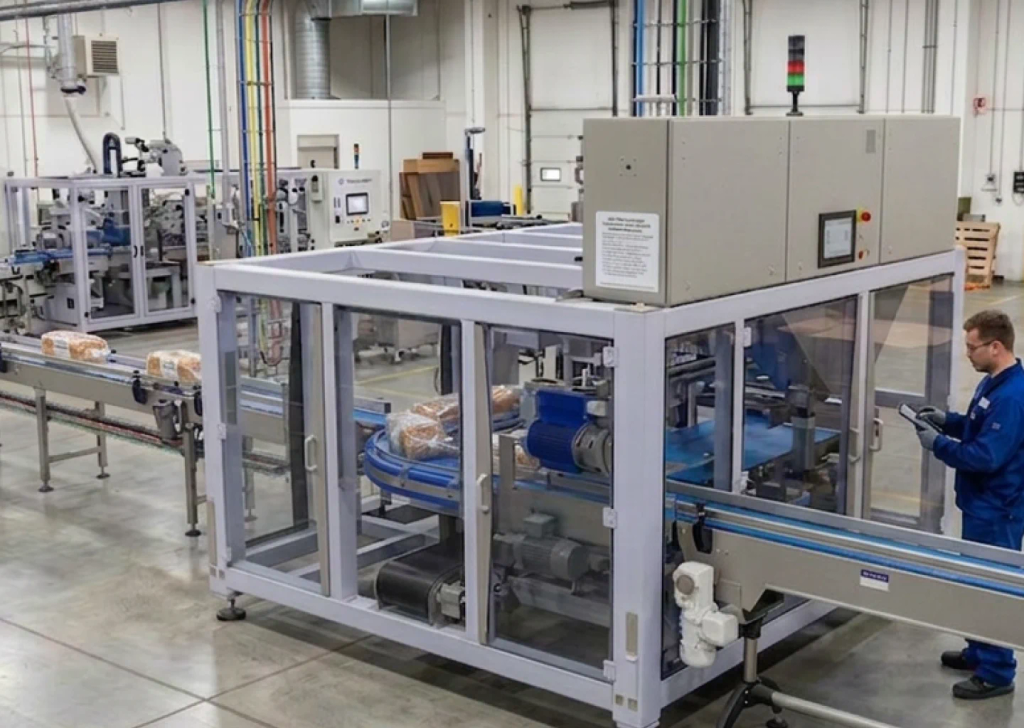
Endline designs and manufactures equipment for each step of the crate flow, from crate filling and conveying to stacking, destacking and palletizing, either as individual machines or as integrated systems built to meet each production need.
Crate fillers
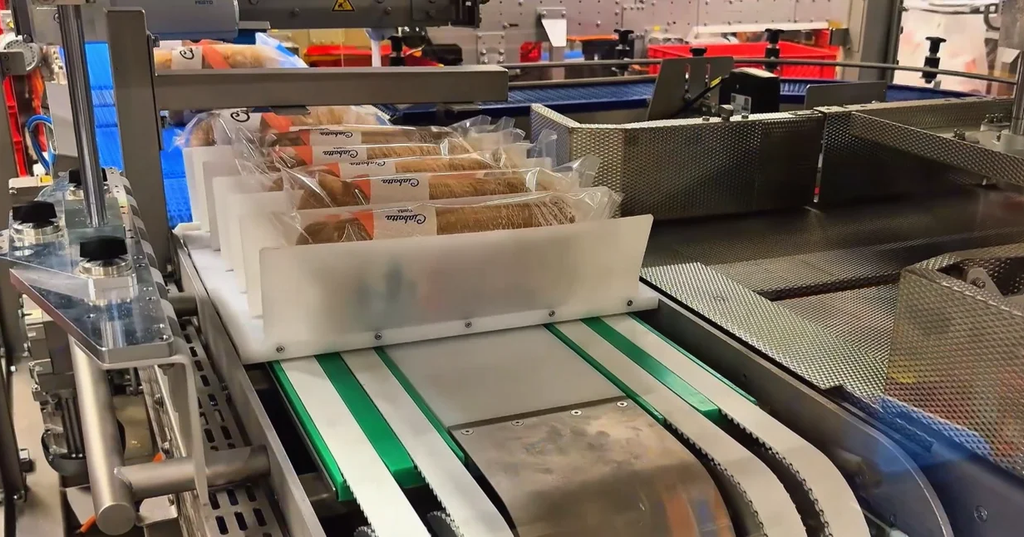
Endline‘s crate fillers load prepacked products into crates and cartons at rates of 5,400 to 7,200 products per hour, depending on the configuration, and are designed to fit the layout of each plant.
Double infeed
A single filler can receive products from two baggers at the same time, so one unit serves both lanes.
Multiple formats in one system
The fillers form flat and on-edge patterns, in single or multiple rows, and can run several packing patterns on the same machine.
Depending on the configuration, they receive products long-side or short-side leading, adapting to the orientation coming from the existing line.
Level change built in
The bottom stacker and destacker combine stacking or destacking with the height change between infeed and outfeed, eliminating separate inclined or declined conveyors. Both handle multiple crate types at the same time, at up to 13 crates per minute, while the servo-controlled top destacker processes up to three stacks simultaneously, reaching up to 2,000 crates per hour.
Conveyors that follow the building
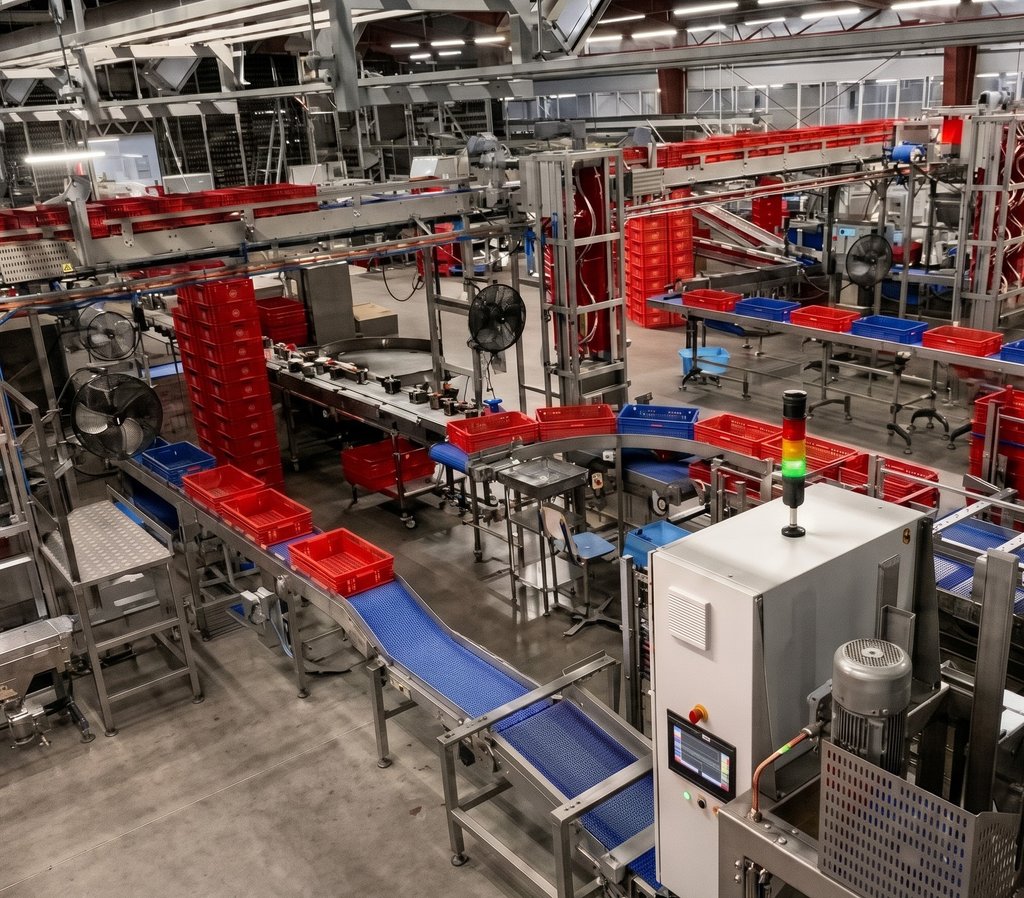
The modular crate conveyor system combines straight sections, curves, transfers, elevators and buffer zones, connecting stackers, destackers, washers, filling lines and palletizers around the constraints of the plant.
Safe operation at close quarters
Light barriers integrated into the frame, fail-safe grippers that hold under power or air loss, and protective fencing with safety interlocks protect operators working near the equipment, while servo-driven motion and engineered drop points load prepacked products with minimal impact.
Step-by-step adoption
A bakery could begin with the station that limits output most and extend the system as space and budget allow.
When floor space is the constraint, end-of-line automation starts with the layout of the plant.
😊 Thanks for reading!
About The company
EndLine is a European specialist in end-of-line automation for industrial bakeries, serving food manufacturers across Europe and the Americas. Through its specialized engineering, hygienic stainless-steel machinery, and turnkey integration capabilities, EndLine delivers comprehensive end-to-end packaging and crate-handling solutions, from filling and internal crate logistics to proofing, cooling, and robotic palletizing, providing integrated technologies that ensure gentle product handling, operator safety, and long-term operational efficiency.
Contact:
Headquarters / Europe: Imantas 8. līnija 11A, Rīga, LV-1083, Latvia
Web: https://endline.eu/
Email: hello@endline.eu
Phone: 00 358 50 589 9333
References:
- Endline. “End-of-Line Automation for Industrial Bakeries”: https://endline.eu/
- Endline. “Machinery”: https://endline.eu/machinery/
- Babor, M., Paquet-Durand, O., Kohlus, R., Hitzmann, B. “Modeling and optimization of bakery production scheduling to minimize makespan and oven idle time.” Scientific Reports, 2023: https://doi.org/10.1038/s41598-022-26866-9