Soy Flour as a Bread Improver: Functions, Dosage, and Limits
Enzyme-active soy flour delivers two simultaneous corrections inside the mixer: it bleaces the crumb by co-oxidizing carotenoid pigments and strengthens gluten through disulfide cross-linking. At dosages between 0.5% and 1.0% on a flour basis, it replaces synthetic oxidants while fitting clean-label declarations.
How Lipoxygenase Transforms Wheat Dough
The soybean, Glycine max, naturally contains lipoxygenase, an oxidoreductase that catalyzes the reaction between polyunsaturated fatty acids, such as linoleic and linolenic acid, and oxygen dissolved in the dough during high-speed mixing. The resulting lipid hydroperoxides drive two parallel effects that define the ingredient’s industrial value.
First, these hydroperoxides attack the conjugated double bonds of lutein and other yellow xanthophyll pigments present in wheat flour. The pigments lose their chromophore structure, and the crumb shifts from creamy-yellow to bright white. This bleaching pathway requires adequate air incorporation during the first mixing stage, where lipoxygenase activity peaks before the enzyme denatures above 65 to 70 °C during baking.
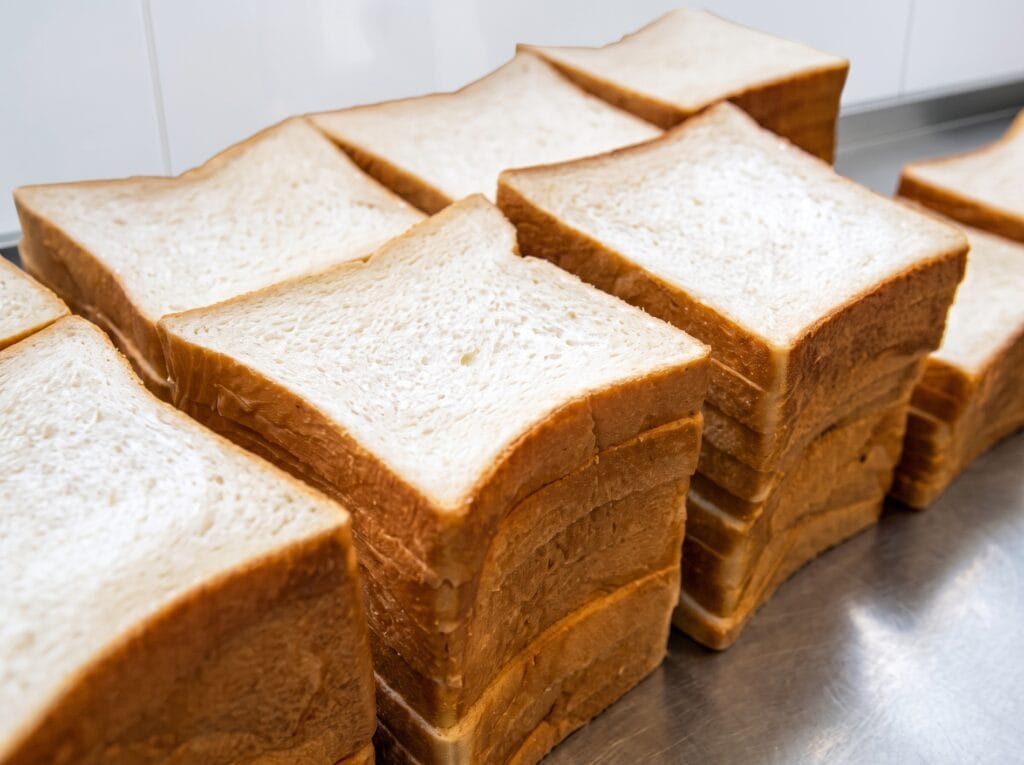
Second, the same reactive intermediates oxidize free sulfhydryl groups on gliadins and glutenins, converting them into disulfide bonds. The net result is a tighter, more resilient gluten network with improved gas retention. Loaf volume increases, and the cell structure becomes finer and more uniform. In farinograph readings, doughs treated with 0.5% to 1.0% enzyme-active soy flour show higher water absorption, roughly an increase of 1.0% to 1.5% per each 1% of soy flour added, and improved stability, while alveograph curves register a measurable rise in tenacity with only a slight reduction in extensibility.
Two Products, Two Dosage Windows
Industrial soy flour is available in two fundamentally different formats, and confusing them may compromise the final product.
Enzyme-active soy flour, which is processed under low-heat conditions with a protein dispersibility index above 70%, retains full lipoxygenase activity. It is used at 0.5% to 1.0%, with a hard ceiling near 1.5%, as a dough conditioner, crumb whitener, and mild gluten reinforcer. This is the grade found inside most commercial bread improver blends.
Heat-inactivated defatted soy flour, which is toasted and has a protein dispersibility index below 20%, contains no residual lipoxygenase. Its value lies elsewhere, as the 45% to 50% protein content, which is rich in globulins such as glycinin and β-conglycinin, absorbs 1.5 to 2.5 times its weight in water, boosting dough yield and delaying crumb firming. Dosages range from 3.0% to 7.0%, with hydration adjustments of approximately 1.2% additional water for every 1% of soy flour in the formula. Natural lecithin in this grade also acts as a mild emulsifier, reducing interfacial tension in the dough and refining crumb texture.
Operational Limits and Common Defects
The benefits of soy flour are tightly dose-dependent, and exceeding the recommended ranges introduces measurable defects.
Excessive dosages can lead to off-flavors. Lipoxygenase converts fatty acids into volatile aldehydes, primarily hexanal and 1-hexanol. Below 1.0%, these compounds remain below sensory detection. Above 1.5% enzyme-active flour, consumers may perceive a beany or grassy note that masks the expected wheat character.
Gluten dilution is another risk. Soy proteins do not form viscoelastic networks. When total soy flour exceeds 3.0% in a medium-strength wheat flour system, the gluten matrix loses cohesion. The dough could collapse during proofing, generating a dense crumb, poor oven spring, and irregular cell distribution. The alveograph strength value drops sharply under these conditions.
Storage instability must also be managed. Full-fat enzyme-active soy flour carries its own polyunsaturated lipid substrate. In warm or humid storage, the residual lipoxygenase may oxidize those lipids before the flour even reaches the mixer, producing rancid off-odors. Cool, dry storage and rapid stock rotation are essential.
Finally, allergen declarations are mandatory. Soy is a regulated allergen under Codex Alimentarius, FDA, EU, and Mercosur regulations. Any formulation containing soy flour, regardless of dosage, requires clear labeling on the final packaging.
Soy Flour Inside the Improver Blend
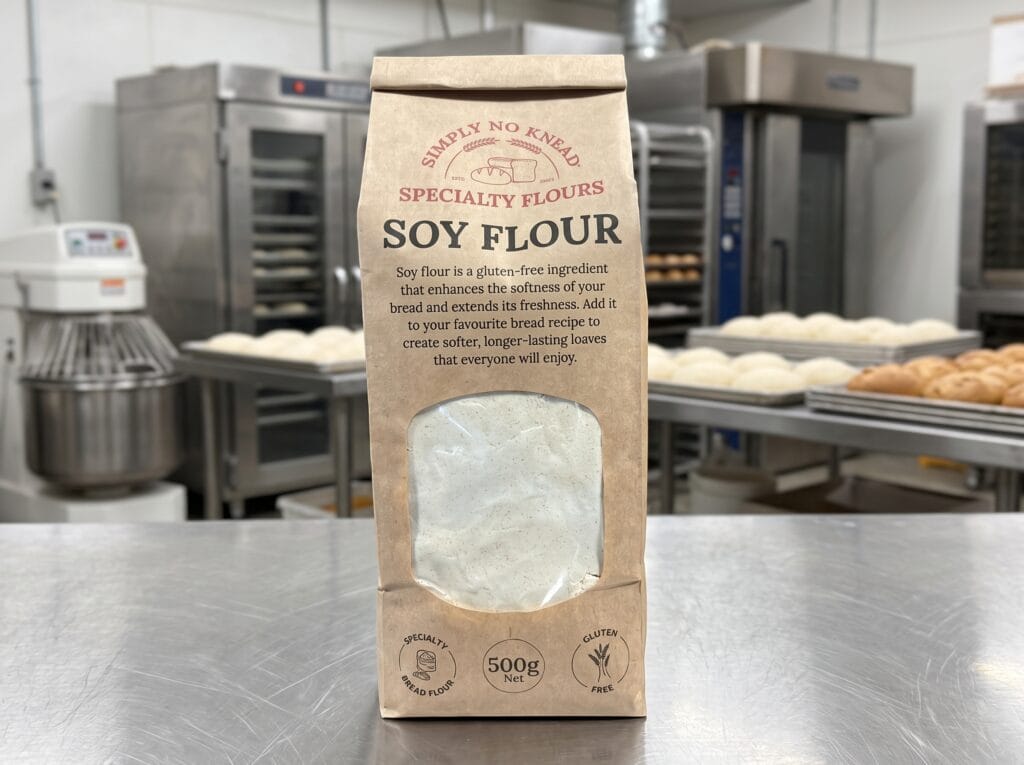
In bread improver systems, enzyme-active soy flour rarely works alone. It is typically combined with ascorbic acid at 30 to 80 ppm, which acts as an indirect oxidant through its dehydroascorbic acid form, reinforcing disulfide bonding in a complementary pathway.
Maltogenic alpha-amylase contributes anti-staling performance by selectively trimming amylopectin branches, while xylanase degrades insoluble arabinoxylans, releasing bound water and improving extensibility.
This enzyme-based architecture, with soy flour at its core, offers industrial bakers a complete clean-label alternative to synthetic conditioners such as diacetyl tartaric acid esters of mono- and diglycerides, sodium stearoyl lactylate, and azodicarbonamide. The soy flour provides the oxidative and bleaching functions, ascorbic acid adds further gluten reinforcement, and amylase and xylanase handle crumb softness and shelf life. Together, they cover the full spectrum of dough conditioning without a single chemical additive code on the ingredient list.
Connecting the Line to the Bottom Line
For an industrial bakery running continuous mixing and high-throughput lines, the decision to integrate soy flour into the improver system translates directly into measurable efficiency gains: higher dough yields through increased water absorption, extended crumb softness that reduces returns, and a whiter crumb achieved without chemical bleaching agents. When formulated within its validated dosage windows and paired with the right enzymatic partners, soy flour remains one of the most cost-effective, clean-label functional ingredients available to the breadmaking industry.
😊 Thanks for reading!
Sources:
BAKERpedia – Enzyme Active Soy Flour
Cauvain, S. P., & Young, L. S. (2007). Technology of Breadmaking (2nd Ed.). Springer.
Zhou, W. et al. (2014). Bakery Products Science and Technology (2nd Ed.). Wiley-Blackwell.
NCBI/PubMed Central – Action of Lipoxygenase on Polyunsaturated Fatty Acids and Sulfhydryl Groups
Bakery Industry Insider – How Soya Flour Works in Breadmaking
FAO/UNIDO – Processing and Utilization of Soybeans in Commercial Bakery Products
CABI Digital Library – Soy Lipoxygenase, Carotenoid Co-oxidation and Disulfide Bonding