Why Industrial Bread Lines Struggle with Crust Color and How Turbulence Technology Changes the Equation
In high-volume bread production, pans and lids that protect product shape and volume become the very obstacles that impede efficient crust formation. Understanding the physics behind this thermal conflict is the first step toward solving it.
Consistency at Scale Is Non-Negotiable
Industrial bakeries today face a dual mandate: produce at volumes that justify automation, while delivering a crust color and texture profile that meets retailer specifications batch after batch.
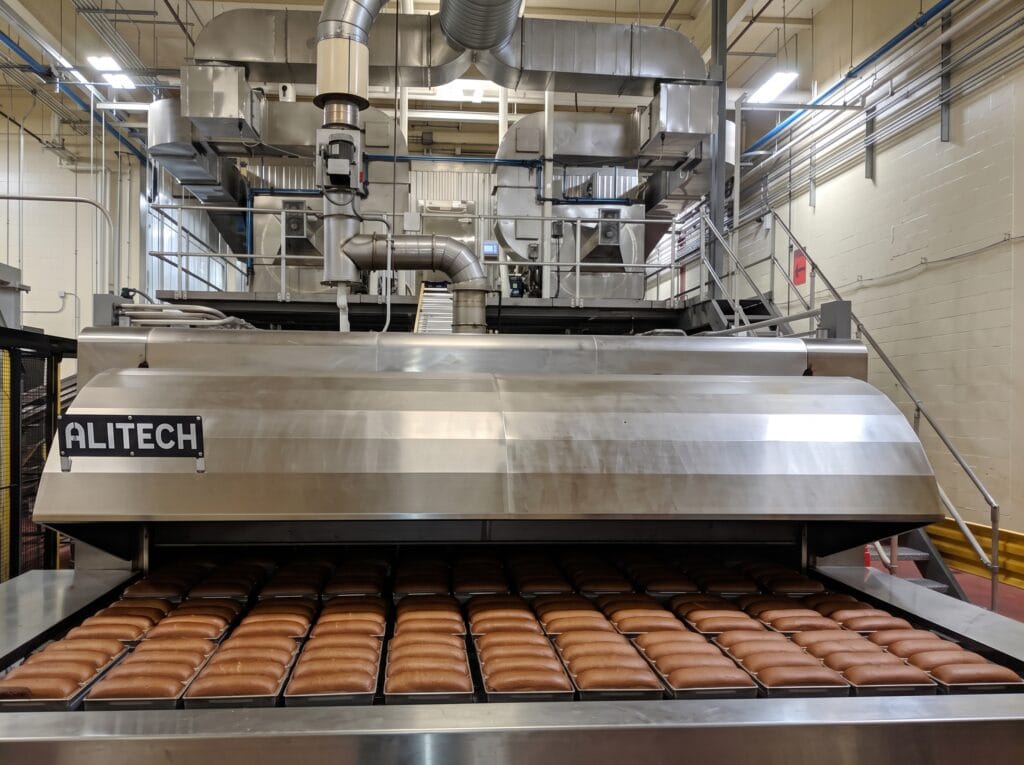
In a competitive market where private-label tin bread, pan loaves, and lidded Pullman-style products dominate supermarket shelves, color uniformity has moved from a quality target to a commercial requirement.
Retailers specify precise scale for crust color. Deviations (whether pale or over-baked) trigger rejection. This pressure falls directly on the oven and its ability to deliver consistent, repeatable heat transfer across every pan position, every run.
The Technical Challenge: Why Pans and Lids Create Thermal Barriers
Maillard reactions (the primary driver of crust browning) require the dough surface to reach approximately 115°C. Caramelization, which deepens color further, begins above 155°C. Achieving these surface temperatures depends entirely on the rate and efficiency of heat transfer to the dough.
When product is baked in tins or with lids, distinct mechanisms interfere with this process:

INSIGHT: In cyclothermic indirect-fired ovens (the dominant architecture for tin bread production) the baking chamber relies primarily on radiant heat from heated tubes above and below the product. This mode is effective for open-hearth baking but generates a comparatively still air environment. For panned products, this still-air condition amplifies the thermal barrier effect of the pans significantly.
The consequences are commercially significant: uneven top color, pale sidewalls, and inconsistent lid-contact browning on Pullman loaves. These defects require costly interventions (extended bake times, higher setpoint temperatures, or manual sorting) all of which affect throughput and energy consumption.
The Engineering Response: Forced Air Turbulence as a Thermal Bridge
The industrial solution to this challenge is well-established in oven design: forced air convection delivered directly to the product.
By actively moving heated air across and through the baking chamber (and crucially, directing it at the panned product) manufacturers can dramatically increase the convective heat transfer coefficient at the dough surface.
The physics are straightforward: in a still-air environment, a thin boundary layer of cooler, moisture-laden air forms around the product surface, acting as an insulating film.
High-velocity turbulent airflow disrupts this boundary layer continuously, bringing fresh hot air into direct contact with the surface and accelerating both heat transfer and moisture evaporation. This is the mechanism that allows the dough surface temperature to rise into the Maillard and caramelization zones faster and more evenly.
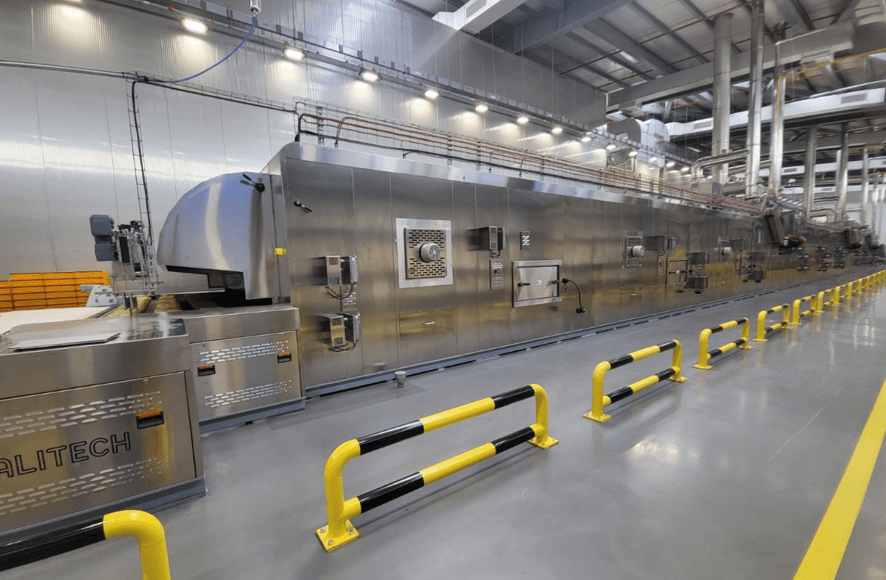
Alitech SRL, a manufacturer of industrial tunnel ovens with over 30 years of installation experience across Europe and North America, has integrated this principle directly into the zonal architecture of its Cyclothermic Indirect Fired Mesh Belt Tunnel Oven.
How Alitech’s Turbulence Zone Works in Practice
In Alitech‘s design, the tunnel oven is structured as a series of independent baking zones.
While each zone provides separate control over ceiling heat, floor heat, and steam extraction, steam infeed is featured exclusively in the first zone.
A dedicated, or multiple Turbulence Zone can be positioned at any point along the oven length based on the product’s baking profile requirements.
The turbulence section operates through an Air Turbulence Blower that drives heated air directly onto the product surface. Air flow direction is adjustable (either top-down or bottom-up) by reversing the blower, giving process engineers precise control over which part of the panned product receives the highest convective heat input. This is particularly relevant for Pullman loaves where the lid-contact surface requires directional heat to achieve the target color.
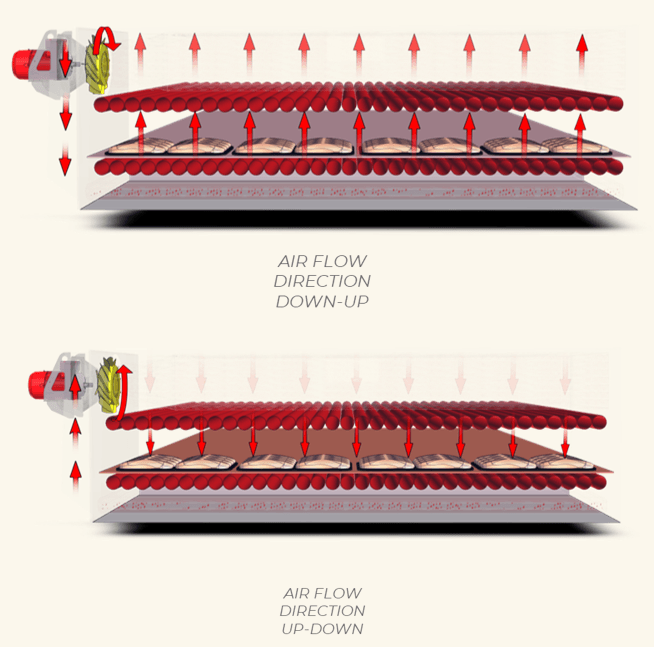
When turbulence is not required (for example, in early-phase expansion where a still, humid environment is preferred) the blower can be switched off and the baking chamber operates as a neutral zone. This flexibility means a single oven configuration can handle very different products and recipes without mechanical modification.

Key Performance Principle: Turbulence increases the rate of heat transfer to the baking surface by breaking the still-air boundary layer that forms around pans and lids. This allows the oven setpoint temperature to remain constant while delivering more net thermal energy to the dough, reducing bake time and improving color development without increasing fuel consumption.
System-Level Integration: Turbulence Within a Recipe-Driven Process
The turbulence function does not operate in isolation. Alitech‘s in-house HMI software allows operators to store complete zone-by-zone recipes, including turbulence air direction, blower speed, heat damper positions, and steam extraction settings. When a product changeover occurs, the oven reconfigures all damper positions and blower states automatically, eliminating manual adjustment and reducing the risk of setting errors between shifts.
Additional system features that interact with the turbulence function include:
Application Range: Beyond Standard Tin Bread
The thermal barrier challenge is not limited to pan loaves. Any product baked in a container, including Pullman (lidded) bread, American-style buns on trays, rye bread, empanadas, and cake bases, presents the same heat transfer constraints. The turbulence zone approach is equally applicable across this range, with air direction and intensity adjusted per recipe.
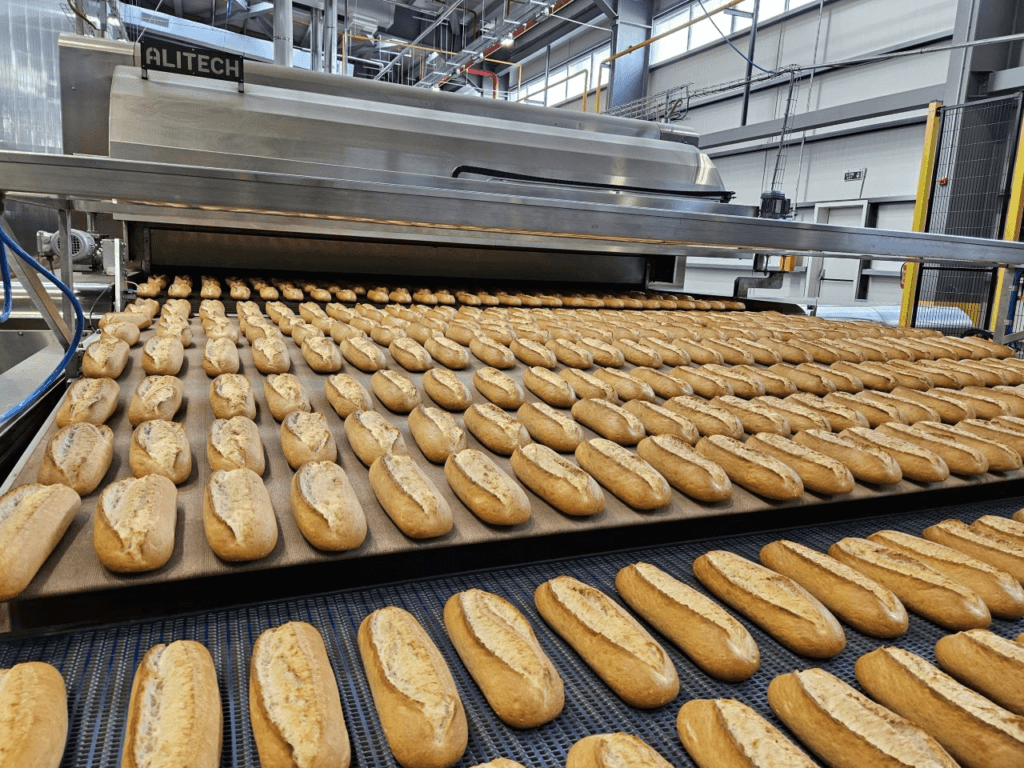
Alitech‘s mesh belt tunnel oven is positioned as a universal system, capable of handling:
- Tin bread, Pullman bread, and lidded formats
- Free-standing hearth bread (baguette, ciabatta, focaccia)
- Buns and rolls, bagels, American-style pizza
- Croissants, pizza bases, cakes, pies, and empanadas
This versatility makes the turbulence system an investment that extends across a facility’s full product mix, not a specialized solution for a single SKU.
For production managers and process engineers evaluating tunnel oven configurations for panned bread lines, the key specification question is not whether the oven can generate enough heat, it is whether the oven can deliver that heat effectively through and around the thermal barriers that are intrinsic to pan-baked products.
😊 Thanks for reading!
About The company

30 Years of Experience in Bakery Equipment and installations across Europe, North America, and beyond
Alitech SRL designs and manufactures Industrial Tunnel Ovens, Travelling Proofers, and Machines for bread, pizza, and baked goods at its facility in Rovereto, Italy. Alitech offers turn-key baking line solutions with output capacities exceeding 5 tons/hour. All ovens are built on demand to customer specifications.
Contact:
Viale Caproni, 15/17 38068 Rovereto (TN) – Italy info@alitechbaking.com alitechbaking.com
+39 0464 455400
References
- Alitech SRL (2026). Cyclothermic Indirect Fired Mesh Belt Tunnel Oven – Technical Presentation. Rovereto, Italy.
- Cauvain, S. & Young, L. (2008). Baking Problems Solved. Woodhead Publishing. Chapters on heat transfer in baking.
- Purlis, E. (2010). Browning development in bakery products – A review. Journal of Food Engineering, 99(3), 239–249.
- Therdthai, N. & Zhou, W. (2003). Recent advances in the studies of bread baking process and their impacts on the bread baking technology. Food Science and Technology Research, 9(3), 219–226.