How Salt Bread Gets Its Hollow Center and Crispy Fried Bottom
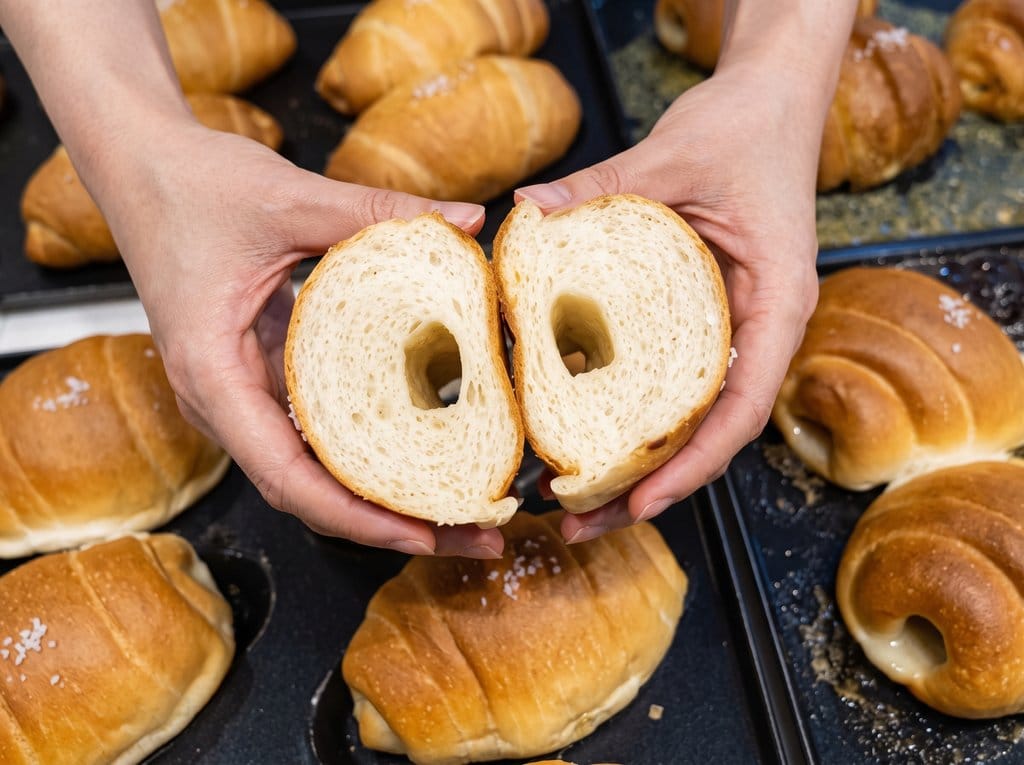
Known in Japan as Shio Pan, this bread relies on a cold butter rod sealed inside lean fermented dough. During baking, this discrete fat core triggers a synchronized thermal cascade, where fat melting, steam expansion, and basal frying each succeed or fail depending on a narrow set of process controls.
Fat Phase Collapse and Emulsion Breakdown
Standard butter used in Salt Bread contains roughly 82% milkfat, 16% dispersed water, and around 2% milk solids. When the dough piece enters an oven set at 210 – 230°C, the embedded butter rod heats rapidly through conduction and radiation.
At around 33°C, the triglyceride crystal network that keeps butter solid at refrigeration temperatures collapses entirely. The solid fat content drops to zero, and the water-in-oil emulsion breaks apart into two functionally independent phases:
This phase separation is the event that initiates the entire downstream cascade. If the butter melts before the dough enters the oven, typically because the proofing chamber ran too warm, the liquid fat saturates the raw gluten network and the pressurization mechanism described below cannot develop.
Steam Flash and Cavity Formation
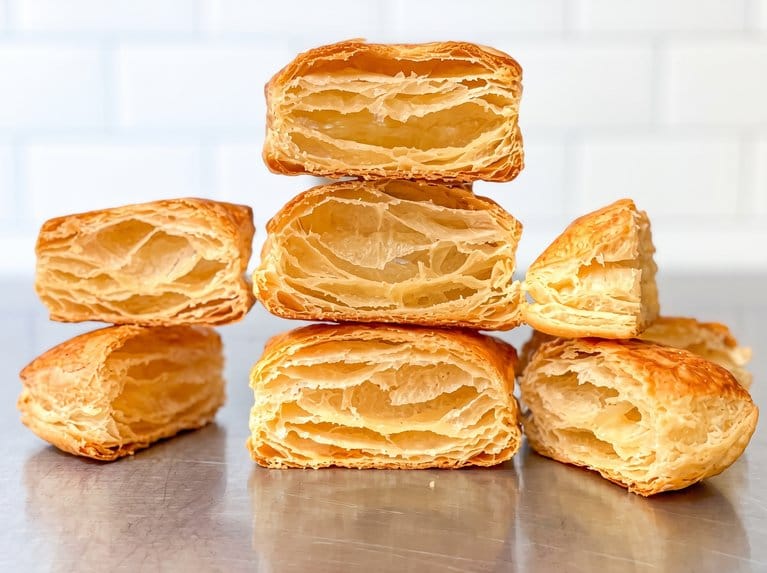
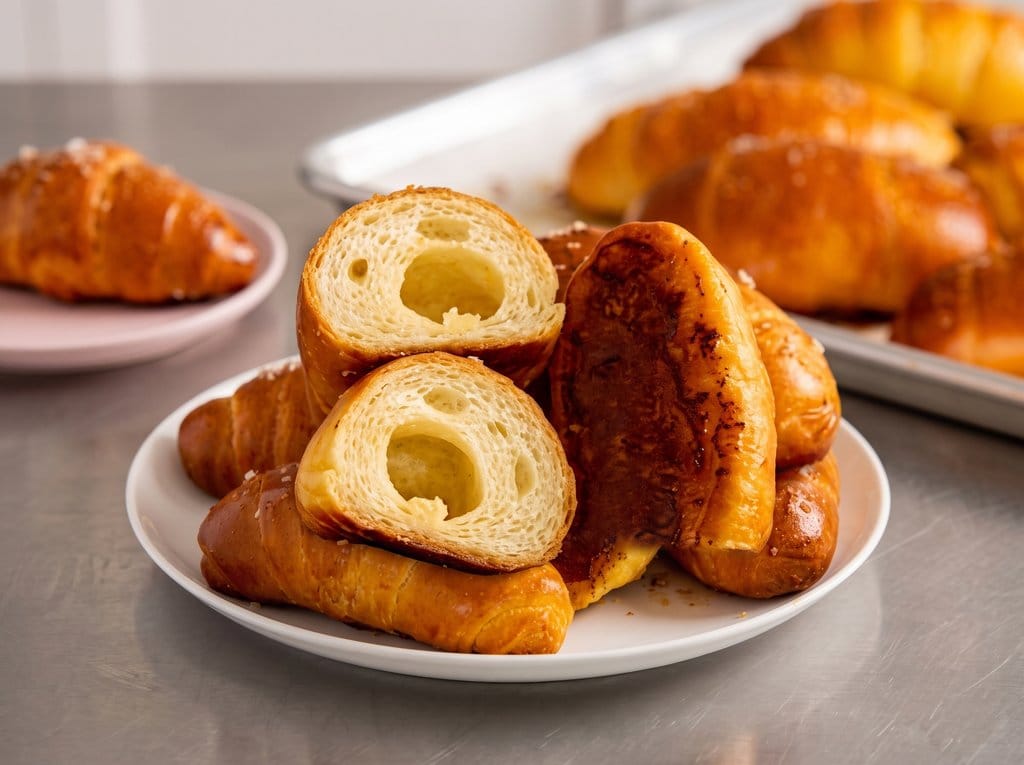
Once the internal temperature reaches 100°C, the water released from the butter rod undergoes a rapid phase change to steam. This steam occupies dramatically more volume than the original liquid water, generating a burst of internal pressure against the surrounding dough walls.
For the cavity to form without blowing the piece apart, timing needs to align with two concurrent transitions in the dough:
The dough wall stretches radially under steam pressure while these transitions progressively rigidify it. Liquid milkfat from the collapsed emulsion simultaneously coats the cavity interior, creating a hydrophobic barrier that prevents the stretched filaments from re-bonding once steam escapes. The result is a hollow central chamber lined with a butter-impregnated membrane of set starch and coagulated gluten.
Basal Frying Mechanism and Maillard Acceleration
As steam pressure builds and the rolled dough ends act as partial pressure relief valves, the liquid milkfat begins draining downward by gravity.
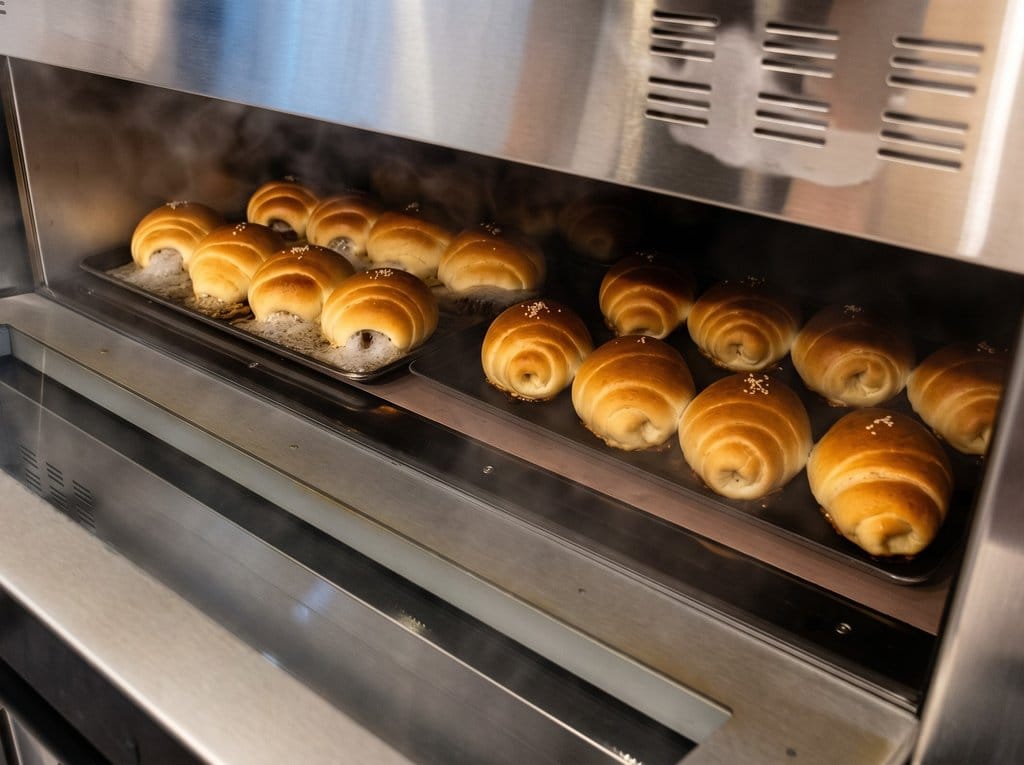
This fat, with significantly lower viscosity and surface tension than water at those temperatures, percolates through the rolled seams and discharges onto the baking tray.
The tray surface, typically maintained at 200 – 220°C in the oven, turns this discharged fat into a shallow frying medium.
The base of the dough piece then experiences a heat transfer regime closer to shallow immersion frying than conventional baking:
The milk solids, primarily casein and lactose, that drained alongside the fat undergo accelerated Maillard reactions and lactose caramelization, generating volatiles associated with browned butter, including diacetyl, acetoin, 2-acetyl-1-pyrroline, and delta-decalactone, contributing the characteristic beurre noisette aroma of the fried base.
Critical Process Controls
Two upstream variables largely determine whether this thermal cascade succeeds or collapses into common defects:
Milkfat begins a nonlinear rheological softening around 28°C and reaches full liquid state shortly above that threshold. Standard proofing chambers for enriched doughs or brioche often operate well beyond this range, so the butter core melts before the piece reaches the oven, saturating the raw dough with liquid fat and eliminating the pressurized steam event.
Shio Pan proofing typically requires a dedicated chamber held below that softening point, with relative humidity around 75%, for 40 – 55 minutes.
The first roll of dough over the butter rod needs a firm transverse seal to anchor the fat in position. However, the lateral ends should not be pinched completely shut. If both ends are fully closed, liquid fat remains trapped inside the cavity throughout baking.
Upon cooling, the crumb at the base absorbs this pooled fat, producing a soggy bottom with no frying effect. A controlled micro-leak at the lateral ends allows fat to drain onto the tray, feeding the basal frying mechanism.
When these two controls align, the finished piece typically exhibits the documented triple texture: a thin, blistered, crisp upper crust with intact mineral salt crystals, an elastic and translucent interior crumb surrounding the hollow cavity, and a deeply caramelized, brittle, fried base.
😊 Thanks for reading!
Sources:
- Pain Maison Official Site (Hitoshi Hirata, Yawatahama / Tokyo): https://shiopan-maison.com/
- Yamauchi, S. “Analyzing the effects of pre-ferments and fermentation time by comparing the textural outcomes of shio pan and pita bread.” ResearchGate, 2024: ResearchGate Publication
- Symrise. “The Rise of Salt Bread: Unpacking the Viral Pastry and Food Science.” Symrise Global Taste, Nutrition & Trend Insights: https://www.symrise.com/
- Delish Kitchen Japan.https://delishkitchen.tv/
- King Arthur Baking & Food52. “Japanese Salt Bread (Shio Pan) Technical Method and Formulation”: https://food52.com/