Water Absorption: Defining the Hydration Limit for the Ideal Crumb Structure
High-hydration doughs offer superior bread texture but present significant processing challenges. Controlling water absorption limits and understanding dough physical transitions from elastic solids to viscous fluids prevents line jams, reduces structural collapse, and ensures consistent crumb structures across different product categories.
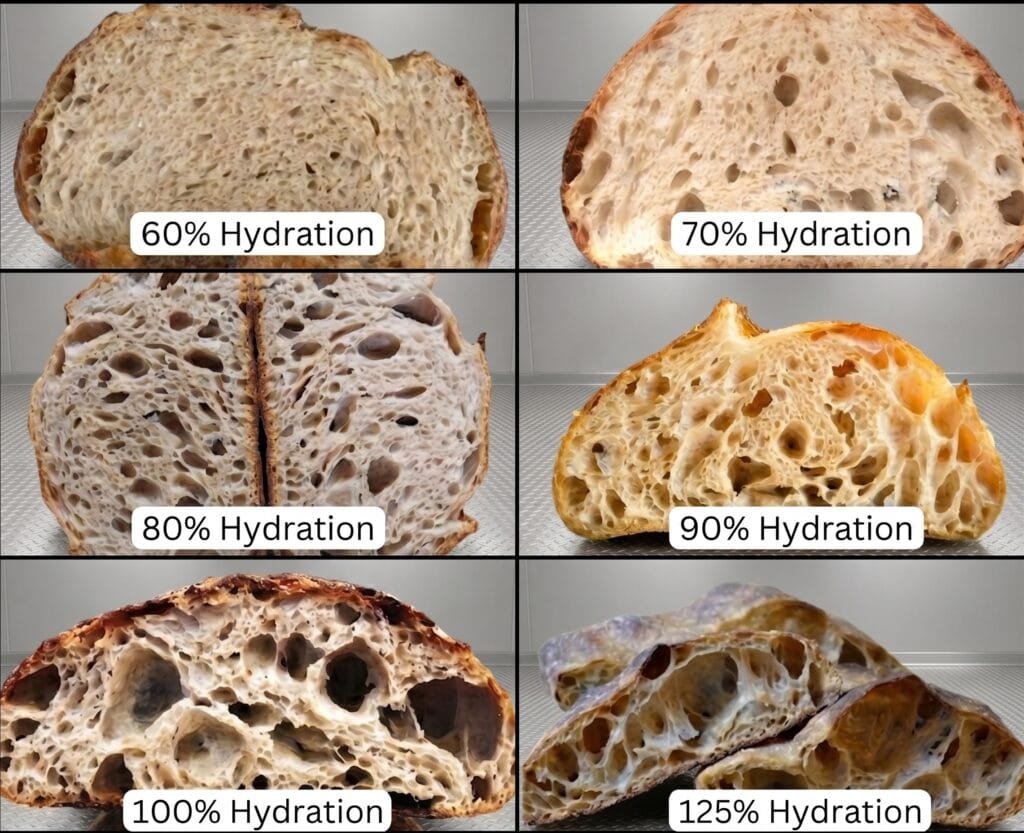
From Tough to Fluid: The Physical Shift Along the Hydration Gradient
Wheat flour dough behaves as a complex viscoelastic system, exhibiting both solid-like elasticity and liquid-like flow. The amount of water added to the flour controls which of these behaviors dominates.
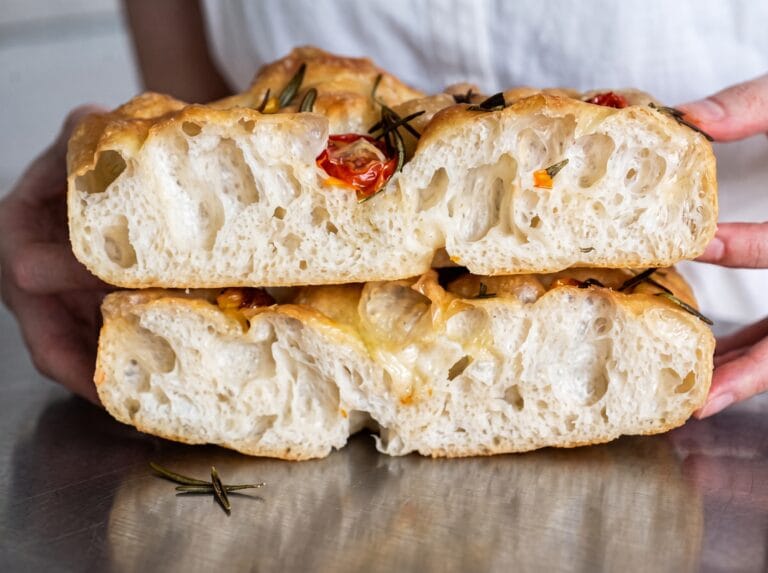
At low hydration levels, water is scarce and binds tightly to the hydrophilic surfaces of damaged starch, pentosans, and proteins. Very little water remains free to lubricate the mixture. The gluten proteins remain tightly folded and crowded, causing the dough to resist stretching and fail to relax under mechanical stress. The resulting baked product has a dense, compact crumb with a closed cellular network.
As water content increases, free water acts as a molecular lubricant. Water molecules insert themselves between the gluten chains, breaking direct hydrogen bonds between protein strands. This opens up the tightly packed protein structures, creating highly hydrated, flexible loop regions. Single-unit proteins, known as gliadins, slip between the larger glutenin polymers, allowing them to slide past each other smoothly. This increases dough stretchability, enabling cell walls to expand significantly without breaking under the pressure of expanding carbon dioxide and water vapor during fermentation and early baking.
Product Categories and Their Associated Hydration Thresholds
Industrial bakeries must align hydration levels with specific product requirements and machine capabilities:
What happens at Extreme Hydration?
When water content reaches extreme limits, such as 130% relative to flour weight, the dough network experiences catastrophic structural failure. In this state, water is no longer a lubricating agent but becomes the dominant continuous phase, suspending the flour particles rather than allowing them to assemble into a cohesive network.
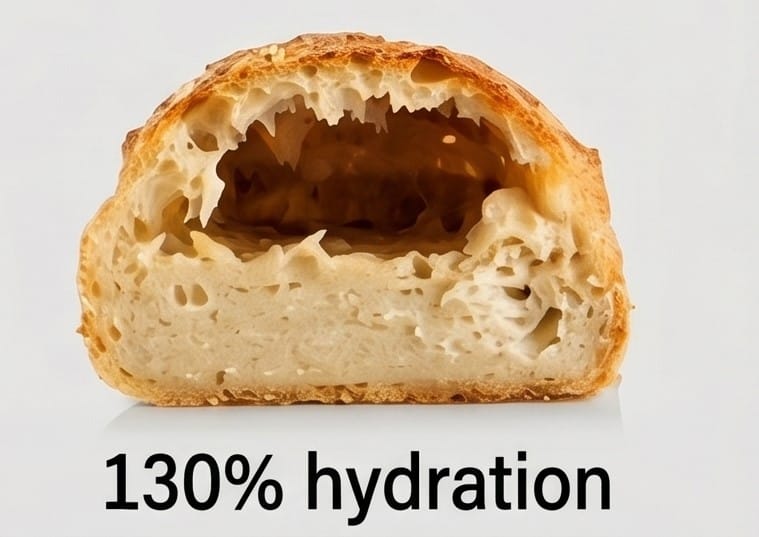
Without a continuous elastic gluten matrix to support the weight of the dough, several physical processes trigger a complete collapse:
Process Controls: Hypermixing and Stage-Wise Hydration
Handling high-hydration and hyper-hydrated doughs on industrial lines requires specialized mixing protocols to build dough strength before the water completely dilutes the proteins:
😊 Thanks for reading!
Sources:
- Understanding the Rheology of Wheat Flour Dough in Baking – Agriculture Institute, accessed June 17, 2026, https://agriculture.institute/baking-and-flour-confectionary/rheology-wheat-flour-dough-baking/
- Importance of Water Quality in Bread Making – Agriculture Notes by …, accessed June 17, 2026, https://agriculture.institute/baking-and-flour-confectionary/importance-of-water-quality-in-bread-making/
- Storage modulus (G’) and loss modulus (G”) for beginners – Rheology Lab, accessed June 17, 2026, https://www.rheologylab.com/videos/storage-and-loss-modulus-for-beginners/
- Understanding Storage and Loss Modulus with TA Instruments, accessed June 17, 2026, https://www.tainstruments.com/understanding-storage-and-loss-modulus-with-ta-instruments-blog/
- G-Values: G’, G” and tanδ | Practical Rheology Science | Prof Steven Abbott, accessed June 17, 2026, https://www.stevenabbott.co.uk/practical-rheology/G-Values.php
- Rheological and Textural Characteristics of Dough and Batter with Ghee Residue, accessed June 17, 2026, https://www.longdom.org/open-access/rheological-and-textural-characteristics-of-dough-and-batter-with-ghee-residue-1103082.html
- Water Absorption Capacity Determines the Functionality of Vital Gluten Related to Specific Bread Volume – PMC, accessed June 17, 2026, https://pmc.ncbi.nlm.nih.gov/articles/PMC7910979/
- Water in baking: the most underestimated ingredient, accessed June 17, 2026, https://bakingbiscuit.com/water-in-baking-the-most-underestimated-ingredient/
- Flour, Protein & Country – Carter’s Bakeshop, accessed June 17, 2026, https://www.carters-bakeshop.com/blog/flour-protein-amp-country-ft7n3
- Changes in Protein Non-Covalent Bonds and Aggregate Size during Dough Formation, accessed June 17, 2026, https://www.mdpi.com/2304-8158/9/11/1643
- Changes in Protein Non-Covalent Bonds and Aggregate Size during Dough Formation, accessed June 17, 2026, https://www.researchgate.net/publication/346842890_Changes_in_Protein_Non-Covalent_Bonds_and_Aggregate_Size_during_Dough_Formation
- Characterization of wheat flour–water doughs. Part I: Rheometry and microstructure, accessed June 17, 2026, https://www.researchgate.net/publication/222366154_Characterization_of_wheat_flour-water_doughs_Part_I_Rheometry_and_microstructure
- Why Does Real Sourdough Have Big Holes? Open Crumb Explained – Atome Bakery, accessed June 17, 2026, https://atomebakery.com/blogs/atome-bakery-blog/why-real-sourdough-has-big-holes-open-crumb
- Influence of Gliadin and Glutenin Fractions on Rheological, Pasting, and Textural Properties of Dough – Taylor & Francis, accessed June 17, 2026, https://www.tandfonline.com/doi/pdf/10.1080/10942912.2012.717154
- Study on Moisture Phase Changes in Bread Baking Using a …, accessed June 17, 2026, https://pmc.ncbi.nlm.nih.gov/articles/PMC12071401/
- Bread baking as a moving boundary problem. Part 2: Model validation and numerical simulation | Request PDF – ResearchGate, accessed June 17, 2026, https://www.researchgate.net/publication/257084201_Bread_baking_as_a_moving_boundary_problem_Part_2_Model_validation_and_numerical_simulation
- Heat and Mass Balance for Baking Process – Hilaris Publishing, accessed June 17, 2026, https://www.hilarispublisher.com/open-access/heat-and-mass-balance-for-baking-process-2155-9821.1000190.pdf
- Starch Gelatinization: When Heat and Water Activate Flour – KPM Analytics, accessed June 17, 2026, https://www.kpmanalytics.com/blog/starch-gelatinization-when-heat-and-water-activate-flour
- Structural Modification of Gluten Proteins in Strong and Weak Wheat Dough as Affected by Mixing Temperature | Request PDF – ResearchGate, accessed June 17, 2026, https://www.researchgate.net/publication/283538057_Structural_modification_of_gluten_proteins_in_strong_and_weak_wheat_dough_as_affected_by_mixing_temperature