5 Technologies Reshaping Energy Recovery in Industrial Baking
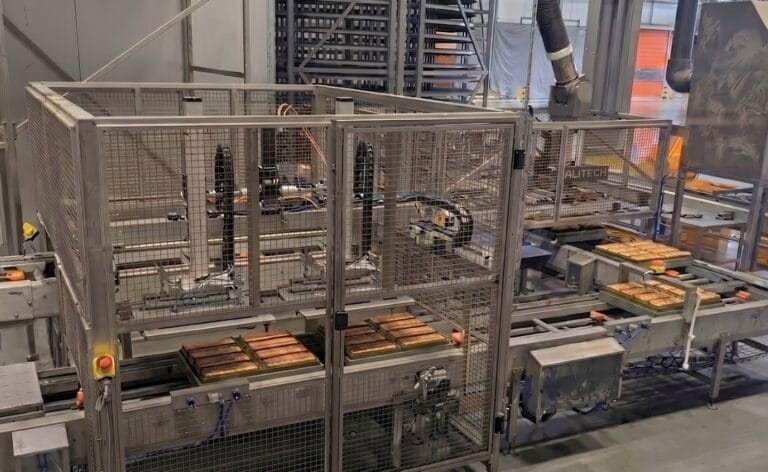
Baking is the single most energy-intensive stage in bread and biscuit manufacturing. Rising fuel costs and carbon reduction targets are forcing the industry to rethink how energy moves through ovens, not just how much fuel is burned. Five technologies now make it possible to capture, reuse, and eliminate waste heat at the plant level, with measurable returns.
The Science Behind the Heat
Industrial baking is, at its core, an exercise in thermodynamics.
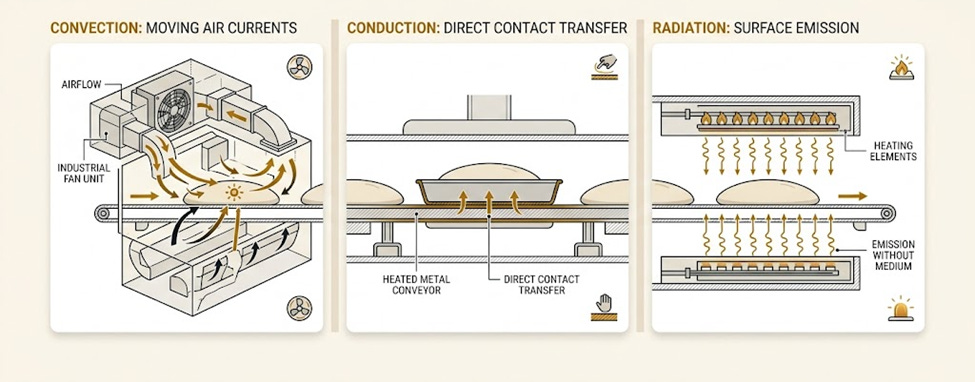
Three mechanisms govern how energy reaches the product:
- Convection (heat carried by moving air currents).
- conduction (heat transferred through contact with a hot band or tin), and
- radiation (heat emitted from hot surfaces without a physical medium). Managing the balance of these three modes determines both product quality and energy efficiency.
Recommended Reading: Improving Cellular Architecture: Why Your Dough Rolling Process Defines the Final Crumb
Two thermodynamic concepts are especially relevant to energy recovery in modern ovens:
• Sensible heat: The thermal energy contained in hot exhaust gases due to their temperature above ambient. This is the most straightforward form of recoverable energy and the primary focus of most industrial heat recovery systems (HRS).
• Latent heat of vaporization: A much larger quantity of energy is required to convert liquid water into steam (approximately 539 calories per gram). During baking, this energy is absorbed by the product and later released as moisture-laden exhaust vapors. Recovering this latent component could significantly amplify overall system efficiency, although it requires more advanced engineering.
Inside the baked product itself, a remarkable thermodynamic cycle occurs: water evaporates near the hot crust, the vapor migrates toward the cooler core, and then condenses, releasing its latent heat deep inside the dough.
This internal heat pump effect is one reason bread bakes efficiently from the outside in.
Why Energy Recovery Can No Longer Be Optional
In a gas-fired tunnel oven, fuel typically accounts for 95 to 96 percent of total energy consumption.
Electrical drives for belts, fans, and controls represent only the remaining 4 to 5 percent.
This ratio means that even modest improvements in thermal efficiency could translate into disproportionately large reductions in operating costs and carbon emissions.
Indirect heating systems, which are common in biscuit and cracker production, may require up to 20 percent additional energy simply to compensate for heat lost through duct walls and closed-circuit systems. That premium is a measurable, recoverable inefficiency.
Before exploring the five technologies at the frontier, it’s worth noting how modern pan-handling is being redefined. Our partners at Rexfab Inc. are demonstrating how replacing pneumatics with electromagnets significantly boosts line reliability.
Check out the full article below:
From Pneumatics to Electromagnets: Cutting Pan Handling Costs in Industrial Bakeries
Five Technologies at the Frontier
1. Polymer Heat Exchangers for Complex Vapors
Provider: HeatMatrix Group
The Science
Vapors generated when baking fatty products, such as certain biscuits or laminated doughs, carry not only thermal energy but also aerosol-phase lipids and organic compounds. Conventional metal heat exchangers would quickly foul and corrode under these conditions, making frequent cleaning or replacement necessary.
Heat Matrix addresses this with advanced polymer composite materials that could resist chemical attack and minimize surface adhesion. The geometry is modular: individual cartridges can be removed and cleaned or replaced independently, avoiding costly full-system shutdowns.
Industrial Application
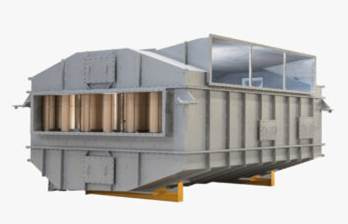
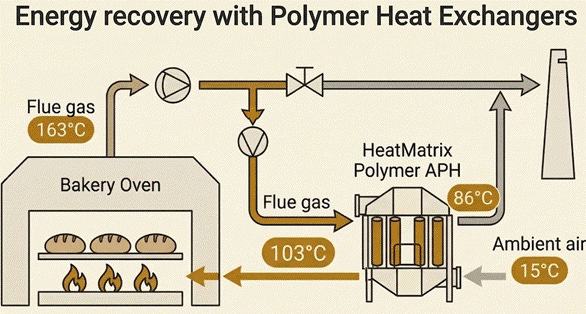
A modular gas-to-liquid exchanger unit is typically installed at roof level, where exhaust streams are captured before dispersing to atmosphere.
The recovered thermal energy could be transferred to process water circuits, supplying heat for washdown, cleaning-in-place (CIP) systems, or fermentation temperature control.
Because the polymer surfaces resist fouling, recovery efficiency may remain stable over long operational periods, which is a key advantage over metal alternatives in greasy or sugary baking environments.
2. Thermal Electrification with Micro-Convection
Provider: GEA Group
The Science
Decarbonizing baking requires eliminating combustion entirely. GEA’s approach applies fluid dynamics principles to high-efficiency electric resistance elements.
The concept of micro-convection targets the boundary layer directly adjacent to the product surface, which is the thin zone where thermal resistance is highest and where conventional forced convection loses efficiency.
By optimizing airflow patterns at this micro-scale, the system could achieve higher effective heat transfer coefficients without increasing bulk air temperature, which in turn reduces over-drying at the surface and may improve product quality consistency.
Industrial Application
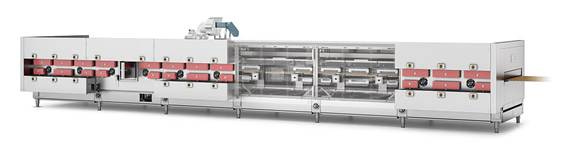
The GEA eBake G1 tunnel oven is designed from the ground up for full electric operation. Independent assessments suggest it could achieve energy consumption reductions of up to 40 percent compared to standard gas-fired equivalents, under matched production conditions.
Because the system is purely electric, it may connect directly to renewable energy grids or on-site generation, offering a practical path to eliminating direct and indirect carbon emissions at the plant level.
This architecture also reduces maintenance complexity, as there are no burners, gas trains, or combustion control systems to service.
3. Combined Counter-Flow Recovery and Isothermal Baking Control
Provider: WP Bakery Group USA
The Science
Classical thermodynamics establishes that counter-flow heat exchanger arrangements maximize the mean temperature difference between hot and cold streams, yielding the highest possible rate of heat transfer per unit of exchanger area.
WP’s system applies this principle to capture both sensible heat from dry flue gases and latent heat from condensing steam vapors in a single integrated block.
Layered on top of this hardware is isothermal baking control: an algorithmic approach that dynamically adjusts energy input zone by zone, maintaining a stable product surface temperature regardless of throughput variability.
Industrial Application
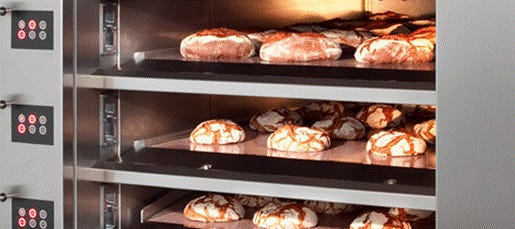
The combined system could prove particularly valuable in production environments with variable throughput, such as artisan bread lines or specialty formats where oven loading fluctuates.
Traditional ovens running at partial load waste a proportionally large share of their energy maintaining temperature in zones with no product.
Isothermal control, informed by real-time load data, could allow the oven to scale its energy demand accordingly, avoiding that waste. The counter-flow recovery block then captures whatever residual thermal energy leaves the system, feeding it back into pre-heating or auxiliary circuits.
4. Electrostatic Purification Coupled with Heat Pump Recovery
Provider: KMA Umwelttechnik GmbH
The Science
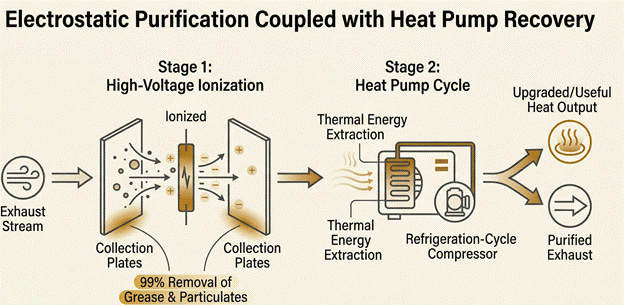
This technology integrates two distinct physical principles: high-voltage ionization (electrostatic precipitation) and vapor-compression thermodynamics (heat pump cycles).
In the first stage, a strong electric field ionizes airborne particles in the exhaust stream, causing them to migrate to collection plates. This process could remove up to 99 percent of suspended grease droplets and particulates.
The now-clean exhaust stream enters a heat pump that extracts its residual thermal energy, even at relatively low temperatures, and upgrades it to a higher, more useful temperature level via a refrigeration-cycle compressor.
This means that low-grade waste heat, which would otherwise be too cool to be useful, becomes recoverable.
Industrial Application
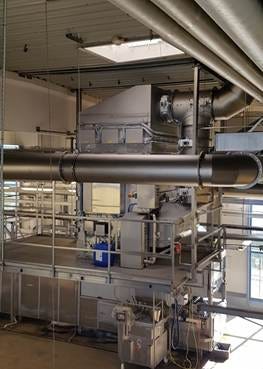
KMA’s approach could be especially relevant in plants where exhaust air quality is regulated, since the electrostatic stage simultaneously addresses both environmental compliance and energy recovery.
The purified, energy-extracted air can be safely discharged or recirculated.
The heat pump output might supply fermentation chambers, space heating, or warm water systems. Because the heat exchanger surfaces remain clean (fouling is removed upstream), long-term thermal performance should remain stable, avoiding the efficiency degradation typical of systems exposed directly to greasy oven exhaust.
5. Integrated Dual Heat Recovery and Electricity-Ready Design
Provider: MECATHERM (M-VT Oven)
The Science
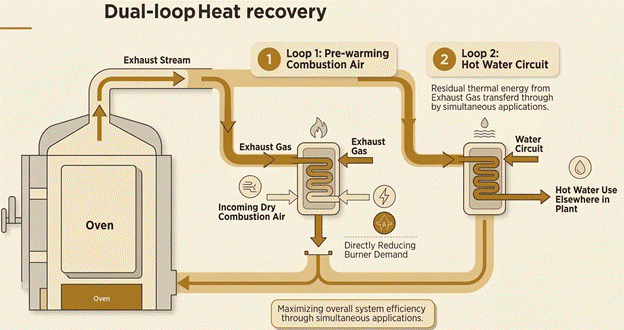
The M-VT system captures energy from exhaust streams for two simultaneous applications, a dual-loop configuration that maximizes overall system efficiency. The first loop recovers heat to pre-warm incoming dry combustion air, directly reducing burner demand. The second transfers residual thermal energy to a hot water circuit for use elsewhere in the plant.
Crucially, the design is also structured to be electricity-ready: its architecture allows the combustion system to be replaced with electric heating elements without significant structural redesign, anticipating a future transition to renewable-powered operation.
Industrial Application
Mecatherm estimates that the dual-loop recovery system may represent up to 19 percent of the oven’s total energy consumption redirected to productive use rather than lost to atmosphere.
The hot water output could feed proofer chambers (where precise temperature control is critical to fermentation), CIP cleaning circuits, or general plant heating.
The electricity-ready infrastructure positions a plant to eliminate emissions when renewable grid access or on-site generation becomes viable, without requiring a full capital replacement of the oven.
Thanks for reading Bakery Industry Insider! Subscribe for free to receive new posts and support my work.
Choosing the Right Technology
These five approaches are not mutually exclusive, and in a well-designed plant they might be combined. A few considerations may guide selection:
- Product type matters: Fatty or sugary baking environments may favor polymer exchangers (Heat Matrix) or the purification-first approach (KMA) to avoid fouling.
- Variable throughput lines could benefit most from isothermal control and adaptive recovery (WP Bakery Group).
- Plants with a clear path to full electrification may prioritize GEA’s eBake architecture or Mecatherm’s electricity-ready design.
- Operations seeking simultaneous compliance and efficiency might find the dual function of KMA’s electrostatic system particularly compelling.
- High water-use plants with fermentation or CIP demands could derive immediate value from the water-heating outputs of Mecatherm or Heat Matrix systems.
CFD (computational fluid dynamics) modeling has become an increasingly important tool for evaluating these choices.
Simulating airflow and temperature distribution within a specific oven geometry can help engineers optimize configurations before committing capital, and may reveal efficiency gains achievable simply by adjusting existing airflow patterns.
😊 Thanks for reading!
Sources
Industry Technologies
• Heat Matrix, Polymer Industrial Heat Recovery: https://www.heatmatrix.nl/en/industrial-heat-recovery/
• GEA eBake G1 Electric Tunnel Oven: https://www.gea.com/en/products/bakery-equipment/bakery-tunnel-ovens/e-bake-g1/
• WP Bakery Group, Energy Recovery Systems: https://www.wpbakerygroupusa.com/wp-energy-recovery/
• KMA Umwelttechnik, Baking Lines: https://www.kma-filter.com/industries/food-processing-industry/baking_lines/
• Mecatherm M-VT Oven Technology (Baking & Biscuit International): https://bakingbiscuit.com/bbi-2024-01-upstanding-oven-technology/
Academic and Technical References
- Cauvain, S.P. & Young, L.S. – Baked Products: Science, Technology and Practice. Blackwell Publishing, 2006.
- Cauvain, S.P. & Young, L.S. – Bakery Food Manufacture and Quality: Water Control and Effects (2nd ed.). Wiley, 2008.
- Zhou, W. & Hui, Y.H. (Eds.) – Bakery Products Science and Technology (2nd ed.). Wiley Blackwell, 2014.
- Davidson, I. – Biscuit Baking Technology: Processing and Engineering Manual (2nd ed.).
- Cauvain, S.P. & Young, L.S. (Eds.) – Technology of Breadmaking (2nd ed.).
- Edwards, W.P. (Ed.) – The Science of Bakery Products. RSC Publishing, 2007.
- Buehler, E. – Bread Science: The Chemistry and Craft of Making Bread. Two Blue Books, 2006.
- Jagarlamudi, L. – Bakery and Confectionery Products: Processing, Quality Assessment, Packaging and Storage Techniques.
- Mathuravalli, S.M.D. – Handbook of Bakery a
For more insights on these industry topics, check out our analyses on Patented Texturizing Pea Protein Decouples Bakery Margins from Volatile Egg Prices, The Variable That May Be Destroying Your Gluten Network (It’s Not Over-Mixing), and New enzyme – hydrocolloid complex replaces 90% of vital wheat gluten in composite flour applications.