From Pneumatics to Electromagnets: Cutting Pan Handling Costs in Industrial Bakeries
How fully electric pan stacking and unstacking technology is reducing operational costs, extending equipment life, and improving line reliability.
In large-scale bread and roll production, baking pans are among the most capital-intensive assets on the line, and among the most overlooked.
A single bakery operating at full capacity can cycle thousands of pans per shift, each subject to mechanical stress, thermal fatigue, and glazing wear.
Over time, poorly managed pan flow translates directly into increased maintenance frequency, premature pan aging, and unplanned downtime.
Traditional pneumatic pan stackers and unstackers have served the industry for decades, but their limitations are becoming harder to ignore. Compressed air systems introduce noise, maintenance complexity, and a tendency toward abrupt mechanical action, conditions that accelerate wear on both the equipment and the pans themselves.

INSIGHT: In bakeries operating three shifts, unplanned downtime attributable to pan handling equipment can represent significant labor and throughput losses, often exceeding $80,000 per year when compared to more reliable electric alternatives.
The Technical Challenge: Balancing Speed, Precision, and Pan Integrity
Pan stacking and unstacking sits at a critical junction of the production loop. The unstacker must feed individual pans to the panning station at line speed (up to 40 units per minute) while the stacker collects empty pans after depanning and organizes them onto pan trucks for return. Any misalignment, jam, or mechanical surge in this circuit creates a ripple effect across the entire line.
The core challenge is exerting sufficient force to handle heavy pans reliably (including ferromagnetic bread pans, combo pans, and lids) without introducing the kind of impact stress that leads to glazing damage or structural deformation. Pneumatic cylinders, while powerful, offer limited force modulation. The result is often a trade-off between throughput and pan longevity.
A Fully Electric Architecture Built Around the Pan, Not Around Air
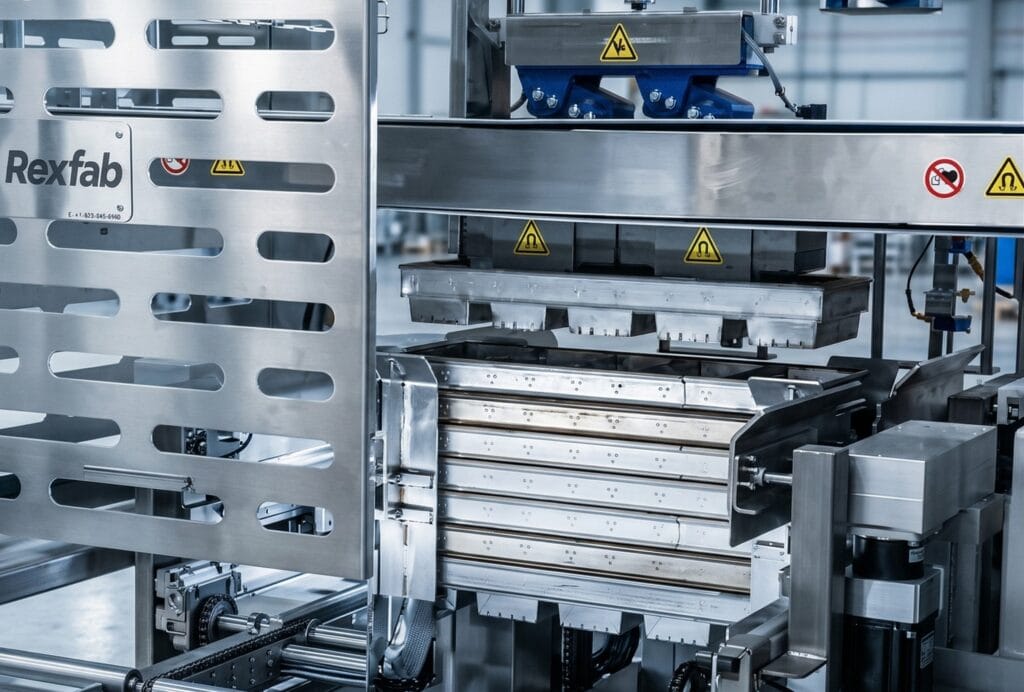
The Rexfab Pan Stacker–Pan Unstacker (PSPU) system addresses this problem through a fully electric design that replaces compressed air with controlled electromagnetic force. The core of the system is an electromagnetic head axis, servo-driven, which applies variable, programmable force to grip and move pans with precision at every stage of the stacking and unstacking cycle.
Compatible with ferromagnetic pans and lids for bread, rolls, and combo formats, the PSPU handles pan dimensions ranging from 7.5 to 42 inches in length and up to 5.5 inches in height. Both easy-way (EW) and hard-way (HW) orientations are supported, in open-side-up (OSU) or open-side-down (OSD) configurations.
Technical Specifications
- Capacity: Up to 40 pans per minute (model-dependent)
- Pan size range: Min. 21 × 7.5 in. / Max. 42 × 34 in. / Max. height 5.5 in.
- Stack capacity: Max. 830 lb per stack; max. combined stacks weight 2,500 lb; max. stack height 60 in.
- Noise level: < 85 dBA at 1 m
- Safety standard: ANSI B11.19-2019 and CSA Z432:23; Control Panel UL certified
- Controller: AB CompactLogix 5380 with AB Panel View Plus 7 Touch Screen (10 in.)
- Motorization: SEW-Eurodrive AC gearmotors, AB Kinetix VP servomotors, Duff & Norton and Festo linear actuators
- Conveyor belts: Intralox®
Servomotor Control and Automatic Adjustment
Servomotors govern the position, speed, and acceleration of all indexing movements, enabling smooth, repeatable pan transfer without the abrupt motion characteristic of pneumatic actuation. Recipe-related dimensional adjustments are executed automatically; additional configuration is available via the HMI touch panel or manual input.
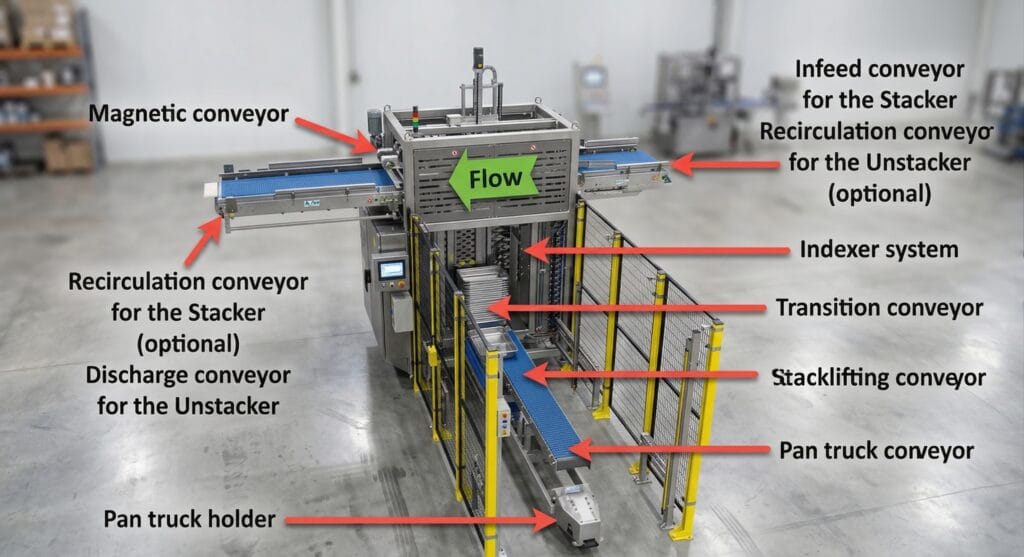
Electrical actuators manage automatic adjustment for varying pan dimensions, supporting width adjustment up to 12 inches and fixed guide tolerances of ±0.25 inches. The system accommodates left- or right-side operation and can be configured with or without a recirculation conveyor between the stacker and unstacker units.
Safety Architecture: Two-Level Zone Design
The PSPU incorporates a two-level safety zone that allows operator access to protected areas of the machine without halting production. The safety enclosure uses Troax® panels and PBS (push-button stations), with polycarbonate panels secured by quarter-turn latches, and interlocked conveyor locks for maintenance positioning.
The risk assessment meets Cat. 3 Pld classification. On the food safety side, the elimination of compressed air and pneumatic components reduces the risk of metal shavings contaminating the product stream, a concern often underestimated in pan handling design.
Total Cost of Ownership: Quantifying the Operational Case
Rexfab’s TCO analysis, based on real data from systems with over five years of operational history, identifies five categories of measurable savings against conventional pneumatic equipment:
| Category | Annual Savings (USD) |
| Pan-Related Savings | $53,978 |
| Energy Savings | $8,507 |
| Spare Parts Savings | $15,000 |
| Downtime Savings | $84,000 |
| Installation & Startup Savings | $8,520 |
| Total Operational Savings | $170,005 |
The largest contributor is downtime avoidance ($84,000/year), reflecting the reliability differential between electric and pneumatic systems at production-scale cycling rates. Pan-related savings ($53,978/year) stem from gentler handling, 25% fewer glazing cycles, 10% reduced pan aging rate, and 90% fewer pan rebuilds.

INSIGHT: Across five savings categories, the PSPU generates over $170,000 in quantifiable annual operational savings compared to pneumatic equivalents, a figure that, depending on capital cost and installation context, can yield a compelling return on investment within a few years of deployment
Retrofit Compatibility and Configuration Flexibility
For bakeries not replacing an entire line, Rexfab offers units designed for retrofitting into existing layouts with minimal footprint impact. The system can be converted between stacker and unstacker functions, and optional configurations include motorized indexer walls, motorized pan guides, motorized stack guides, motorized stack stoppers, and a rib roller on the recirculation conveyor for lids.
The plug-and-play installation eliminates compressed air piping (saving approximately $1,800 on installation alone) and startup support requirements are substantially reduced versus pneumatic systems.
About The company

35 Years of Experience in Bakery Automation
Rexfab, established in 1990, designs and manufactures automated downstream handling systems for commercial bakeries in North America. The company’s engineering focus spans conveyor systems, pan handling, and depanning equipment, with an emphasis on sanitary design, operational reliability, and total cost of ownership. Rexfab is headquartered in Sherbrooke, Québec, with a U.S. office in Erlanger, Kentucky.
Performance Automated solutions that outperform safety and sanitation standards, delivering dependable, steady productivity.
Committed Partnership More than equipment, a partner from conception to installation and through the full lifespan of the system.
Data • Automation • Reliability • Safety The four pillars shaping Rexfab’s vision for the future of the baking industry.
Canada: 4845 Robert-Boyd, Sherbrooke, QC J1R 0W8 USA: 2791 Circleport Dr, Erlanger, KY 41018 Toll-free: +1 877 303-4490 | Office: +1 819 846-4490 | info@rexfab.com | rexfab.com
References
1. Rexfab. Pan Stacker–Pan Unstacker (PSPU), Technical Specifications and Features. Rexfab Inc., 2024.
2. Rexfab. Total Cost of Ownership (TCO) Analysis, Rexfab Pan Stacker–Pan Unstacker. Rexfab Inc., 2024.
3. Industry background on stacking, destacking, and magnetic conveying in industrial bakeries. BII Research Compilation, 2024.