Fried vs. Baked, Palm Oil vs. Coconut: Can Industrial Donuts Make the Switch?
Consumers increasingly demand healthier products, and donuts are no exception. Coconut oil looks like a promising clean-label swap for palm oil, with a more favorable nutritional profile. But industrial reality tells a different story: it underperforms structurally at scale. Baking with impingement technology may reduce calories, though it still cannot fully match what frying delivers.
Frying Chemistry: How Oil Degrades Under Continuous Production Stress
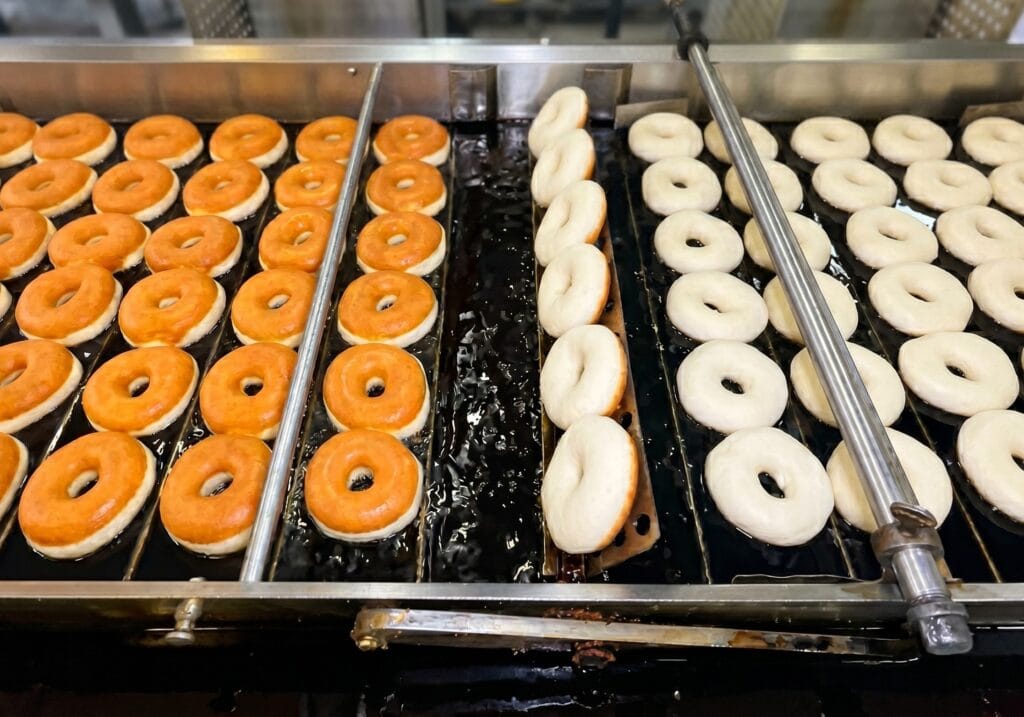
The lipid medium in a donut production line assumes a critical dual role, acting as the primary thermal conductor and becoming an ingredient that constitutes approximately 22% of the finished product’s weight. The industry massively adopted refined palm oil and its fractions, like olein and stearin, due to their balanced triglyceride composition dominated by palmitic acid.
This molecular structure provides exceptional resistance to continuous stress, limiting chemical vulnerability compared to highly unsaturated liquid formulations, such as soy or canola oils, which accelerate rapid auto-oxidation.
Operating a vat at chronically high temperatures triggers unavoidable degradation processes. The alteration of fat molecules generates compounds detrimental to food safety and the thermal matrix’s efficiency:
Continuous Fryers and Fluid Purification
To mitigate the polymerization kinetics, plants integrate continuously regulated fryers linked to dilution circuits. The process’s success rests on the design and the metric known as the turnover rate, defined as the time required for the oil volume absorbed by the fried product to equal the vat’s total volumetric capacity. The optimal operational range for this rate could be between 5 and 10 hours.
Maintaining low turnover rates, where oil remains in the line for several days without being replaced, inexorably exacerbates oxidative degradation. A rapid turnover closely matches the product’s absorption capacity with constant injections of fresh oil, lowering TPC concentration and operating as an uninterrupted dilution purge.
To prevent pyrolytic carbonization and PAH molecular growth, systems rely on external fluidic purification loops. This mechanism usually operates in continuous synergistic stages:
Automated extractors expels deteriorated oil when it surpasses safety thresholds, officially classifying it as Used Cooking Oil (UCO). Due to its minimal moisture and insignificant presence of residual solids, this high-grade industrial UCO is pumped into hermetic collection cisterns and sold directly for commercial Biodiesel production, generating massive direct capital returns for bakery manufacturers.
Lipid Alternatives: Why Switching Fats Is Not Simple
Dietary guidelines push for clean label and healthier formulations. Seeking functional alternatives, refined coconut oil gained popularity, driven by its saturation with medium-chain fatty acids like lauric acid.
Although coconut oil provides high oxidative stability at elevated temperatures and offers a more nutritionally favorable profile, its structural functionality post-frying is highly deficient. Migrating from one lipid to another could radically alter post-cooling performance, seriously compromising the surface and palatability of the donut.
Post-frying functional behavior depends on the Solid Fat Content (SFC) profile. Palm oil, acting as a plastic shortening, exhibits a staggered polymorphic crystallization profile, stabilizing beta-prime crystals that trap air and ensure the emulsion. It maintains a firm 54% solid fat at 10 °C and preserves nearly 13% even under 25 °C ambient conditions, creating a ductile yet dry film on the crust that blocks crumb moisture and anchors heavy fondant coatings.
In marked contrast, pure coconut oil crystallizes in a brittle and rigid manner at low temperatures, but collapses abruptly into a liquid phase upon exceeding 25 °C. If the distribution or commercial display line were to encounter warm temperatures, the lipid layer would transition abruptly and induce a lethal, chronic exudation defect. Capillary action would then drive the liquid oil outward, softening the crispy exterior, ruining packaging materials, and causing glazes to crack and liquefy irreversibly. Overcoming these instabilities would require complex handling, in addition to tripling or quadrupling formulation costs.
Baking Without Frying?
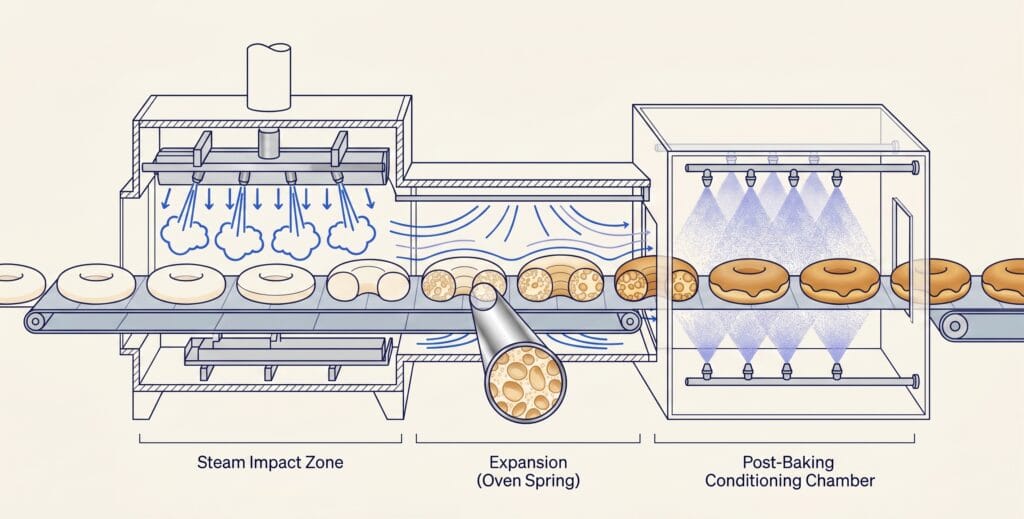
Achieving a rapid oven spring in leavened dough without submerging it in a massive thermal conductive fluid presents a high hurdle, as traditional dry convection quickly consolidates a rigid surface crust, trapping the product into a dense, flattened cylinder. Current resolution combines specialized sequences:
Impingement Ovens
They deploy pressurized vectors or highly focused air columns at extremely high speeds over the food’s faces. This convection geometrically increases heat transfer, breaking the passive perimeter air and rapidly pre-gelatinizing the exterior surface.
Vapor Micro-Injection Conditioning
Ovens ballistically inject pressurized water vapor during the start of the heat cycle. The vapor collides and condenses, drastically increasing the crust’s actual temperature without drying it, creating a compliant hydrolyzed varnish that facilitates massive volumetric stretching driven by the yeast’s carbon dioxide, simulating the frying vat’s reaction.
Enzymes like glucose oxidase reinforce the internal cell wall by crossing disulfide bridges, shielding pores against collapse.
Capillary Oil Aerosols (Enrobing and Micro-Spraying)
Upon exiting the oven, the hot bread immediately enters a capillary aerosol tunnel equipped with adjustable pneumatic nozzles that apply a dense, pressurized microscopic mist of fat alloys.
Depositing a minuscule fraction of oil, contributing only between 2% and 5% of the final product weight exclusively on the external surface, this micro-spraying replaces the heavy caloric load of frying while achieving critical functions:
Conclusion: Fried or Baked?
While coconut oil presents an optimal nutritional profile, palm oil remains functionally unparalleled in industrial applications. How the sector will ultimately satisfy this consumer demands remain an ongoing subject of research. Regarding alternative baking technologies, although they effectively reduce the product’s final caloric load, this reduction often comes at the expense of authentic palatability and increased retail costs.
However, the market is expansive enough to accommodate both paradigms: a specific niche willing to accept these compromises for a healthier alternative, and a traditional demographic loyal to the classic fried flavor. Both methodologies are valid within their respective domains, and neither should necessarily replace the other; each product effectively serves its dedicated niche.
😊 Thanks for reading!
Sources:
- Donut Frying Insights | Cargill, accessed May 6, 2026, https://www.cargill.com/doc/1432128530434/donut-frying-insights-report.pdf
- Influence of frying conditions on quality attributes of frying oils …, accessed May 6, 2026, https://pmc.ncbi.nlm.nih.gov/articles/PMC12212271/
- Coconut Oil vs Palm Oil Composition | PDF | Fat | Saturated Fat – Scribd, accessed May 6, 2026, https://www.scribd.com/document/381497847/Chemical-Compostions
- Coconut Oil and Palm kernel Oil, accessed May 6, 2026, https://www.soci.org/-/media/files/conference-downloads/2007/sci-cairo-conference-mar-07/sahasranamam.ashx
- Kinetics of forming polar compounds in frying oils under frying practice of fast food restaurants | Request PDF – ResearchGate, accessed May 6, 2026, https://www.researchgate.net/publication/333987285_Kinetics_of_forming_polar_compounds_in_frying_oils_under_frying_practice_of_fast_food_restaurants
- Acrylamide in starchy foods subjected to deep-frying, 20 years after …, accessed May 6, 2026, https://pmc.ncbi.nlm.nih.gov/articles/PMC10904932/
- Kinetics for the distribution of acrylamide in French fries, fried oil and vapour during frying of potatoes | Request PDF – ResearchGate, accessed May 6, 2026, https://www.researchgate.net/publication/303423899_Kinetics_for_the_distribution_of_acrylamide_in_French_fries_fried_oil_and_vapour_during_frying_of_potatoes
- Formation of Polycyclic Aromatic Hydrocarbons (PAHs) in Thermal Systems: A Comprehensive Mechanistic Review | Energy & Fuels – ACS Publications, accessed May 6, 2026, https://pubs.acs.org/doi/10.1021/acs.energyfuels.4c03513
- Industrial Deep Fat Frying – Oklahoma State University Extension, accessed May 6, 2026, https://extension.okstate.edu/fact-sheets/print-publications/fapc-food-and-agricultural-products-center/industrial-deep-fat-frying-fapc-176.pdf
- Edible Oil Separator: Working, Components, Applications & FAQs, accessed May 6, 2026, https://cbsseparators.com/edible-oil-separator
- Industrial Used Cooking Oil Florida | $286k Profit Case Study, accessed May 6, 2026, https://greaseconnections.com/get-paid-for-industrial-used-cooking-oil-in-florida/
- Applications of NMR Spectroscopy – ResearchGate, accessed May 6, 2026, https://www.researchgate.net/profile/Xiaoyang_Sun6/publication/299407082_Applications_of_Low-Field_Pulsed_Nuclear_Magnetic_Resonance_Technique_in_Lipid_and_Food/links/5a8d62f70f7e9b27c5b4ad95/Applications-of-Low-Field-Pulsed-Nuclear-Magnetic-Resonance-Technique-in-Lipid-and-Food.pdf
- Wholesale Refined Palm Oil: A Complete Guide from a Trusted, accessed May 6, 2026, https://dthcompanyltd.com/wholesale-refined-palm-oil/
- Image analysis of structural changes in dough during baking | Request PDF – ResearchGate, accessed May 6, 2026, https://www.researchgate.net/publication/248558562_Image_analysis_of_structural_changes_in_dough_during_baking
- Effect of the amount of steam during baking on bread crust features and water diffusion | Request PDF – ResearchGate, accessed May 6, 2026, https://www.researchgate.net/publication/230605120_Effect_of_the_amount_of_steam_during_baking_on_bread_crust_features_and_water_diffusion
- US20070014891A1 – Dough compositions and related methods …, accessed May 6, 2026, https://patents.google.com/patent/US20070014891A1/en
- Bakery & Confectionery Processing Spray Nozzles | NozzlePro, accessed May 6, 2026, https://nozzle-pro.com/pages/food-beverage-bakery-confectionery
- Bakery and Confectionery Products – Processing, Quality Assessment, Packaging and Storage Techniques | PDF | Breads | Flour – Scribd, accessed May 6, 2026, https://www.scribd.com/document/669086134/Bakery-and-Confectionery-Products-Processing-Quality-Assessment-Packaging-and-Storage-Techniques
- Edible Films and Coatings for Food Applications – ResearchGate, accessed May 6, 2026, https://www.researchgate.net/profile/Guadalupe-Olivas/publication/227213968_Edible_Films_and_Coatings_for_Fruits_and_Vegetables/links/0c9605314a19f29b3c000000/Edible-Films-and-Coatings-for-Fruits-and-Vegetables.pdf
For more insights on these industry topics, check out our analyses on Gentle Handling: Technology to Prevent Cookie Breakage, Stuffed Crust Pizza Production: Maintaining the Artisanal Touch at Scale, and Molecular Butter: The Future of Bakery Lipids.