Dough Rounders: Matching the Machine to Your Production Needs
Rounding, technically referred to as dough rounding or pre-shaping, is one of the most complex and frequently underestimated steps in an industrial bread line. Beyond giving the dough piece a spherical geometry, its primary objective is the controlled creation of surface tension: a continuous, smooth, elastic outer skin formed by the same gluten network that…
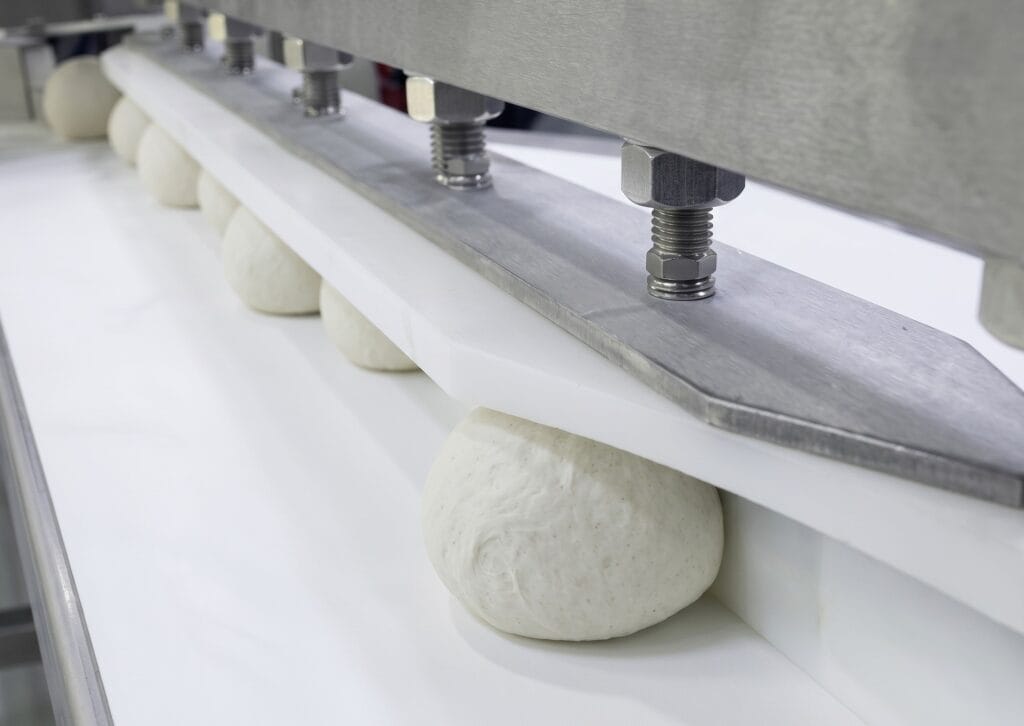
Rounding, technically referred to as dough rounding or pre-shaping, is one of the most complex and frequently underestimated steps in an industrial bread line. Beyond giving the dough piece a spherical geometry, its primary objective is the controlled creation of surface tension: a continuous, smooth, elastic outer skin formed by the same gluten network that has been stretched and aligned concentrically over itself.
This viscoelastic membrane acts as a semi-permeable barrier. Its function is to retain the gases, mainly carbon dioxide and ethanol vapor, produced by yeast metabolism during the bench rest and final proofing phases that follow. Insufficient surface tension leads to lateral collapse and dense crumb; excessive mechanical stress tears the skin, causes premature degassing, and results in irreversible structural failure before the oven.
This process also serves three additional functions:
The industrial challenge is the diversity of formulations now required by the market. Hydration levels ranging from 45% in standard white bread to 90% in artisan-style ciabattas, combined with variable fermentation times and the use of sourdough cultures, demand completely different mechanical stress profiles.
Applying the wrong rounding technology for a given dough rheology may result in sticky masses that adhere to contact surfaces, triggering line stops and reducing Overall Equipment Effectiveness (OEE).
Traditional Fixed-Path Rounding Technologies
Traditional rounding machinery is based on the concept of kinematic confinement: the application of consistent force to move a dough piece through a physically predetermined and restrictive space, using a combination of linear and rotational surfaces. The critical variables include belt or cone rotation speed, raceway gap, track length, angle of incidence, and surface friction coefficients.
Five distinct mechanical typologies have shaped the industry for decades, each suited to a different dough profile and production objective.
Conical Rounders
The conical rounder is the industrial standard for tin bread, white bread, and standard burger buns. Its core design uses a wide-base cone mounted on a vertical rotating shaft, surrounded by a concave spiral track fixed to the machine frame.

The dough piece rises along the spiral through the friction differential between the rotating cone and the stationary track, covering up to 4.7 meters of travel path on advanced models.
This configuration produces high friction and high mechanical stress, making it optimal for rigid or low-to-medium hydration doughs, typically below 65% water content. Key operational considerations include:
Cylindrical Rounders
The cylindrical rounder is the direct evolution of the conical design. By replacing the cone with a cylindrical or hybrid drum (as in the Tallround model by Royal Kaak), the machine achieves a significantly longer vertical travel path for the same floor footprint. This extended track distributes mechanical stress over a longer time window, reducing peak shear forces.

The primary benefit of the cylindrical geometry is seam quality: the longer rounding path ensures a fully continuous and hermetic bottom closure. An improperly sealed seam could allow gases to escape asymmetrically during oven spring, producing crust ruptures at the base. Notable operational features include:
V-Belt Rounders
Consumer demand for clean-label products, long-fermented breads, sourdough, and high-hydration doughs pushed the industry toward gentler mechanical handling. The V-belt rounder, classified as a low-stress system, eliminates rigid stationary tracks entirely. Two longitudinal belts, typically felt or synthetic-coated, are arranged in a V-shaped channel. Each belt is driven independently by a variable-frequency motor.

The differential speed between the two belts induces a tangential rotation in the dough piece without compression. This approach could preserve the open cell structure formed by the yeast, making it the only traditional machine viable for doughs from 65% up to 90% hydration. Key operational data:
Drum and Pocket Rounders
When the plant strategy centers on high-volume uniform production of burger buns, hot dog rolls, pre-frozen pizza bases, or industrial donuts, the metric that overrides all others is volumetric consistency at extreme speed. Drum and pocket rounders, also known as continuous divider-rounders, integrate the division and rounding stages into a single compact mechanical block.

Dough is fed from a bulk hopper into a volumetric chamber, where pneumatic or vacuum-assisted systems portion it into small cylindrical pockets on a rotating drum. Actuators then induce a vigorous oscillatory circular motion within the confined space, achieving spherical geometry in fractions of a second. Advanced vacuum-assisted division systems by @WP Bakery Group, for example, allow excess air to escape during extrusion, reducing compression force and providing a surprisingly gentle treatment despite high throughput.
Production volumes are the defining feature of this technology:
Flagship high-capacity systems like the Koenig Rex series operate with up to 14 rows, achieving a massive output of up to 50,400 pieces per hour for lightweight formats (22 to 180 grams).
Eccentric and Bar Rounders
After a bench rest phase in overhead proofers, enzymatic and yeast activity re-inflates the gluten network and weakens its shear resistance. Applying conical friction at this point would destroy the mature alveolar structure. The eccentric rounder addresses this constraint by simulating the biomechanical gesture of a skilled baker’s cupped hand.
The dough piece moves on a flat conveyor belt. Above it, a structure of angled bars, guide channels, or inverted cups performs a circular oscillatory motion driven by an off-center axis. The combined vector of linear base movement and overhead vibration recreates the artisan hand-shaping technique with minimal secondary friction. Performance highlights:
The Technological Frontier: Robotic Rounding Systems
Despite advances in tribological coatings such as nano-ceramic alloys and multi-layer fluorocarbon polymer depositions that prevent adhesion without altering the seam closure, fixed-path technologies face a structural limitation: hard physical components restrict the operational spectrum. Changing formulations may require significant downtime to reconfigure hardware. Robotic rounding systems were developed to eliminate this bottleneck.
Zero-Stress Kinematics with End-of-Arm Tooling (EOAT)
The leading example of this paradigm shift is the RONDObot by Swiss manufacturer RONDO, alongside systems such as the Radini bread processing module developed by Rademaker BV. Instead of dragging dough through meters of spiral tunnels, these installations use fast kinematic robotic arms, frequently in Delta or multi-axis configurations, with an interchangeable tool mounted at the terminal point.

For rounding, the End-of-Arm Tooling takes the form of an inverted cup. When a dough piece, cut stress-free by a traveling guillotine, advances on the conveyor, the robot descends its tool with micrometric precision and executes a multi-phase rounding process that simulates artisan hand-shaping. The PLC controls four kinetic variables in real time:
The transformative operational impact is the instant software changeover. Moving from a firm 100-gram burger bun to an 800-gram rustic sourdough loaf no longer requires stopping the line to reconfigure V-barriers, swap heavy drums, or interrupt dough supply. A new recipe is selected, the robot instantly adapts its eccentric cycle, and an automatic tool-changing system swaps the cup size in seconds without human intervention.
Output capacity may range from 1,100 to 1,800 kg per hour per module, scalable to 7,200 pieces per hour for 150-gram formats using double or triple rounder configurations.
3D Computer Vision and Predictive Quality Telemetry
Robotic manipulators acting on amorphous biological material in constant motion require absolute positioning systems. Leaders such as Rademaker and Royal Kaak integrate arrays of cameras and lasers under 3D vision protocols upstream of the rounding station. The sensor matrix scans the moving dough surface and, through self-learning algorithmic software platforms such as Rademaker BV ‘s SENSURE environment, builds a topographic profile in milliseconds that determines:

If the software detects an irregularity, the robot’s eccentric trajectory compensates to guarantee final sphericity. Any piece falling outside volumetric tolerance margins is automatically rejected or bypassed by pneumatic systems without interrupting the line. This aborts the processing of defective units before they consume baking energy and packaging materials downstream.
😊 Thanks for reading!
Sources:
- bakingbiscuit.com, Physical, chemical and rheological changes in bread during dough mixing, Baking & Biscuit
- rondo-online.com, RONDObot, RONDO
- rademaker.com, Bakery Robotics, Rademaker
- kaak.com, Dough rounders and Scoring systems, Royal Kaak.
- wp-l.de, Dough dividing and rounding machine, WP Bakery Technologies
- koenig-rex.com, Industrie Rex V AW EC & Ceres 2.2, Koenig Bakery Systems
- empirebake.com, Why a Dough Rounder is a Must-Have for High-Volume Bakeries, Empire Bake
- ortuna-bakery.com, Divider and rounder Magnus, Fortuna Bakery
- bongard.fr, V-belt rounder BLP, Bongard
- dev.bakerpedia.com, Dough Rounding, BAKERpedia
For more insights on these industry topics, check out our analyses on How Corn Tortilla Production Works: Key Process Steps and Quality Factors, Autonomous Pan Washing for Industrial Bakeries, and Fried vs. Baked, Palm Oil vs. Coconut: Can Industrial Donuts Make the Switch?.