How English Muffins Get Their Nooks and Crannies: Hydration, Griddle Baking, and Fork-Splitting
Producing a consistent English muffin at 20,000+ pieces per hour requires managing an unusually wet dough through griddle contact baking, a process where hydration control, alveolar coalescence, and fork-splitting mechanics determine whether the final product holds butter or repels it.
Base Formulation and Ultra-High Hydration
Industrial English muffin production typically begins with a lean, straight-dough formulation built around high-strength wheat flour (12.5% to 14% protein), yeast (2% to 4%), salt (1.5% to 2%), sugar or dextrose (1.5% to 3%), and chemical leaveners, most commonly sodium bicarbonate paired with a leavening acid, to boost gas evolution once the dough contacts the hot griddle plate. Coarse cornmeal or farina is applied as a surface dusting agent that prevents adhesion to the metal cooking surfaces and contributes to the product’s characteristic outer texture.
In clean label programs aiming to replace synthetic leavening phosphates, formulators may substitute natural organic acids such as cream of tartar (potassium bitartrate), citric acid, or pre-fermented sourdough cultures as the acid component. Encapsulated leavening systems, where the acid or bicarbonate particles are coated with vegetable-based lipids, can also help control reaction timing by delaying gas release until the dough reaches griddle temperature, reducing the risk of premature degassing during mixing and floor time.
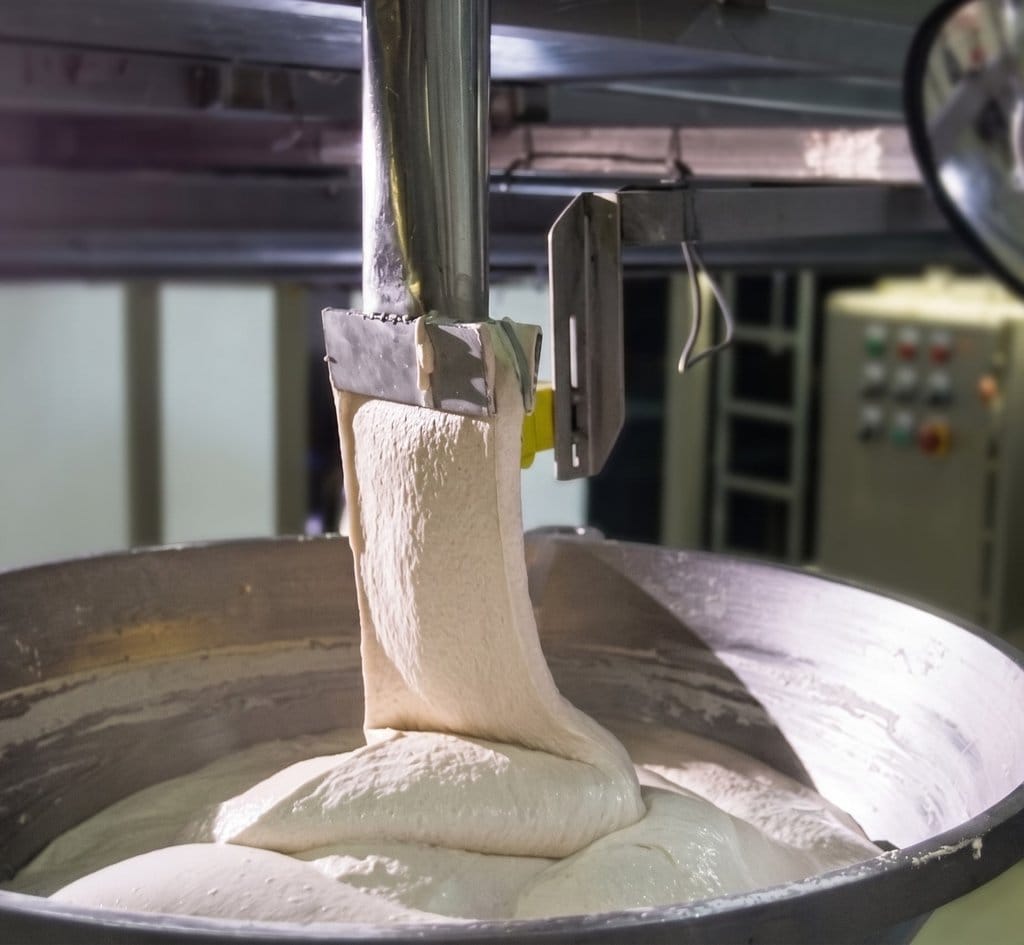
English muffin dough is a highly hydrated system, typically running between 75% and 85% water (baker’s percentage), with some formulations reaching 88% when vital wheat gluten is added to reinforce the protein matrix. For comparison, standard pan bread operates in the 60% to 62% range. This difference fundamentally changes how the dough handles at every stage of the line.
At these water levels, free moisture acts as a powerful plasticizer of the gluten network, sharply reducing apparent viscosity and yield stress.
The resulting “slack dough” is too soft and adhesive for conventional volumetric piston dividers, which could tear its structure or jam entirely.
Industrial lines manage this challenge with specialized equipment:
Alveolar Coalescence and Crumb Structure
The open, irregular crumb characteristic of the English muffin results from deliberate alveolar coalescence, where adjacent gas cells merge into larger, connected cavities rather than remaining small and isolated as in fine-crumb breads.
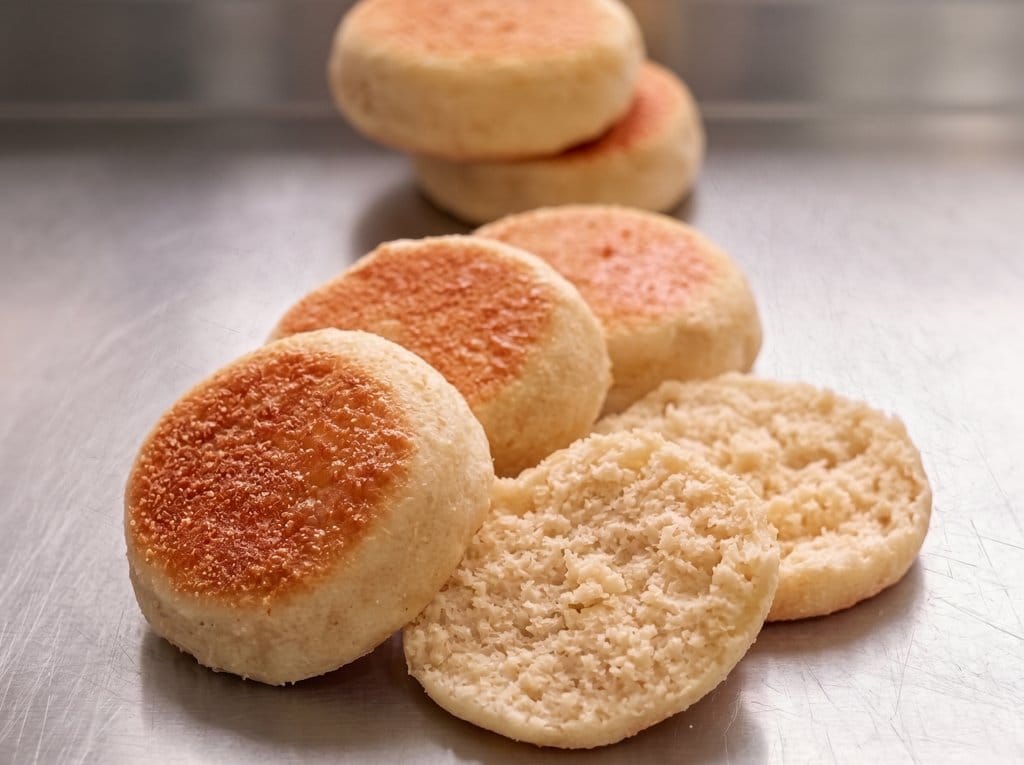
Several formulation strategies encourage this controlled structural breakdown:
The net effect is a dough with low tenacity and very high extensibility, where the balance between elastic modulus and viscous modulus favors controlled cell wall rupture during proofing and baking.
Griddle Baking: Contact Heat and Steam Flash
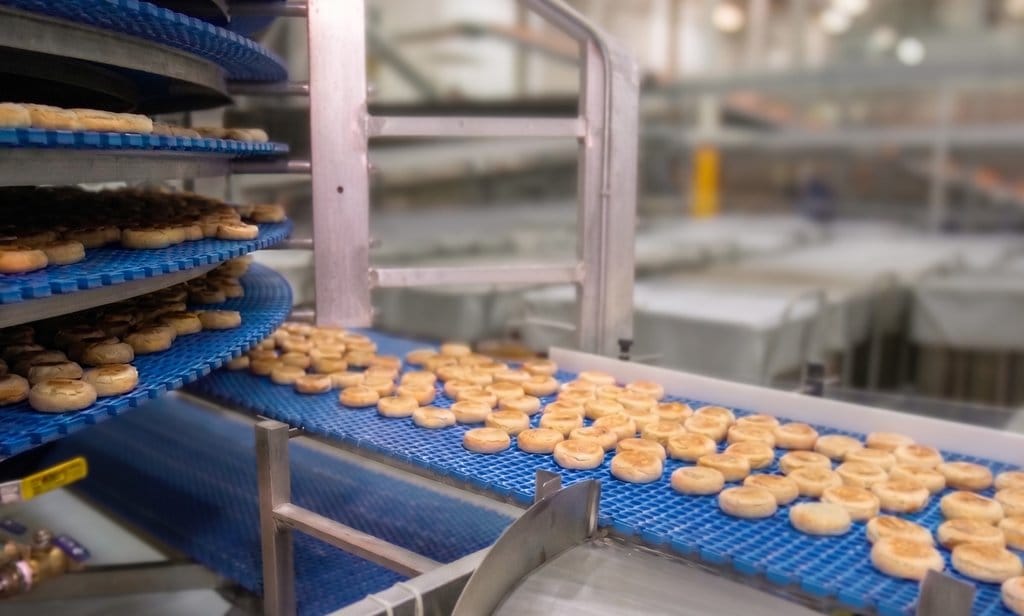
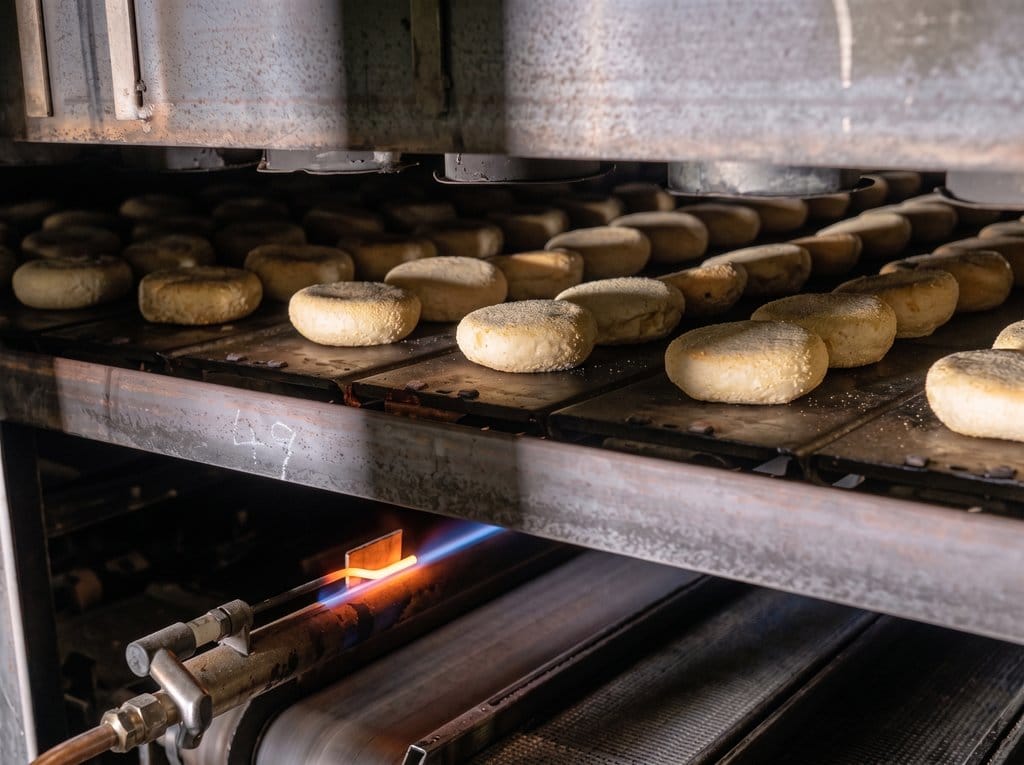
Unlike conventional convection ovens, English muffins bake by direct conductive contact on heated iron or steel plates at 200°C to 245°C, confined within metal cups roughly 98 mm in diameter and 30 mm tall. This geometry creates the conditions for rapid steam generation inside the dough mass.
The baking cycle typically runs 7 to 10 minutes total, split into two phases:
1. Bottom contact (3.5 to 4 minutes)
Free water at the dough base tends to vaporize almost instantly on contact with the hot plate. Because the piece is enclosed within its metal cup, the superheated steam can only escape upward through internal channels of least hydraulic resistance, inflating existing pores and frequently fusing them together.
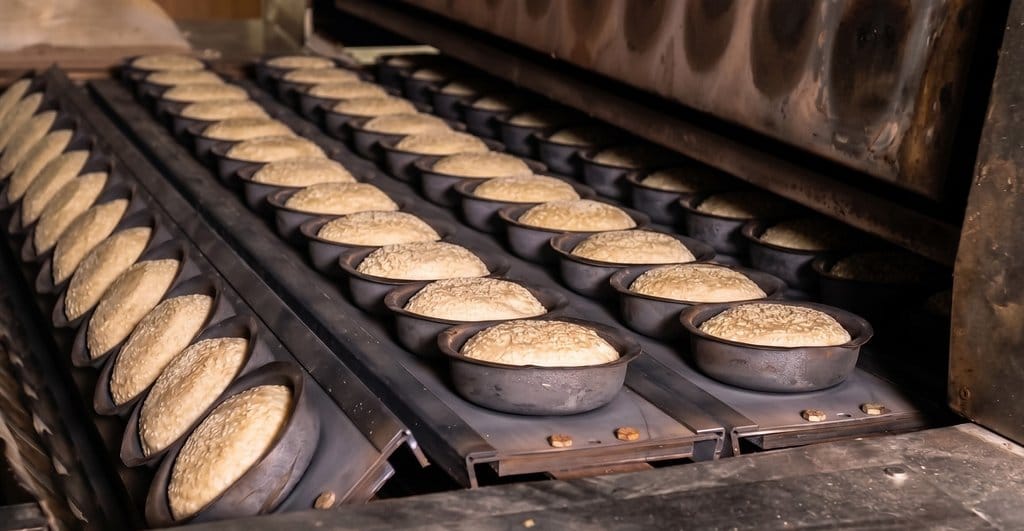
2. Flip or top plate descent (3.5 to 4 minutes):
The piece is mechanically inverted 180°, or a heated top plate descends, to toast the second face. This typically produces two flat, toasted surfaces with a soft, pale lateral band.
Proofing conditions before griddle loading also differ from pan bread. English muffin proofers typically operate at 45°C to 55°C but at only 50% to 55% relative humidity, deliberately lower than the 80% to 85% used for sandwich bread. This forms a light surface film that prevents the dough from sticking to the metal cooking plates.
Fork-Splitting and Surface Texture
Once cooled, the muffin passes through a dedicated scoring and splitting station. Industrial lines rely on sets of metal tines or pronged rings that penetrate radially and tear the crumb along its natural lines of weakness rather than slicing across it.
Specialized manufacturers build combined scorer-splitter-slicer units that can process up to 300 pieces per minute using four rings of polymer-coated fork tines. The coating prevents crumb adhesion to the metal, and the rings can retract to switch to flat blade cutting when a customer requires it.
The torn surface exposes the peaks and valleys of the cavernous crumb, where butter and other spreads can lodge by capillary action, a texture feature consumers and food service operators identify as essential to the product.
😊 Thanks for reading!
Sources:
- BAKERpedia, English Muffins | Baking Processes: https://bakerpedia.com/ingredients/english-muffins/
- BAKERpedia, Chemical Leavening Formulation: https://bakerpedia.com/ingredients/chemical-leavening/
- Ed Finkel, Flexible griddles and fryers for snacks and frozen breakfast foods, Snack Food & Wholesale Bakery: https://www.snackandbakery.com/articles/89972-flexible-griddles-and-fryers-for-snacks-and-frozen-breakfast-foods
- AMF Bakery Systems / Making.com, English muffin production system: https://making.com/equipment/english-muffin-production-system
- Clock Associates, English Muffins: https://www.clockassociates.com/main-navigation/products/english-muffins
- Clock Associates, English Muffin Line (DP-Oven): https://www.clockassociates.com/main-navigation/products/english-muffins/english-muffin-line
- Clock Associates, Fork Splitters: https://www.clockassociates.com/main-navigation/products/english-muffins/english-muffin-scorers-splitters-slicers
- Oshikiri Machinery Ltd., Products Line [‘MUFFIN’ Line]: https://www.oshikiri.com/line/muffin/0muffin.html
- Dugan Allan Rucker, Louis Albert Wollermann, Jack Kern Krum, Porous yeast leavened dough product (Patent US4109023A): https://patents.google.com/patent/US4109023A/en
- Nandini Roy Choudhury, Global English Muffins Market, Future Market Insights: https://www.futuremarketinsights.com/reports/english-muffins-market