Scaling Artisan Bread Without Losing Its Soul: The Engineering Behind the Crust
Consumer demand for bread that looks, feels, and tastes “artisanal” has grown steadily for over a decade. Market research consistently shows that shoppers are willing to pay a premium for a thick, crackling crust, an open and irregular crumb structure, and the complex flavor profile that comes with long fermentation. For industrial bakeries, meeting this demand at volume is one of the most technically demanding challenges on the production floor.
The difficulty is not a lack of effort or investment, it is physics.
The properties that define an artisan loaf are deeply intertwined with the specific thermal conditions of traditional hearth baking: intense, direct bottom heat; controlled steam in the early baking phase; and precise, programmable transitions between zones.
Standard high-speed industrial processes were not designed to replicate these conditions. They were designed to maximize throughput.
What Actually Gets Lost When You Scale Up
The degradation of artisan character at industrial scale tends to fall into two categories: crumb structure and crust behavior. Both are consequences of how heat is generated, distributed, and applied to the dough.
The Crumb
Open crumb structure (the irregular, aerated cell network found in baguettes, ciabatta, and rustic loaves) requires two conditions to survive at scale:
The Crust
It presents a separate engineering problem.
Hearth breads baked directly on a hot surface develop a thick, friable crust because the dough undergoes rapid dehydration from direct conductive heat. Standard industrial ovens operating primarily via hot-air convection cannot replicate this. The result is a thinner, softer crust that lacks the structural character of a traditional loaf.

The two key variables that determine crust quality at industrial scale are baking surface thermal mass and steam control precision. Without both, replicating hearth conditions across a continuous belt line is not achievable.
The Engineering Response: Cyclothermic Indirect Fired Tunnel Ovens
The answer to this challenge from Alitech, a manufacturer with over 30 years of experience in industrial bakery equipment, based in Rovereto, Italy, is the Cyclothermic Indirect Fired Tunnel Oven.
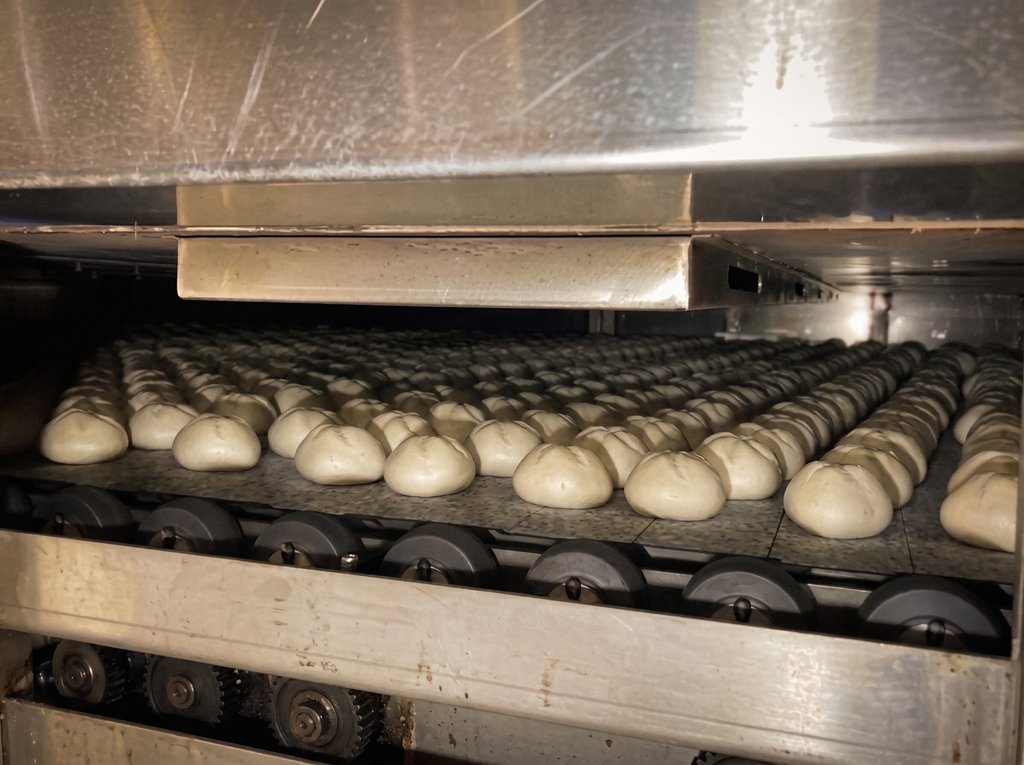
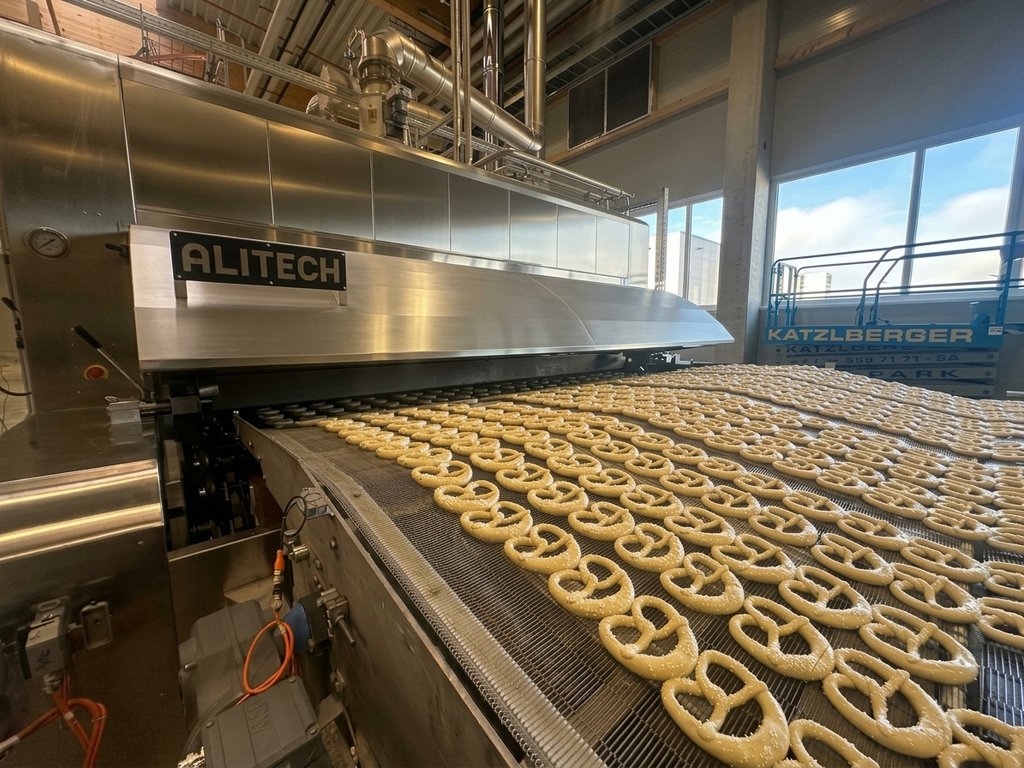
Rather than applying heat directly via flame or open convection, the cyclothermic system circulates heated gases through enclosed radiator channels positioned above, below, and along the return path of the baking belt. Heat reaches the product via radiation and conduction, replicating the thermal behavior of a traditional deck oven at continuous industrial throughput.
The system’s baking process is structured around three simultaneous heat transfer mechanisms:
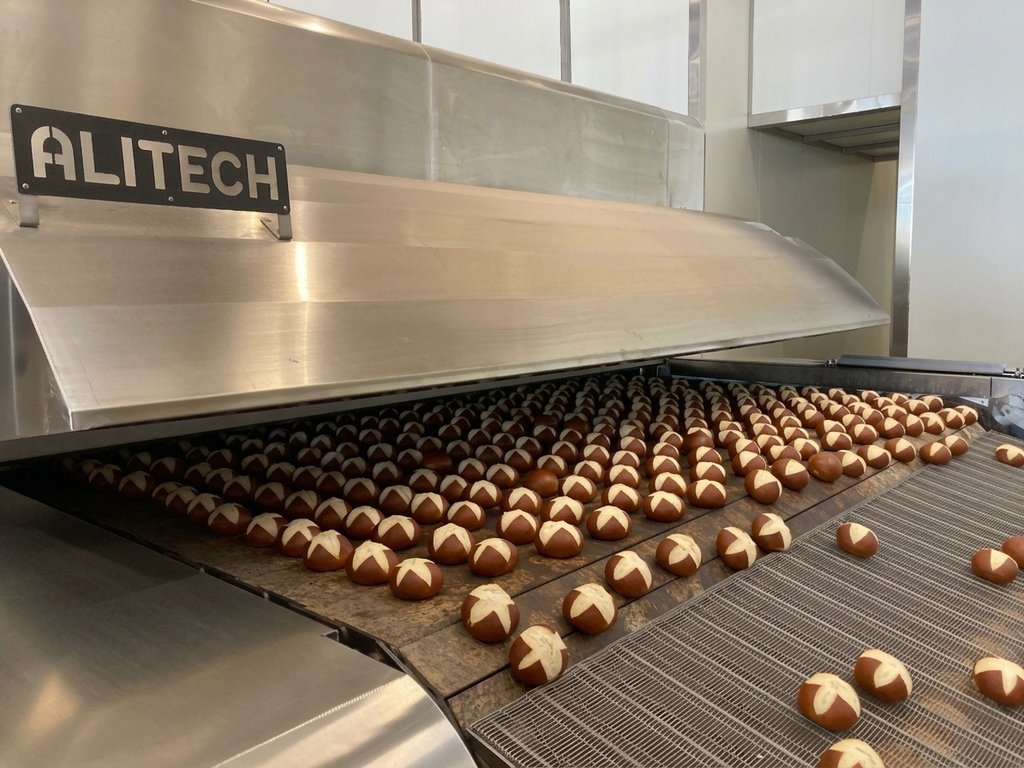
For free-standing hearth breads (baguettes, ciabatta, rustic loaves, Kaiser and dinner rolls) Alitech offers the Stone/Steel Belt version of the same cyclothermic platform.
In this configuration, the standard wire mesh is replaced with a continuous belt made of natural stone or steel with high thermal mass, delivering the intense direct conduction that is the thermodynamic signature of traditional stone-hearth baking.
This is the critical engineering bridge between artisan quality and industrial volume.

The combination of a high-mass baking belt with independently controlled radiation zones allows operators to programming a specific thermal profile for each product, without mechanical changes to the oven.
Steam Control: The Variable That Determines Crust Character
Steam in the early baking phase performs a specific and non-replaceable function: it keeps the outer skin of the dough flexible during oven spring, delaying crust formation until internal gas expansion is complete. Without it, the crust sets prematurely, the loaf cannot expand fully, and the surface cracks irregularly.
In Alitech’s system, steam management is engineered with the same precision applied to heat distribution:
Zone Independence: Replicating a Baker’s Intuition at Scale
An experienced artisan baker intuitively manages the progression of heat and humidity as a loaf moves through its baking curve. At an industrial level, this has to be engineered. The Alitech tunnel oven is structured as a series of fully independent zones, each with its own:
All parameters are stored as named recipes in the HMI control panel. When switching between product types, the oven automatically repositions every damper to the saved configuration, eliminating manual operator adjustment and reducing product changeover time. Temperature trends, burner power, and gas consumption are logged in real time for quality traceability.

The ability to configurate and recall complete baking profiles (including turbulence direction, steam volumes, and multi-zone heat gradients) is what transforms an industrial oven into a repeatable artisan environment.
Product Range: One Platform, Broad Application
The Cyclothermic Indirect Fired Mesh Belt Tunnel Oven is classified as a universal oven. Product changes are managed through recipe recall, not mechanical reconfiguration. A single installation can handle the following product categories:
- Tin bread and pan bread.
- Free-standing hearth breads: baguettes, ciabatta, focaccia, rustic loaves.
- Buns, rolls, Kaiser rolls, dinner rolls, hamburger buns, hot dog buns.
- Regional and specialty breads: rye bread, pretzels (Bretzel), twisted pretzels, dough balls.
- Bagels, pizza bases, American-style pizza.
- Croissants, cakes, pies, empanadas.
For operations requiring outputs exceeding 5 tons per hour, Alitech manufactures out-of-standard ovens to custom dimensions.
The modular construction (variable-length baking zones, stainless steel lining throughout, belt tensioning via hydraulic pistons) is designed for continuous operation with minimal downtime. The belt tracking system maintains alignment automatically at both infeed and outfeed, even in ovens exceeding 40 meters.
😊 Thanks for reading!
About The company

30 Years of Experience in Bakery Equipment and installations across Europe, North America, and beyond
Alitech SRL designs and manufactures Industrial Tunnel Ovens, Travelling Proofers, and Machines for bread, pizza, and baked goods at its facility in Rovereto, Italy. Alitech offers turn-key baking line solutions with output capacities exceeding 5 tons/hour. All ovens are built on demand to customer specifications.
Contact:
Viale Caproni, 15/17 38068 Rovereto (TN) – Italy info@alitechbaking.com alitechbaking.com
+39 0464 455400
References
- 1. Source documents: Alitech SRL: Cyclothermic Indirect Fired Mesh Belt Tunnel Oven (Product Flyer and Technical Presentation, 2026).
- 2. Background: “Escalabilidad del Pan Artesanal”: internal technical reference document on artisan bread scale-up challenges (BII, 2026).
- 3. Industry context: AIBI (Association Internationale de la Boulangerie Industrielle): annual trend reports on premium and artisan-style bread consumption in Europe.