Sustainable Packaging for Scaling Artisan Bread That Could Eliminates 97% of Plastic
Artisan sourdough bread typically loses its crust crispness within hours of packaging in conventional plastic, yet mass retail would demand shelf lives of five to seven days. Hybrid fiber-polymer substrates, laser-calibrated microperforated films, and automated flow bagging lines could bridge that gap while cutting plastic content by up to 97%.
The Core Tension: Artisan Identity vs. Retail Shelf Requirements
Unlike industrial sandwich breads that rely on calcium propionate or sorbates to achieve 20 to 30 days of shelf life, fresh clean-label artisan bread contains no synthetic preservatives.
Characterized by slow fermentation, high-hydration crumb (typically 65% to 85%), and thick crusts, it would face an immediate packaging conflict on supermarket shelves, where retail channels generally require tamper-evident sealing, extended microbiological stability beyond five days, digital traceability, and dimensional uniformity.
Bakeries attempting retail access would typically encounter three compromise paths:
Hybrid Fiber-Polymer Substrates
Halopack thermosealed cardboard trays use recycled or FSC-certified virgin fiber (approximately 85% to 90% of total pack weight) lined with an ultrathin multilayer polymer barrier film of roughly 35 to 50 microns. Net polymer content would drop to approximately 2.5 to 3.5 grams per tray versus 25 to 35 grams in conventional plastic, achieving roughly 85% to 90% plastic reduction. A peel-off tab allows consumers to separate the film from the cardboard for single-stream paper recycling, offering a rigid fiber-based alternative to conventional plastic clamshells.
Visio DUNE paper-based packs combine high-grammage kraft paper with a longitudinal anti-fog BOPP window, reducing polymer content by up to 97% compared to equivalent clamshells. The transparent window exposes crust scoring and crumb alveolation, while the kraft surface communicates tactile warmth and artisan authenticity, potentially supporting a green premium at retail.
Microperforated Films: Calibrating the Moisture Equilibrium
In industrial lines, baked loaves typically pass through cooling spirals, or vacuum cooling systems to lower core temperatures below 30 °C before packaging, preventing immediate steam condensation. However, even after thorough cooling, bread could remain a non-equilibrium system. The high-hydration crumb (42% to 46% moisture) would continuously release water vapor toward the much drier crust (roughly 8% to 12% moisture) across subsequent storage days.
In a sealed impermeable pack, this persistent migration could condense on the film’s inner surface, raising crust moisture above 16% to 18% and shifting the glassy matrix responsible for crispness into a rubbery, soggy state.
Laser-based microperforations, using carbon dioxide lasers to create pores of approximately 80 to 250 microns with tolerances of plus or minus 5 to 10 microns, offer a calibrated solution. At optimal densities (15 to 35 pores per square centimeter), the film could establish an Equilibrium Modified Atmosphere (EMA):
While mechanical macro-perforations (1 to 6 mm holes) are widely utilized for short-turnover, same-day crusty baguettes, their convective airflow would prove problematic for multi-day retail shelf life, potentially causing up to 4% weight loss within 72 hours and accelerating starch retrogradation, while offering negligible resistance to airborne mold spores.
Automated Flow Bagging and Retail Compliance
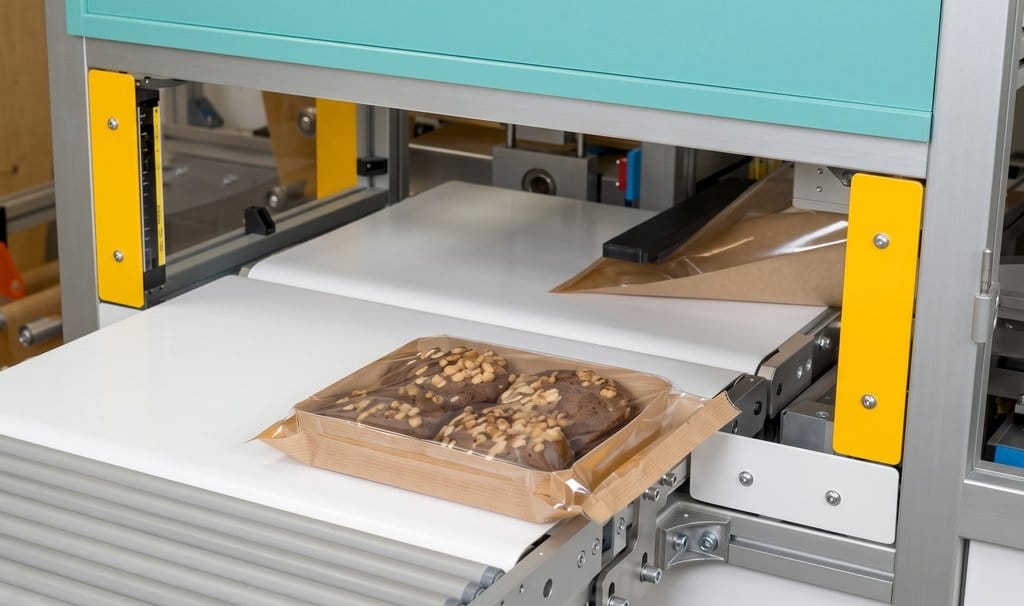
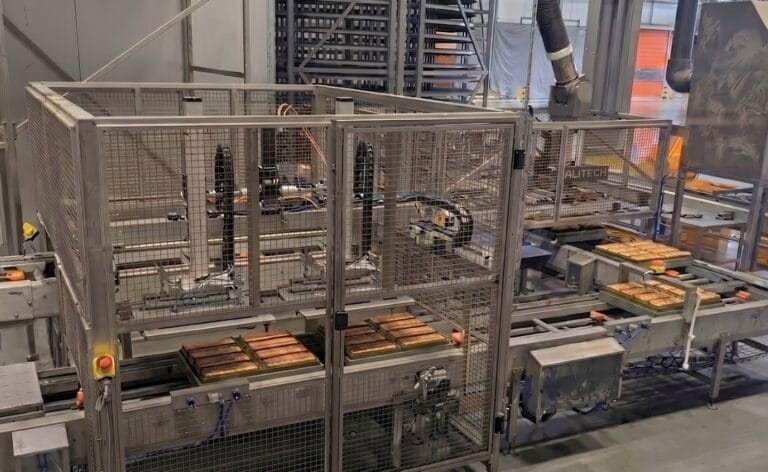
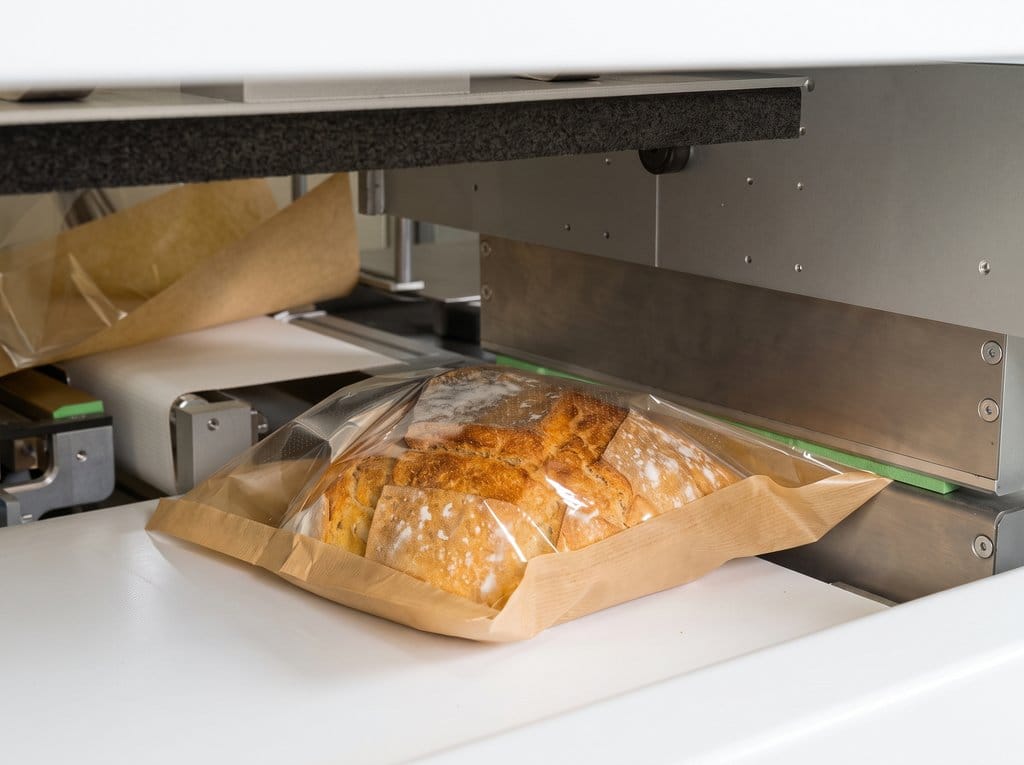
Manual bagging of artisan loaves would typically yield around 150 to 250 units per hour per operator. Automated horizontal flow bagging lines could scale throughput up to approximately 1,800 cycles per hour with a single operator, incorporating double thermal sealing for tamper-evident closure.
By shifting labor from repetitive manual bagging to line supervision, bakeries could substantially dilute labor costs per unit while curtailing bag-breakage scrap, accelerating capital payback across high-volume retail supply contracts.
Shrinkage Reduction and Commercial Viability
Where unpackaged or paper-wrapped artisan bread commonly sees end-of-day waste rates between 12% and 18%, properly engineered packaging might reduce spoilage rates to below 2.5%, extending the viable commercial window from one day to five or more.
😊 Thanks for reading!
Sources:
- https://kapelis.gr/en/protaseis/bakery-sweets/
- https://kapelis.gr/en/ylika_category/flowpack-film/
- https://kapelis.gr/en/ylika_category/trays-cups/halopack-en/
- https://halopack.eu/halopack-sustainable-cardboard-recyclable-trays-faq/
- https://aptar.com/en-us/news-events/aptar-food-protection-enters-exclusive-partnership-with-halopack-to-launch-recyclable-fiber-based-tray-system-in-north-america
- https://www.prodandpack.com/fr/liste-exposants/dune-94729
- https://www.youtube.com/watch?v=Jhbwqi4FTd0
- https://www.feldman.st/2026/02/26/plastic-film-micro-perforation-technology-comparison-for-food-packaging/
- https://ibg.es/en/micro-and-macro-perforated-food-packaging/
- https://www.mdpi.com/2304-8158/10/1/76
- https://www.bakeryandsnacks.com/Article/2008/08/01/Water-levels-key-to-keeping-bread-crispy/
- https://soontact.com/difference-between-manual-and-automatic-packaging-machines/
- https://www.gs1.org/insights-events/case-studies/reducing-food-waste-and-improving-bakery-operations-efficiency-gs1-standards
- https://eur-lex.europa.eu/legal-content/EN/TXT/?uri=CELEX:32025R0040
- https://pubmed.ncbi.nlm.nih.gov/18611031/