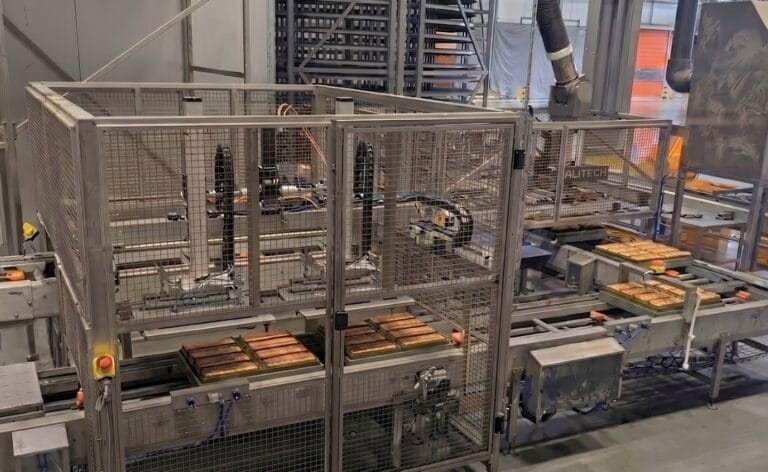
Topping Equipment: Raking Systems for Uniform Crumb Bases
Maintaining the structural quality of a cheesecake crumb crust relies directly on the performance of industrial topping equipment. A base that turns soggy, crumbles during portioning, or separates is rarely a recipe issue. Mechanically conditioning the crumb mixture on the depositing line ensures uniform particle and moisture distribution.
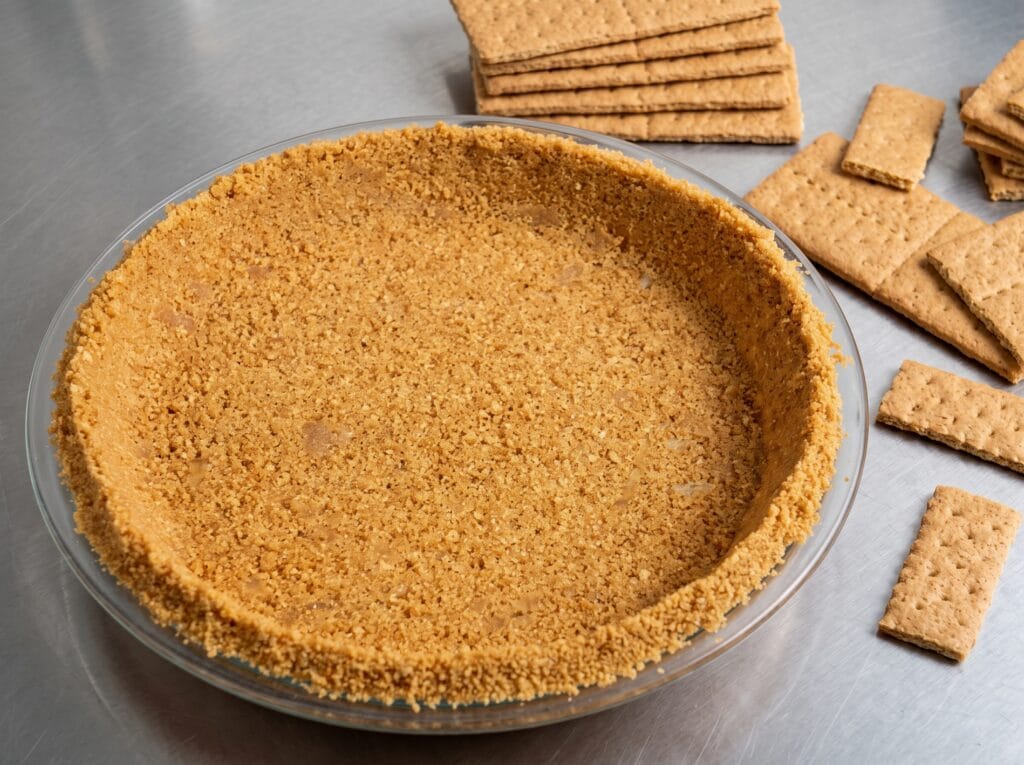
The Graham cracker is the standard raw material for compacted crumb bases in cheesecakes, pies, and layered desserts. It owes its signature crumbly snap to a deliberate suppression of gluten. Its flour is milled in a distinctive way: the starchy endosperm is ground fine, while the bran and germ are left coarse. Protein content typically ranges between 12% and 14%, yet the dough behaves nothing like a bread dough of comparable protein levels.
Two mechanisms account for this:
These two effects are not accidental. They are the foundation on which every subsequent step in cheesecake crust production depends.
What Happens When the Cracker Is Crushed
Once baked and cooled, the Graham cracker enters a grinding stage where it is reduced to crumbs. The degree of gluten development in the original dough dictates how cleanly and uniformly the cracker fractures.
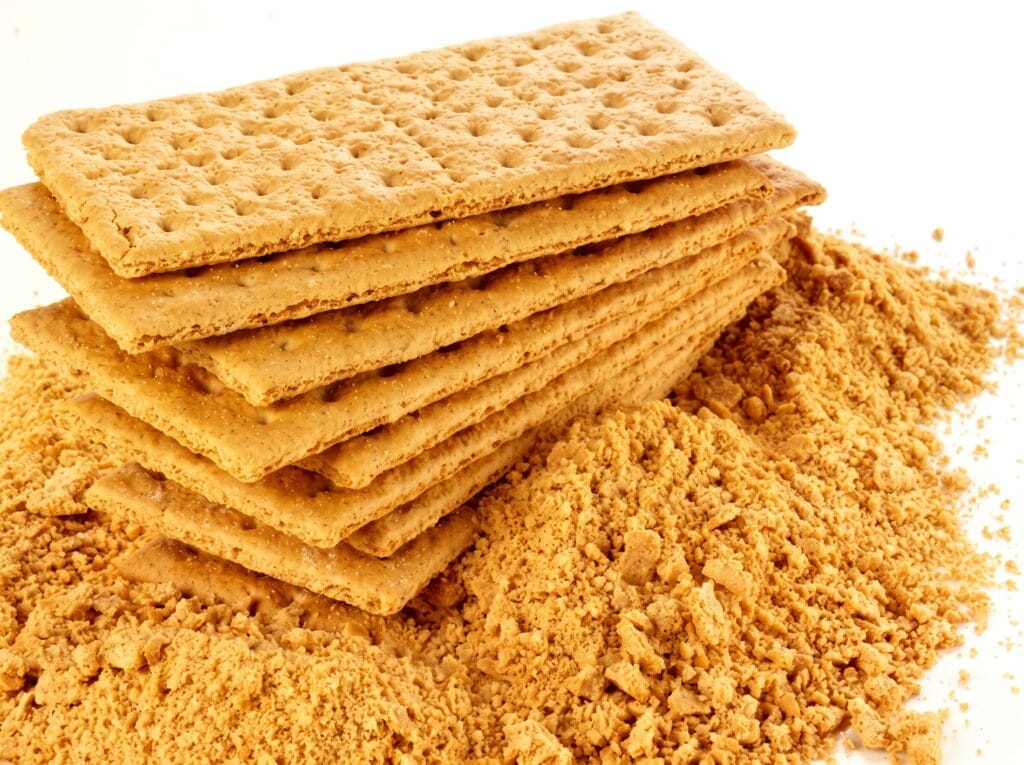
When gluten was properly suppressed, the baked cracker contains thin, fragile cell walls with abundant air pockets. A low-energy pass through a roller or hammer mill shatters the structure along natural planes of weakness, those trapped air bubbles and porous boundaries. The result is a tight, uniform particle size, typically in the range of 0.3 to 0.8 mm, with minimal dust and almost no oversized lumps.
When gluten was overdeveloped, the baked cracker is dense, glassy, and elastic. It resists fracture and demands far more mechanical energy. Under high-impact grinding, it does not break cleanly. Instead, it splinters into a chaotic mix of ultrafine powder (below 0.1 mm) and hard, stubborn macro-lumps (above 1.5 mm). This heterogeneous particle distribution creates cascading problems on the production line and, ultimately, in the finished dessert.
Mechanical Leveling: The Role of Raking Systems in Topping Equipment
The crushed crumbs are blended with melted butter (typically at 55 °C to 60 °C) to form the crust mixture. This step transforms a free-flowing powder into a sticky, cohesive mass that resists uniform distribution. The melted fat forms liquid bridges between particles, creating strong capillary attractions that cause the mixture to clump, bridge inside hoppers, and compact unevenly under its own weight.
Standard vibratory feeders or gravity-drop dosifiers cannot overcome this cohesion. The mixture simply falls in irregular chunks, leaving some zones densely packed and others starved.
Industrial equipment solves this problem with oscillating rake or comb systems. Metal fingers, mounted on eccentric or servo-driven shafts, sweep continuously through the falling mass.
Their controlled oscillation applies just enough shear force to break the capillary bridges between particles without compressing the mixture or squeezing the butter out. Each stroke of the rake disaggregates clumps back into loose, flowable crumbs and redistributes them across the full width of the conveyor belt or mold array.
This action accomplishes three things simultaneously:
Why Uniformity Prevents Moisture Migration
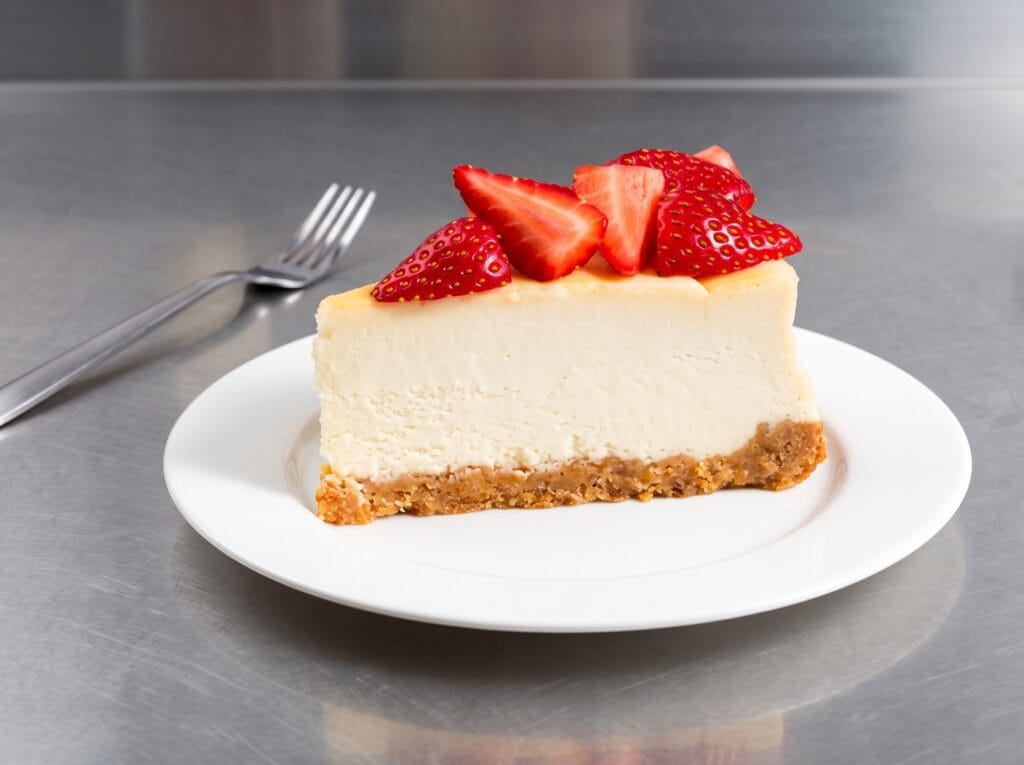
A cheesecake is a two-layer system with a steep moisture gradient. The cream cheese filling carries very high water activity (approximately 0.95 to 0.98), while the compacted crumb base sits at a much lower range (approximately 0.30 to 0.50). Water will always migrate down this gradient, from filling into crust, driven by the difference in chemical potential.
The speed of that migration depends on the internal structure of the base. A well-leveled crust, where the butter has uniformly sealed the pores between cracker particles, presents a dense, tortuous path that water molecules cannot easily navigate. Migration slows to a rate that preserves the crust’s crunch throughout the dessert’s commercial shelf life.
An unevenly distributed base, however, contains weak spots. In low-density zones, the butter failed to fill every pore. Water from the filling penetrates rapidly through these open channels, softening the starch in the cracker particles and turning the crust soggy. In zones where excess butter pooled, surrounding areas may be left uncoated and equally vulnerable.
The consequences extend beyond texture loss. During baking, residual moisture at the crust-filling interface evaporates. In a uniform base, that steam diffuses evenly and escapes without incident. In an irregular base, low-density pockets act as steam chimneys while dense patches act as plugs. The trapped vapor pressure pushes upward, delaminating the crust from the cheesecake body and, in severe cases, cracking the surface of the filling.
Clean Cuts and Line Efficiency
When the cheesecake reaches portioning, whether by ultrasonic blade in the factory or by knife at the point of sale, the base must withstand the shear force of cutting without crumbling or resisting excessively. A base of uniform density and thickness distributes the cutting force evenly along the blade’s path, producing clean portions with intact edges. Inconsistent zones, by contrast, may shatter into loose crumbs at one point and deform the cheesecake by excessive hardness at another.
For the industrial plant, this translates directly into profitability. Fewer rejected portions, less rework, reduced ingredient waste from uneven dosing, and a longer shelf life all trace back to a single engineering principle: controlling particle uniformity from the moment the Graham cracker dough is mixed to the moment the rake smooths the last crumb into place.
😊 Thanks for reading!
Sources:
• Edwards, W. P. The Science of Bakery Products. Royal Society of Chemistry.
• Cauvain, S. P. & Young, L. S. Bakery Food Manufacture and Quality: Water Control and Effects. Wiley-Blackwell.
• Manley, D. Biscuit Baking Technology: Processing and Engineering Manual. Woodhead Publishing.
• Hui, Y. H. (Ed.). Bakery Products: Science and Technology. Blackwell Publishing.
• Figoni, P. How Baking Works: Exploring the Fundamentals of Baking Science. John Wiley & Sons.
• AIB International. Graham Cracker Dough Rheology and Crumb Quality Standards.
• Anton Paar. Particle Size Distribution in Food Processing.
• GEA Group. Industrial Bakery Depositing & Topping Systems.
• Grote Company. Topping & Depositing Equipment.
• Axis Automation. Automated Topping Solutions.
• Krumbein Rationell. Crumb Topping Systems.