Thermal Revolution in Baking: New Thermostable Protease for Late Oven Spring Control
Conventional proteases collapse at 65 °C, limiting volumetric expansion during baking. A newly genetically engineered pepsin withstands extreme heat, relaxing the gluten network during the critical oven spring phase to maximize alveoli and allow for dense formulations without gumminess.

The global bioscience market and the science of baking may be facing a structural paradigm shift. During the 28th China International Bakery Exhibition, which took place in May 2026 in Shanghai, the biotechnology conglomerate Sunson Industry Group and East China Normal University (ECNU) presented a joint patent that redefines the thermal limits of industrial enzymes (Patent No.: CN115896073A).
The focus of this innovation lies on an artificially engineered pepsin. This enzyme was specifically designed to exhibit extreme thermostability against the radiant heat of the commercial oven.
The empirical problem with classic fungal and bacterial proteases is their thermal denaturation curve. The vast majority of these conventional natural enzymes suffer a structural collapse upon crossing the 60 to 65 °C threshold. This means their catalytic activity stops abruptly in the initial stages of baking.
This limitation restricts the formulator’s ability to modulate the dough’s viscoelastic architecture when it matters most; that is, during the rapid thermal expansion known as oven spring.
To resolve this barrier, the researchers applied advanced genetic engineering. The technical details of this enzymatic mechanism could be summarized in the following axes of molecular reengineering:
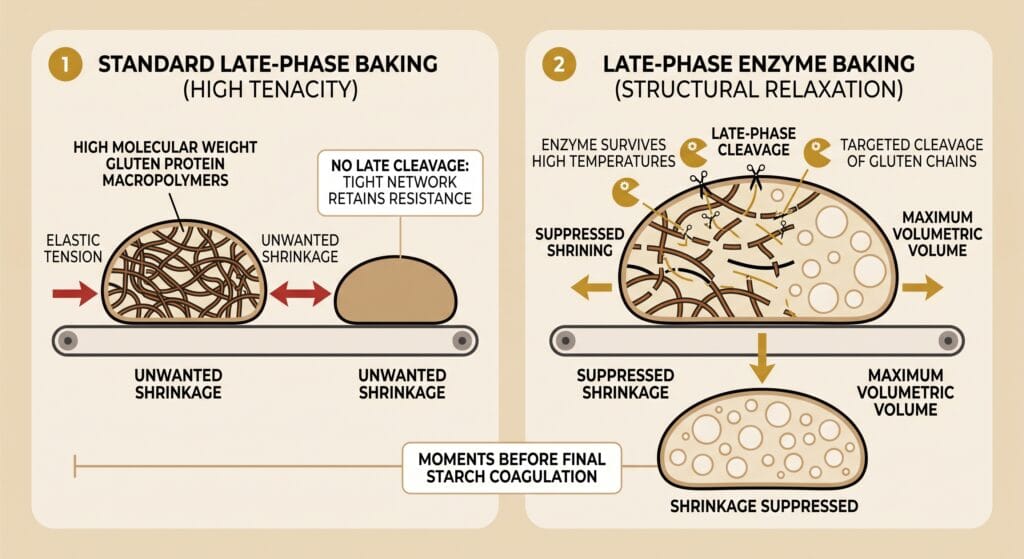
The impact of this thermostability on the production line could be substantial for the design of new products. By surviving the accelerated temperature increase, the new enzyme continues cleaving the high molecular weight protein macropolymers of gluten in a late phase of the baking cycle.
This late enzymatic cleavage relaxes the elastic tension of the dough exactly at its moment of maximum expansion. As a direct result, the unwanted shrinkage that usually occurs due to the tenacious resistance of the protein network is suppressed.
This structural relaxation allows the internal steam pressure to expand the dough’s alveoli to their maximum volumetric volume. All this happens moments before the final coagulation of the starch is consolidated.
For industrial-scale operations, the direct benefits are multiple, efficient, and highly measurable. First, this technology should allow formulators to incorporate very high protein alternative flours without the usual risk of structural collapse.
It would also facilitate the integration of dense upcycled components into the base formulation. Traditionally, adding large volumes of these ingredients results in a final product with an unacceptable gummy densification for quality standards.
With the gluten tension modulated late in the process, the baked good optimizes its texture towards a short bite. This dramatically improves the consumer’s sensory experience, delivering a tenderer and airier crumb.
In continuous baking lines, thermal efficiency and consistency control are critical variables. The incorporation of this modified pepsin could mean a direct reduction in the use of chemical reducing additives like sulfites; compounds traditionally used to artificially relax gluten.
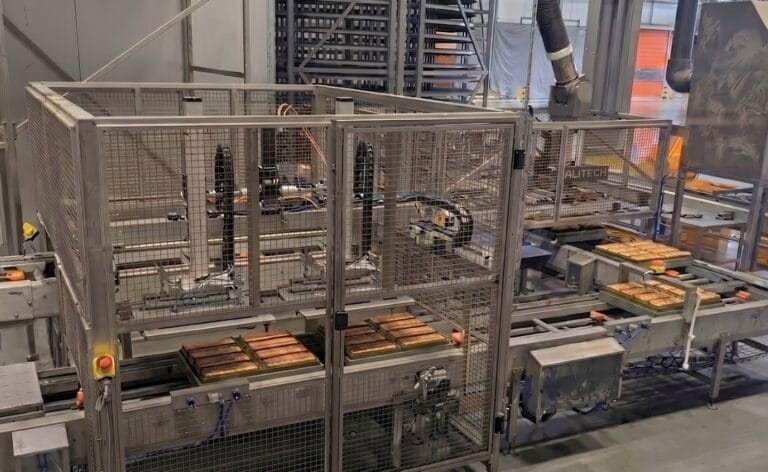
Controlling the oven spring at a molecular level should also reduce the rate of rejected products due to lack of volume or deformations in the trays. By ensuring a predictable and uniform expansion, automated packaging systems operate more efficiently when processing pieces with standardized geometries.

😊 Thanks for reading!
Sources:
- https://www.sunsonzymes.com/news/detail/1/46
- https://www.sunsonzymes.com/news/detail/1/47 East China Normal University (ECNU) & Sunson Industry Group Joint Communications.
- https://patents.google.com/patent/CN115896073A/en?oq=CN115896073A