
Why Contact Baking Gives Welsh Cakes a Texture Tunnel Ovens Can’t Match
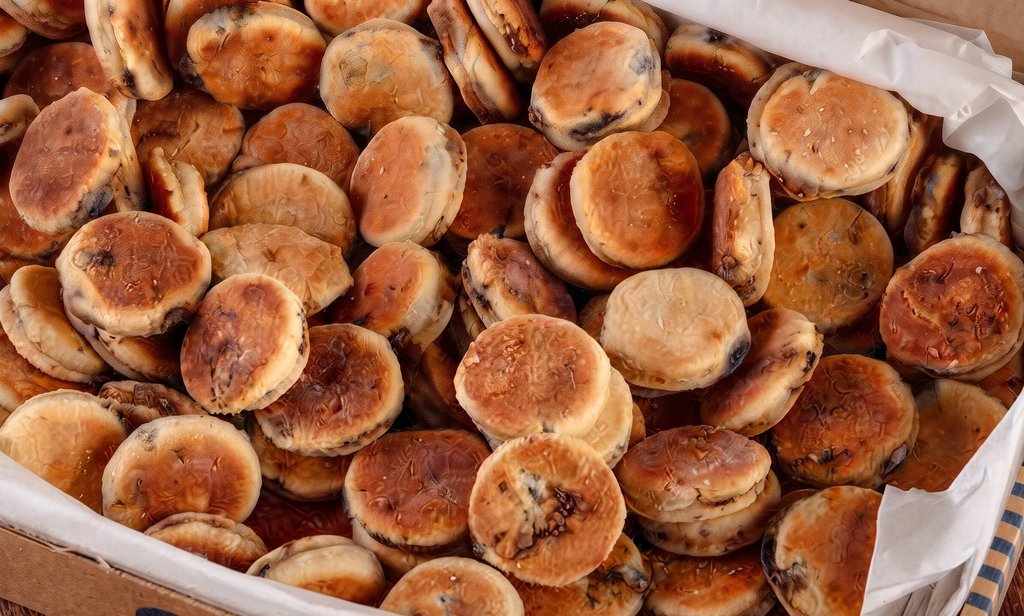
A crumbly, butter-rich dough studded with fruit, seared on both faces and flipped halfway while still raw on top. Scaling the Welsh cake means taming crushed sultanas, charred specks, fragile turnovers and carbonising plates, and each of these can quietly erode yield on a hotplate line.
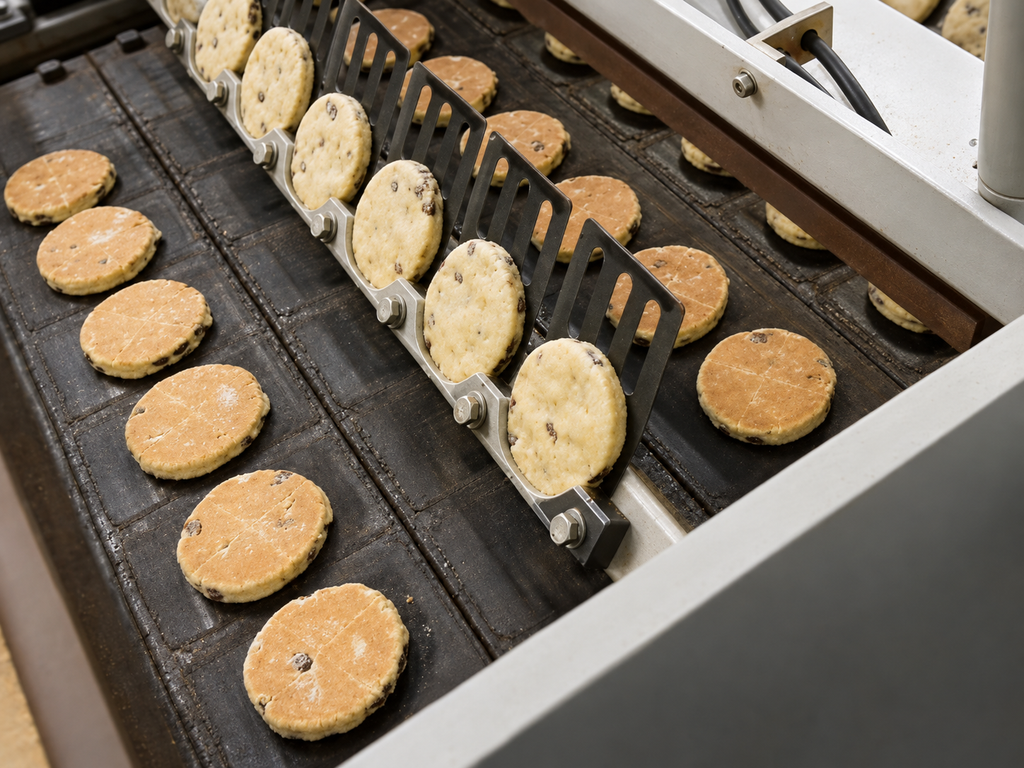
From the Bakestone to the Continuous Hotplate
The Welsh cake, known in Welsh as picau ar y maen or pice bach, emerged in the late nineteenth century in the mining communities of Glamorgan. It was cooked on a bakestone, a flat iron or stone plate set over an open fire, and packed into miners’ food boxes as a dense, durable ration.
The traditional formula is a rich short dough of flour, butter, lard, sugar and currants. That profile, high in fat and sugar and loaded with dried fruit, shapes most of the challenges when the product moves from the bakestone to a continuous hotplate line.
Why Contact Baking Instead of a Tunnel Oven
On a hotplate, heat enters the dough mainly through direct contact with the moving plate. The base sears quickly while the side wall stays relatively protected, which gives the flat, golden faces and the soft, pale edge consumers associate with the product.
A convective or radiant tunnel oven surrounds the whole piece with hot air and radiation. In practice, this tends to dry the edges and the upper surface earlier, which may push the texture towards a scone or shortbread.
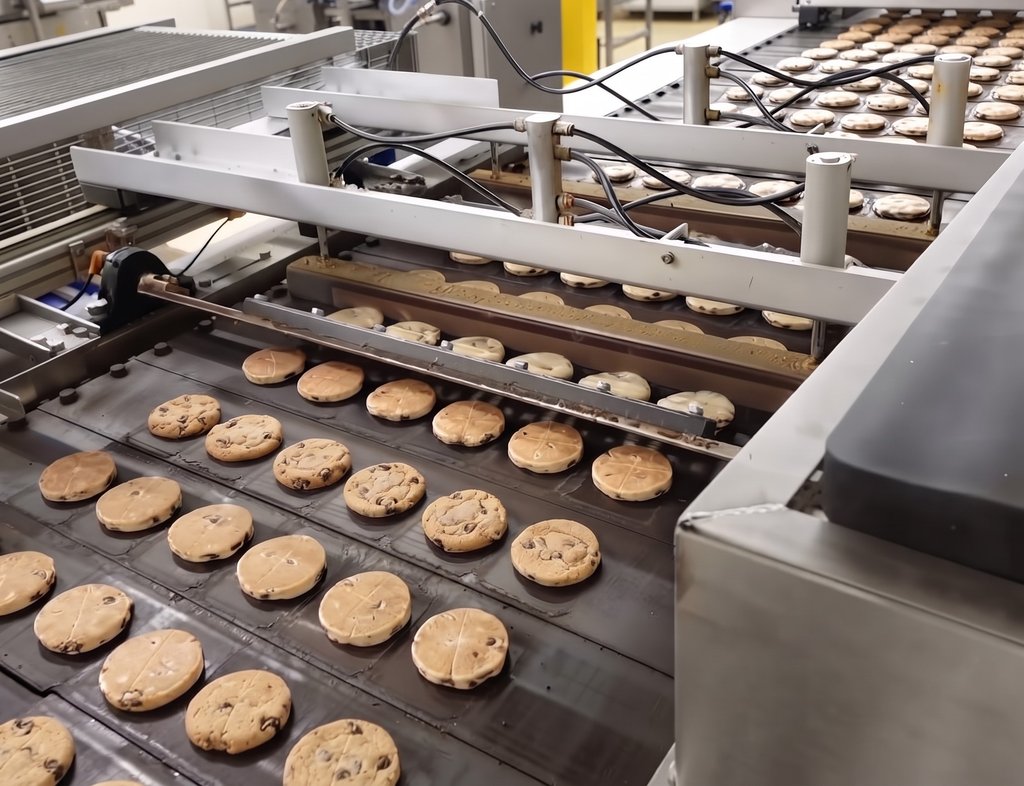
Inside the dough, a moisture cycle carries much of the heat:
Turning the cake halfway reverses this direction for the second face.
Sheeting and Cutting a Fruit-Loaded Short Dough
In short doughs, fat coats the flour particles and limits gluten development. This gives a tender bite, but also a sheet with low cohesion that can tear or stick when it warms up.
Dried fruit adds a second constraint. Sultanas, seedless dried white grapes, can be as large as, or larger than, the final sheet thickness. Aggressive single-pass reduction may crush them, release sticky sugar onto the rolls and tear the sheet. Multi-roll sheeters with gradual gauge reduction and synchronised roll speeds are commonly used to keep the sheet relaxed.
Rotary cutting of round discs leaves a continuous lattice of trim. In some industrial lines, a rotary cutter stamps several rows of discs across the sheet while the trim climbs a return conveyor back to the sheeter. With circular dies, roughly a fifth of the sheet often returns as scrap, so rework management becomes a daily variable:
Recommended Reading:
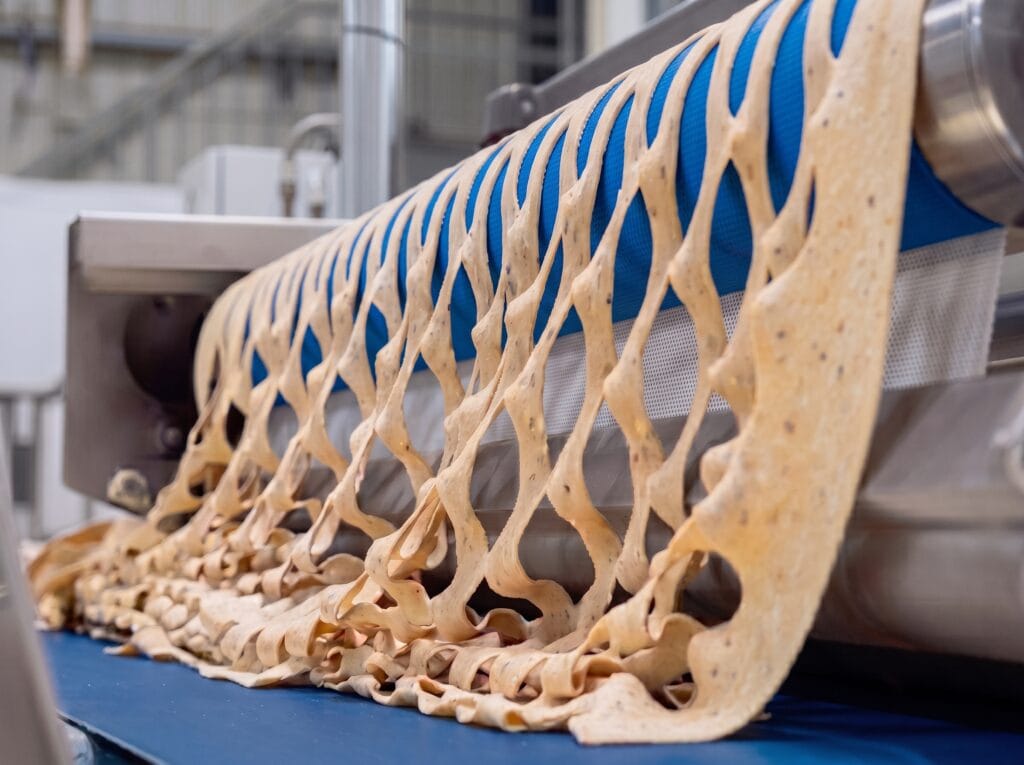
Industrial Biscuit Production: Managing Raw Scrap and Slurry Rework
In high-capacity industrial biscuit and cracker plants, managing the material flow of unused dough is a core determinant of dough rheology and facility efficiency.
Bakery Industry InsiderWhat Happens to Starch, Sugar and Fruit on the Plate
Sugar binds much of the limited water in the dough, while fat coats the flour particles and slows water from reaching the starch. As a result, starch tends to gelatinize only partially. Much of the final structure is likely to come from protein setting and chemical leavening gas expanding before the crumb firms.
Browning on the contact face involves two routes. The Maillard reaction between sugars and amino acids builds most of the color and toasted flavor. Caramelization of sugars on their own needs more heat, although fructose starts to caramelize at much lower temperatures than sucrose.
This has a direct consequence for fruit-loaded products:
Mid-Line Turnover
Turnover happens when the top face is still raw and the fat inside is soft, so the cake has little mechanical strength. Any shock at this point can break the piece or knock out fruit.
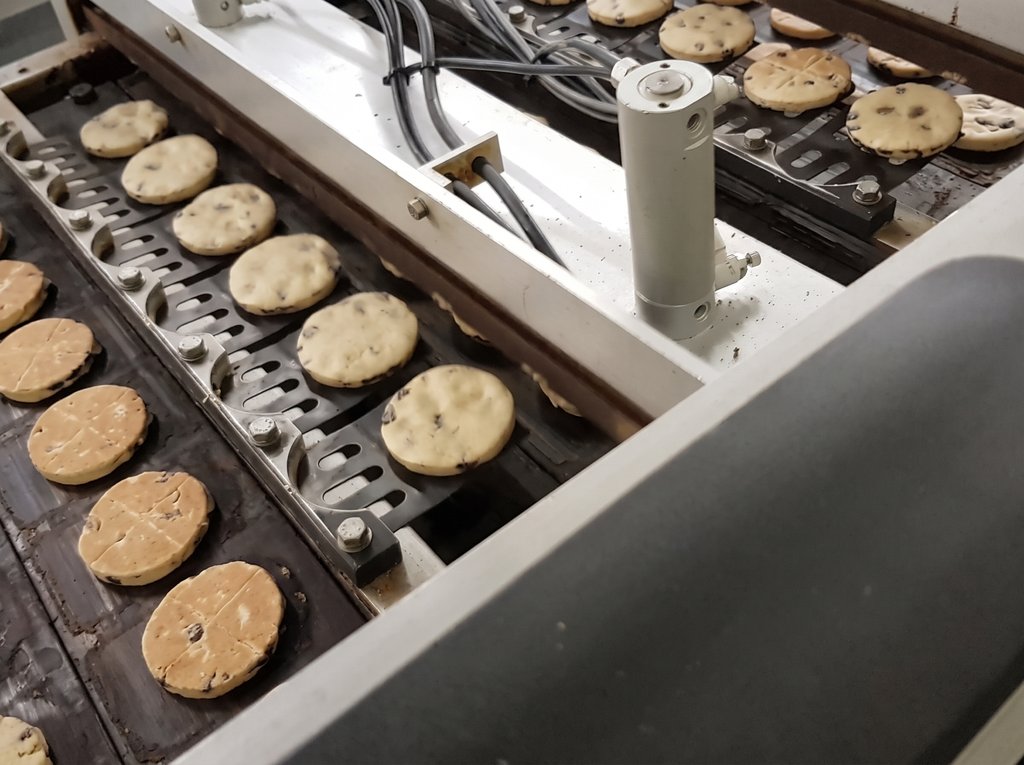
A common turnover setup uses overhead pneumatic cylinders to drive a row of slotted fingers that slide under a row of half-baked cakes and flip them onto the next plate. The design is simple and robust, although air cylinders can lose positional accuracy at high cycle rates, and ball screw drives may wear quickly under constant short strokes.
Other lines use servo-driven, belt-type linear units linked by a beam of spatulas, indexing around 22 times per minute. Programmable motion profiles allow the spatula to slide close to the plate, slow down during the flip and place the product gently.
Plate Conditioning on the Return Run
Butter, oil and leaked fruit sugar gradually polymerize and carbonize on hot metal. Carbon deposits conduct heat poorly, so even thin layers may create cold spots, increase sticking at turnover and transfer dark marks to the product.
Many lines clean the plates continuously on the underside return run, typically with:
Insulation also matters. Fully insulated hotplates have been reported to reduce energy use by 25 to 30%.
Discharge, Sugar Dusting and Shelf Life
At the end of the plate, a sweep blade pushes the finished cakes onto a cooling conveyor. Sugar dusting is usually applied while the surface is still warm, when softened fat helps the crystals adhere. If applied too hot, the sugar may dissolve into a sticky film; if too cold, it tends to bounce off.
Adequate cooling before packing helps avoid condensation inside the film, which can create local wet spots where mould growth becomes more likely.
😊 Thanks for reading!
Sources:
- Welsh Foods Collection: https://museum.wales/collections/welsh-foods/?id=118
- Traditional Hotplate Systems: https://sugden.ltd.uk/2022/06/08/golden-opportunities/
- Hotplate Servo Automation Overview: https://www.confectioneryproduction.com/feature/38986/bakery-focus-sugden-eyes-expansion-with-50th-anniversary-on-the-horizon/
- Linear Transmission Flipping System: https://factoryandhandlingsolutions.co.uk/pancake-flipping-linear-transmission-and-positioning-system/
- Moisture Phase Changes in Contact Baking: https://pmc.ncbi.nlm.nih.gov/articles/PMC12071401/
- Fat Types in Short Dough and Biscuits: https://pmc.ncbi.nlm.nih.gov/articles/PMC4152542/
- Commercial Sheeting Systems: https://www.readingbakery.com/resources/commercial-cracker-production-equipment.html
- Rotary Cutting Station: https://www.readingbakery.com/rotary-cutting-station-bakery-equipment.html
- Managing Raw Scrap and Slurry Rework: https://bakeryinsider.com/industrial-biscuit-production-managing-raw-scrap-and-slurry-rework/
- Starch Gelatinization in Baking: https://bakerpedia.com/processes/starch-gelatinization/
- Maillard Reaction and Caramelisation: https://www.ragus.co.uk/the-maillard-reaction-the-science-behind-flavour-and-colour-in-foods-and-beverages/
- Acrylamide and HMF in Biscuits: https://pmc.ncbi.nlm.nih.gov/articles/PMC12874612/
- Continuous Contact Baking and Turnover Patent EP1759585A2: https://patents.google.com/patent/EP1759585A2/en
- Carbon Buildup in Baking Bands: https://bakeryinsider.com/carbon-buildup-baking-bands/