
Water Jet Scoring Relies on Adapting to Dough Structure and Low Water Hardness
Mechanical blades often drag, tear, or degas delicate dough pieces right before the oven. Water jet scoring eliminates solid tool contact and blade wear on high-speed lines, though consistent cuts still depend on matching jet pressure to dough rheology and keeping feed water free of mineral hardness.
Water Jet Scoring on the Line
In a water jet scoring station, a pump feeds pressurized, purified water through fine calibrated nozzles above the conveyor or oven infeed. Fast-acting stainless steel coaxial solenoid valves or pulsed electric nozzles open and close in milliseconds to direct a coherent stream onto each dough piece. Integrated check valves shut off flow right after each cut, keeping stray drops from staining the crust, altering Maillard browning, or wetting pans and cloths.
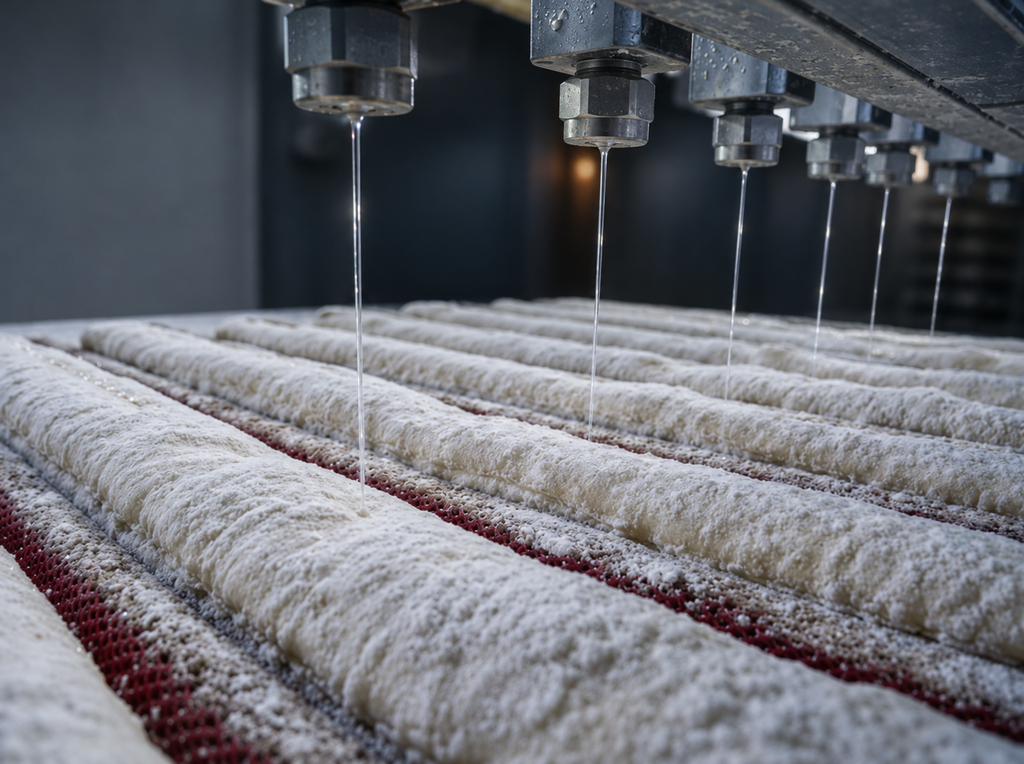
Industrial bakeries run two distinct pressure regimes depending on whether the line scores raw dough or portions finished goods. On proofed dough, scoring heads operate at moderate pressures, typically up to 20 bar on robotic units or up to 150 bar on coaxial valves, opening a slit 6 to 12 mm deep without piercing the loaf base. By contrast, pure waterjet portioning of baked bread, cakes, or frozen pastry at -20°C uses intensifier pumps at 3,000 to 6,200 bar, driving hair-thin jets past twice the speed of sound to slice all the way through.
On raw dough, the trace water left in the cut also influences expansion during early baking. As oven heat warms the intact outer skin toward 60°C to 70°C, gluten coagulates and starch begins to gelatinize and dry, while moisture inside the groove absorbs heat and keeps the cut lips extensible slightly longer. Expanding carbon dioxide and steam vent through that pliable opening, lifting an inclined cut on baguettes or batards into a crisp ear.
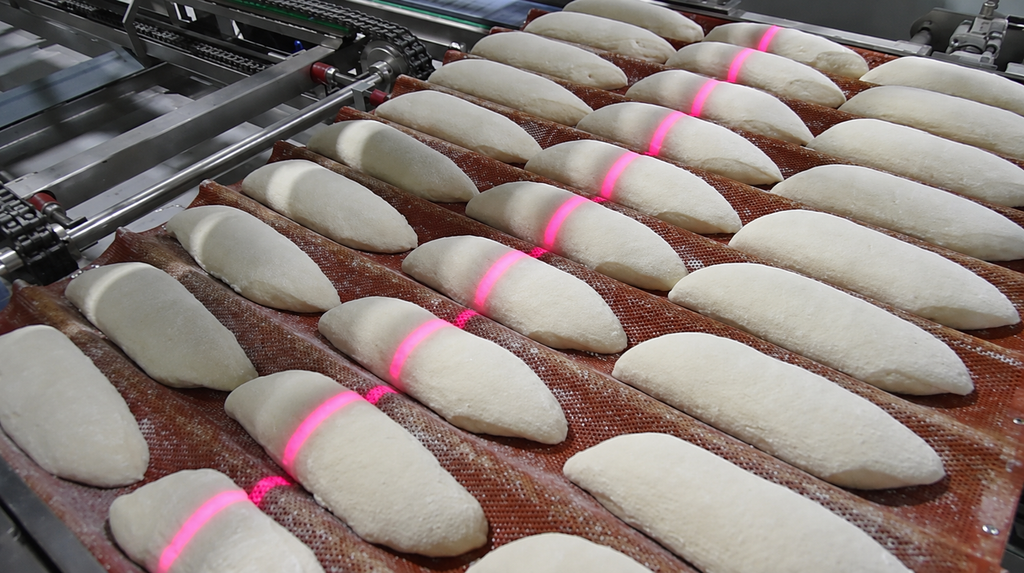
Because proofed loaves vary slightly in height and belt position, fixed nozzles can cut taller pieces too deeply or skim past lower ones. Automated lines often pair the head with 3D laser scanners that map each loaf in milliseconds and adjust vertical height, angle, and depth per piece.
Dough Rheology and Performance Across Formulations
Leaving the final proofer, dough behaves as a delicate foam where stretched gluten and starch films hold pressurized carbon dioxide cells. Even a sharp metal blade applies compression and forward drag, which may stick to wet gluten, tear adjacent cell walls, and degas the loaf before baking. Replacing the blade with a narrow water stream removes mechanical drag, scoring lightweight rolls down to 20 g without shifting them on the tray.
Across recipes from 50% to 95% hydration, surface response shifts with dough structure and proofing state:
Recommended Reading:
Water Quality and Hardness
Removing blades eliminates sharpening schedules, yet cutting consistency shifts upstream to water quality. Hard water rich in dissolved calcium and magnesium salts tends to deposit mineral scale inside fine nozzle orifices. Even thin mineral buildup narrows the bore, which can cause pressure drops, diffused streams, and incomplete cuts across the pan strap while accelerating wear on pump seals and fast-switching valve seats.
To keep the jet coherent, industrial lines treat feed water through softening or reverse osmosis and fine filtration, removing dissolved minerals and suspended particles before they reach the pump and nozzles. Surface scoring heads meter minimal water that stays in the cut and bakes off. In higher-flow or through-cutting stations where vacuum collectors capture excess water beneath the belt, closed-loop circuits pair filtration with thermal or ultraviolet disinfection to limit microbial risk.
Eliminating metal blades removes fragment hazards from HACCP plans, avoids stoppages for dull or gummed-up knives, and removes cut risks during sanitation. Holding those uptime gains on the floor still depends on matching the jet to compatible doughs and keeping up with water softening, fine filter changes, and valve checks. When water hardness drifts upward or heavy inclusions exceed what a fluid stream can part cleanly, scrap and unplanned maintenance can return through the hydraulic circuit instead of the blade holder.
😊 Thanks for reading!
Sources:
- Ultrasonic, Water Jet, or Blade? Choosing the Right Bread Scoring System, Maite Carricaburu, Bakery Industry Insider. https://bakeryinsider.com/bread-scoring-systems-technologies-precision-and-industrial-applications/
- ABI Unveils KATANA II: Next-Generation Robotics Scoring System for precise scoring and enhanced simplicity, ABI LTD. https://www.abiltd.com/news/2025/9/26/abi-unveils-katana-ii-next-generation-robotics-scoring-system-for-precise-scoring-and-enhanced-simplicity
- Bread Scoring, American Society of Baking (ASBE). https://asbe.org/article/bread-scoring/
- Bread Scoring, Baking Processes, BAKERpedia. https://bakerpedia.com/processes/bread-scoring/
- New development in waterjet cutting: Precise cutting of bread dough pieces with innovative 2/2-way coaxial solenoid valve, Frank Kerkau, Bavaria Fluid Systems GmbH. https://www.bavariafluidsystems.com/new-development-in-waterjet-cutting-precise-cutting-of-bread-dough-pieces-with-innovative-2-2-way-coaxial-solenoid-valve/
- Waterjet Dough Scoring Machine, Bariletti SRL. https://www.bariletti.it/en/production-processes/waterjet-dough-scoring-machine/
- Bread Scoring System, Koenig Bakery Machines. https://www.koenig-rex.com/en/machines/scoring-unit/
- Scoring Systems, Abendschoen Maschinenbau GmbH. https://abendschoen-maschinenbau.de/en/products/scoring-systems/
- Bread Scoring Automation, European Process Plant Ltd (EPP Ltd). https://www.eppltd.co.uk/equipment/bread-scoring-automation/
- Automated Dough Scoring: Where Robotics Meet Precision Spray Technology, Paul Burchard, Spraying Systems Co. https://www.spray.com/en-eu/blog/automated-dough-scoring-where-robotics-meet-precision-spray-technology
- Cortar pan con chorro de agua: Los beneficios de cortar alimentos, KMT Waterjet. https://kmtwaterjet.com/es/misc-cortar-pan-con-chorro-de-agua-los-beneficios-de-cortar-alimentos/
- Tecnologia, Waterjet cutting machines for pastry Watercut, Metronics Technologies SL. https://watercutpastry.com/tecnologia/
- Secrets of Bread Baking: Temperature, Humidity, and Tips, Mae Innovation. https://mae-innovation.com/en/secrets-of-bread-baking-temperature-humidity-and-professional-tips/
- US10919174B2, Device for cutting food using a liquid jet, Nienstedt GmbH. https://patents.google.com/patent/US10919174B2/en10
- US10981259B2, Waterjet systems and methods, Wazer Inc. https://patents.google.com/patent/US10981259B2/fr
- Yano, H. (2019). Recent practical researches in the development of gluten-free breads. NPJ Science of Food, 3, 7. https://pmc.ncbi.nlm.nih.gov/articles/PMC6550274/
- Yazar, G. & Kokini, J. L. (2025). Recent Advances in the Assessment of Cereal and Cereal-Based Product Quality. Foods, 14(7), 1220. https://pmc.ncbi.nlm.nih.gov/articles/PMC11988388/