How Dough and Filling Affect Coiling on Swirl Pastry Lines
Swirl pastry lines can lose spiral definition, filling and run time when dough handling, filling consistency and roller surfaces drift out of balance. This review links each variable at the conical roller to the defects it tends to produce and to the adjustments plants commonly evaluate first.
Swirl Pastry Products and Line Sequence
On continuous pastry make-up lines, swirl products are formed from a filled dough strip that is coiled into a log and sliced. Typical formats include:
A typical sequence runs as follows:
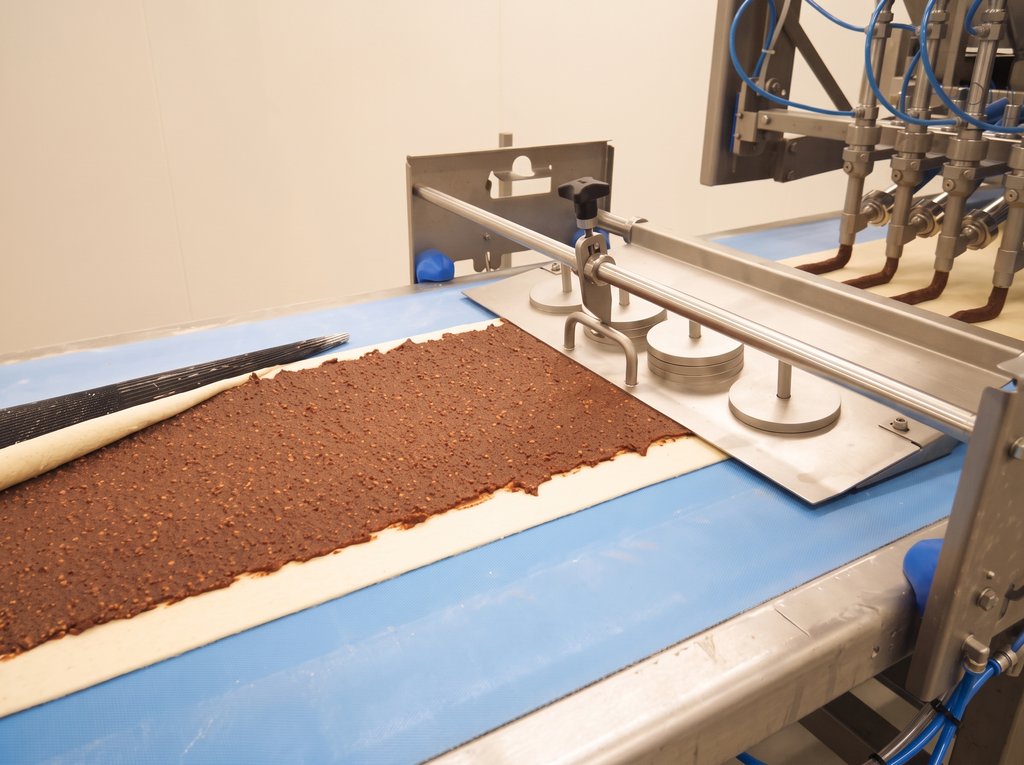
Cinnamon rolls serve as the reference product below.
Conical Roller Geometry and Coiling Stages
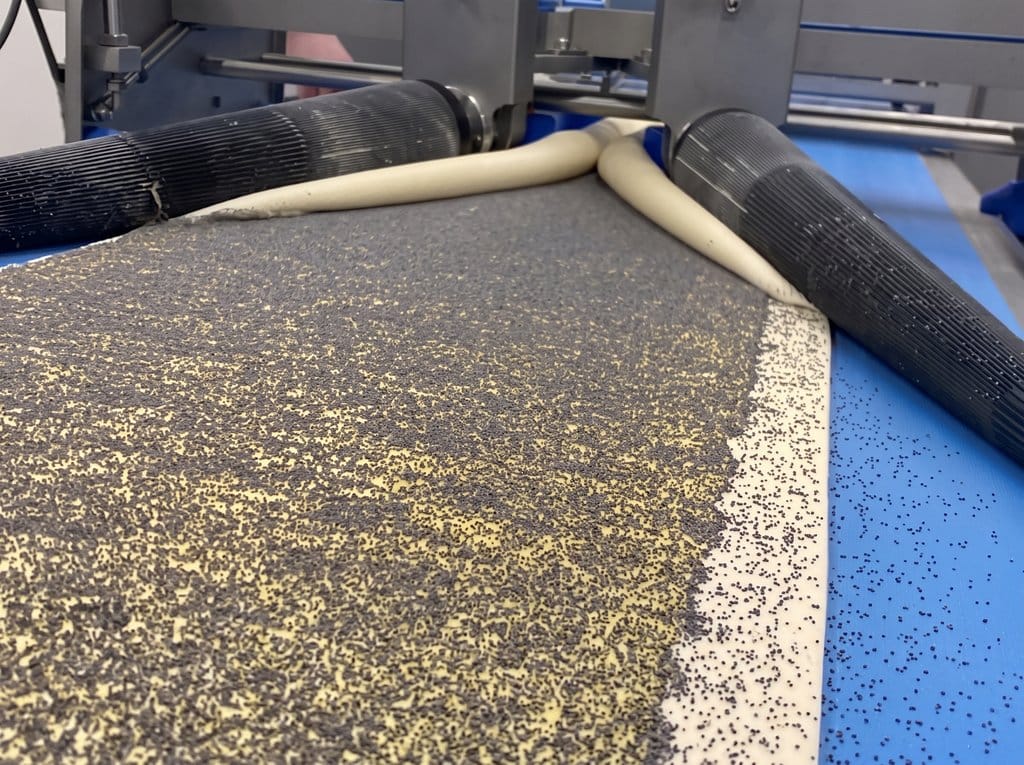
A cone narrows from base to tip. At a constant rotational speed, its wide end moves faster at the surface than its narrow tip. With the roller set at an adjustable angle over the moving belt, coiling develops in three stages:
Two conditions commonly disturb this balance:
Dough Handling Window at the Roller
For cinnamon rolls, the formulation carries a heavy load of enriching ingredients against flour weight, notably around 15% sugar, 12% fat and 10% eggs with 54% water absorption and 8% yeast.
Sugar, salt and egg proteins compete with gluten-forming proteins for water, which may weaken the network. Osmophilic yeast is generally preferred at these sugar levels, since non-osmophilic strains may need two to three times longer to ferment.
The balance between tenacity and extensibility shapes how the sheet responds at the cone:
A warm sheet may start gassing before coiling, and the bubbles can weaken the sheet and burst against the roller, releasing sticky moisture. Warmth may also soften the fat until it migrates toward the roller interface. Upstream, loose gauge rolls tend to yield thick sheets with too few curls, while tight settings may tear the dough.
Stickiness Between Dough and Roller
Uncontrolled stickiness can cause hours of downtime, yet a moderate level helps hold folded layers together, which may keep swirl turns bonded. Common contributing factors include overworking, excess water, flour extraction, water-soluble pentosans, protein composition and proteolytic enzyme activity. Adjusting water absorption is usually the simplest correction.
The Chen-Hoseney stickiness cell offers a way to quantify this before bulk preparation. A probe presses on the dough and is withdrawn quickly, giving three readings:
A clean release is more likely when the dough holds together internally more strongly than it clings to the cone. If adhesion prevails, a dough film may remain on the roller and mark the following pieces.
Filling Consistency and Layer Stability
Swirl fillings range from sugar-based smears to savoury sausage fillings. For cinnamon rolls, a blend of white and brown sugar is commonly preferred. In spreadable fillings, flow behaviour can strongly influence log stability:
Roller, Belt and Scraper Surfaces
Because sweet dough and sugar-rich fillings cling easily to equipment, contact surfaces in the coiling zone are typically selected for clean release:
Water absorption, dough temperature, sheet gauge, filling consistency and surface release tend to account for most coiling defects. Each product change or flour batch could shift the workable roller angle, so tracking stickiness and filling consistency between runs may reduce cleaning stops, filling losses and misshapen pieces, protecting margin on continuous swirl lines.
😊 Thanks for reading!
Sources
- Rademaker. “Efficient Pastry production by Rademaker.” YouTube: https://www.youtube.com/watch?v=efs_APHZDHg&t=2s
- Rademaker B.V. “Radini Pastry Make-Up Line”: https://rademaker.com/bakery-equipment/radini/radini-pastry-make-up-line/
- Beier, S. and Trost, E., A. Fritsch GmbH & Co KG. EP0740508B1, “Vorrichtung zum Aufwickeln eines Teigbandes” (Device for coiling a dough sheet): https://patents.google.com/patent/EP0740508B1/en
- BAKERpedia. “Cinnamon Roll | Baking Process”: https://bakerpedia.com/processes/cinnamon-roll/
- BAKERpedia. “Dough Handling Properties”: https://bakerpedia.com/processes/dough-handling-properties/
- BAKERpedia. “Dough Sheeting | Baking Process”: https://bakerpedia.com/processes/dough-sheeting/
- Stable Micro Systems. “Chen-Hoseney Dough Stickiness Cell” (Chen & Hoseney, LWT, 1995): https://www.stablemicrosystems.com/products/attachments/dough-stickiness-rig/
- Forbo Siegling GmbH. “Bakery Conveyor Belts for Dough Processing: Hygienic Solutions”: https://www.forbo.com/movement/en-gl/industries-applications/food/dough-processing/p96exd