Gummy Slices and Sweating Bags Start When Dispatch Pressure Shortens Bread Cooling
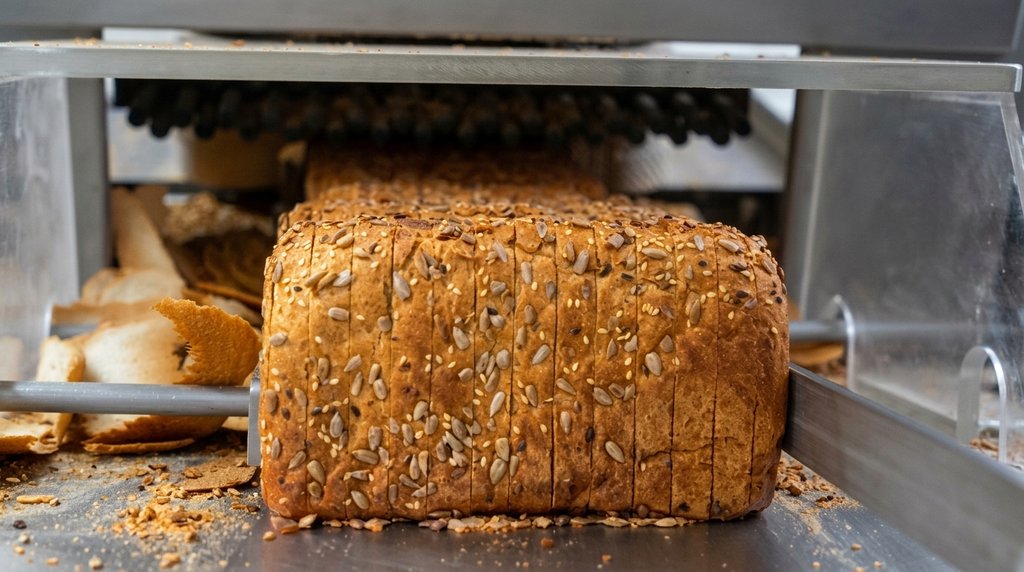
A late truck can tempt a plant to slice and bag loaves with cores near 38 to 40 °C instead of 32 °C. Those few degrees may coat slicer blades with starch paste, crush sidewalls and seed condensation that wakes mold spores before the bread reaches the shelf.
What Happens Inside the Loaf After the Oven
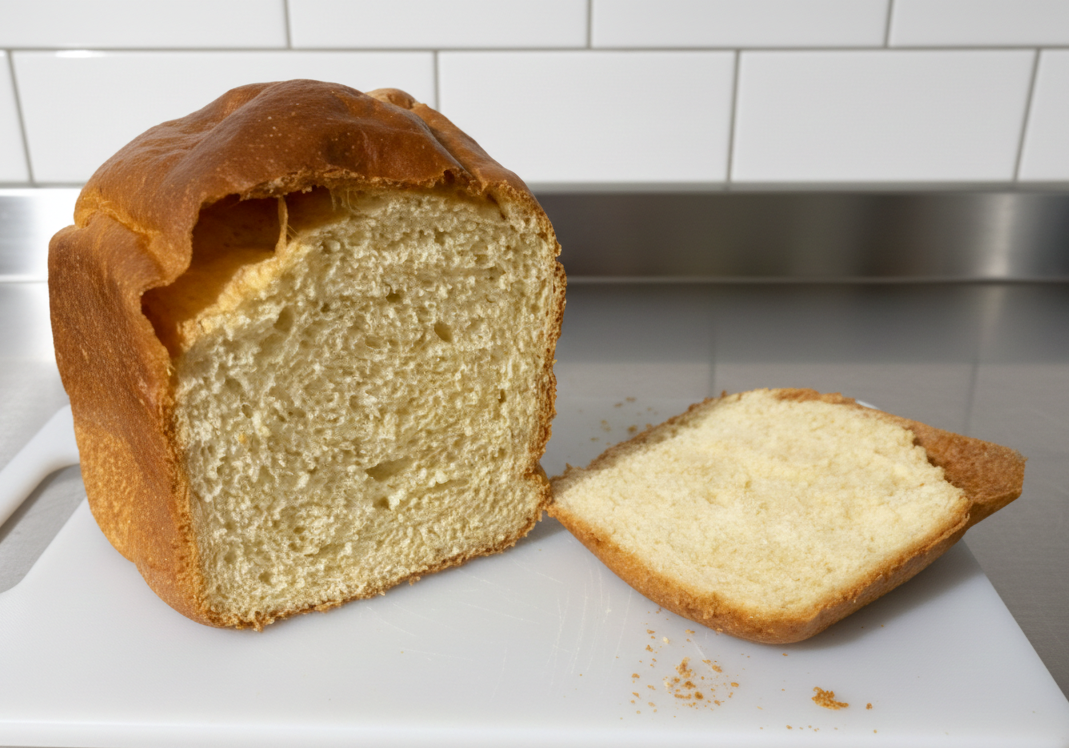
Bread leaves the oven with a core around 93 to 97 °C. At that point the gelatinized starch forms a soft, plastic gel, and the crumb still carries a large amount of mobile water. Cooling moves heat and moisture outward together: vapor travels from the moist center toward the drier crust, which gradually turns from a brittle shell into a more pliable layer.
The structural event that matters for slicing is amylose retrogradation. As the core cools, the linear amylose chains reassociate and partially recrystallize, setting the crumb into a resilient network that can recover after compression. Amylopectin, the branched starch fraction, recrystallizes far more slowly over several days and drives staling. The early amylose set is what gives a loaf enough firmness to survive the slicer.
Industrial guidance places the slicing window roughly between 30 and 36 °C, with many lines targeting 32 to 35 °C. Above that range, the amylose network may still be incomplete and vapor is still moving through the crumb, so the loaf behaves more like a warm sponge than a set structure.
Why Warm Crumb Gums the Blades
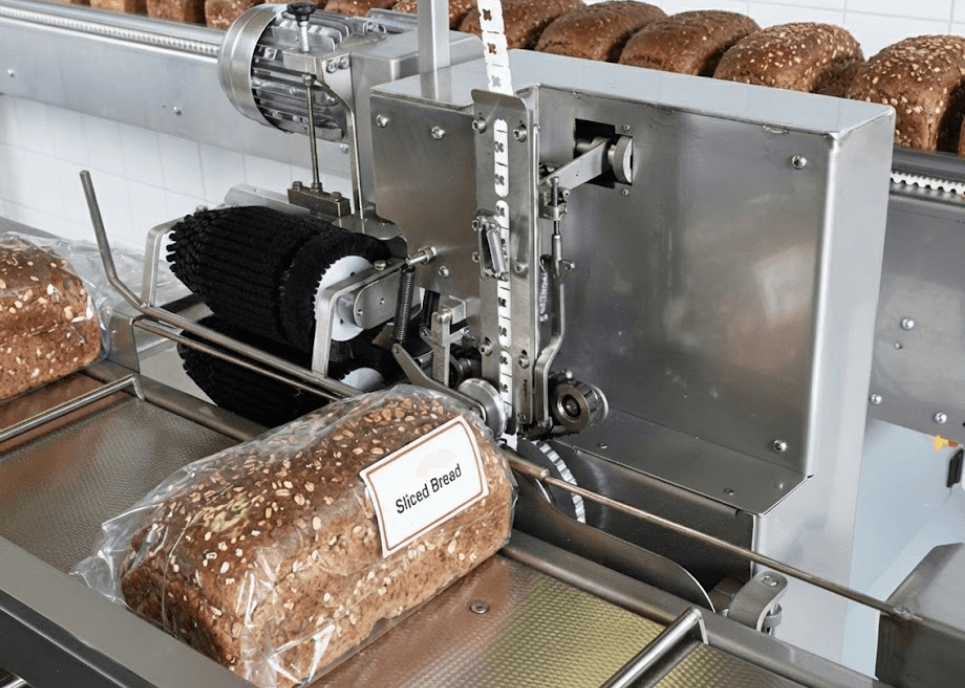
Most high speed lines use band slicers, where endless blades driven by two drums run in a figure eight path through guides.
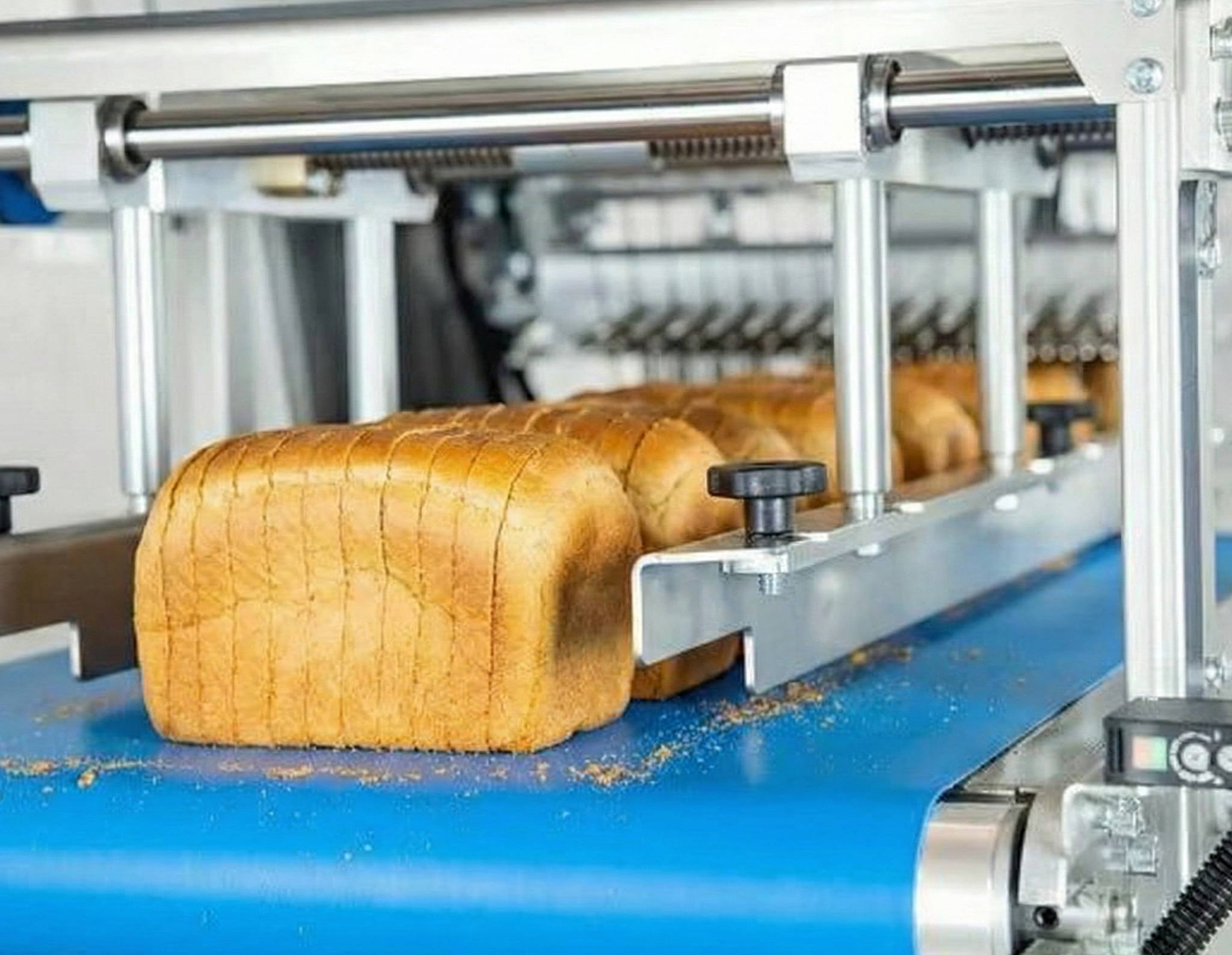
Reciprocating slicers move a frame of fixed blades up and down as loaves pass through.
When the core is still above that window, the crumb is too soft to fracture cleanly. Small pieces of doughy crumb and soluble starch tend to stick to the blade sides and to the valleys between the teeth. As that film builds up, friction rises and the problem feeds on itself:
The same build up often appears in summer, when warmer rooms slow cooling. Some slicer designs respond with narrower blade bodies that reduce side contact, hard low friction coatings and pneumatic oil mist. These measures can reduce adhesion, although heavier oiling may mark slices and trap crumbs inside the frame, so they work best as support for adequate cooling.
Formulation can amplify the effect. In sourdough or rye based breads with insufficient acidity, alpha amylase may convert part of the starch into dextrins, short and very sticky sugar chains that resist setting. An overdose of maltogenic amylase, an anti staling enzyme that trims amylopectin branches, could also delay the early crumb set and leave sidewalls too tender to support the crust.
Recommended Reading:
Shape Matters: Eliminating Downtime in Automated Bakery Packaging
Reduce downtime and prevent bottlenecks in automated bakery packaging by mastering product geometry and dimensional consistency.
Bakery Industry InsiderHow a Warm Loaf Creates Condensation in the Bag
Polyethylene bags are chosen for their low water vapor transmission, which keeps the crumb soft for days. Even with properly cooled bread, the air inside a sealed plastic bag tends to settle close to 90% relative humidity, in balance with the moist crumb.
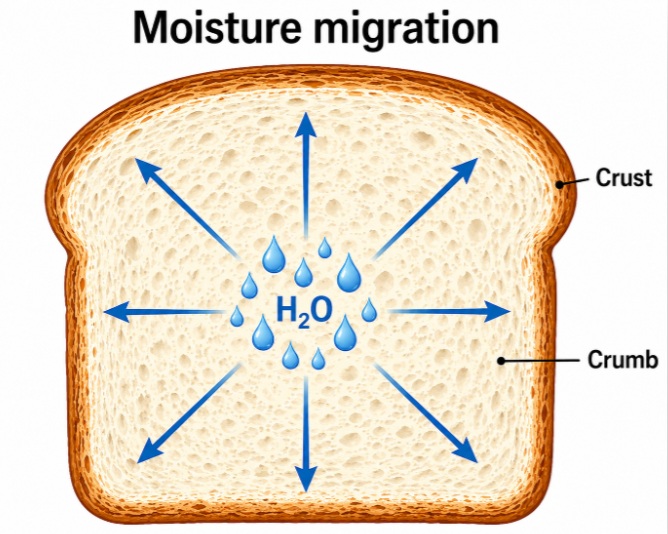
A loaf sealed with a warm core keeps releasing vapor into that small headspace. Once the crates move to a cooler dock or delivery truck, the film cools faster than the bread. When its inner surface drops below the dew point of the trapped air, vapor turns into droplets on the film and on the crust. Temperature swings during distribution can repeat this cycle several times.
Liquid water causes more damage than humid air alone. It creates local wet spots, softens the crust into a soggy skin and raises the surface water activity close to that of free water, exactly where airborne spores have settled.
Why Mold Can Appear Within Days
Bread leaves the oven essentially sterile, since baking temperatures inactivate molds well before the core is done. Contamination happens afterward, during cooling, slicing and packing. Flour dust carries spores through unfiltered or recirculated air, and slicer blades can drag them across every cut face. Common spoilage genera include Penicillium (blue green), Aspergillus and Rhizopus (black, cottony growth).
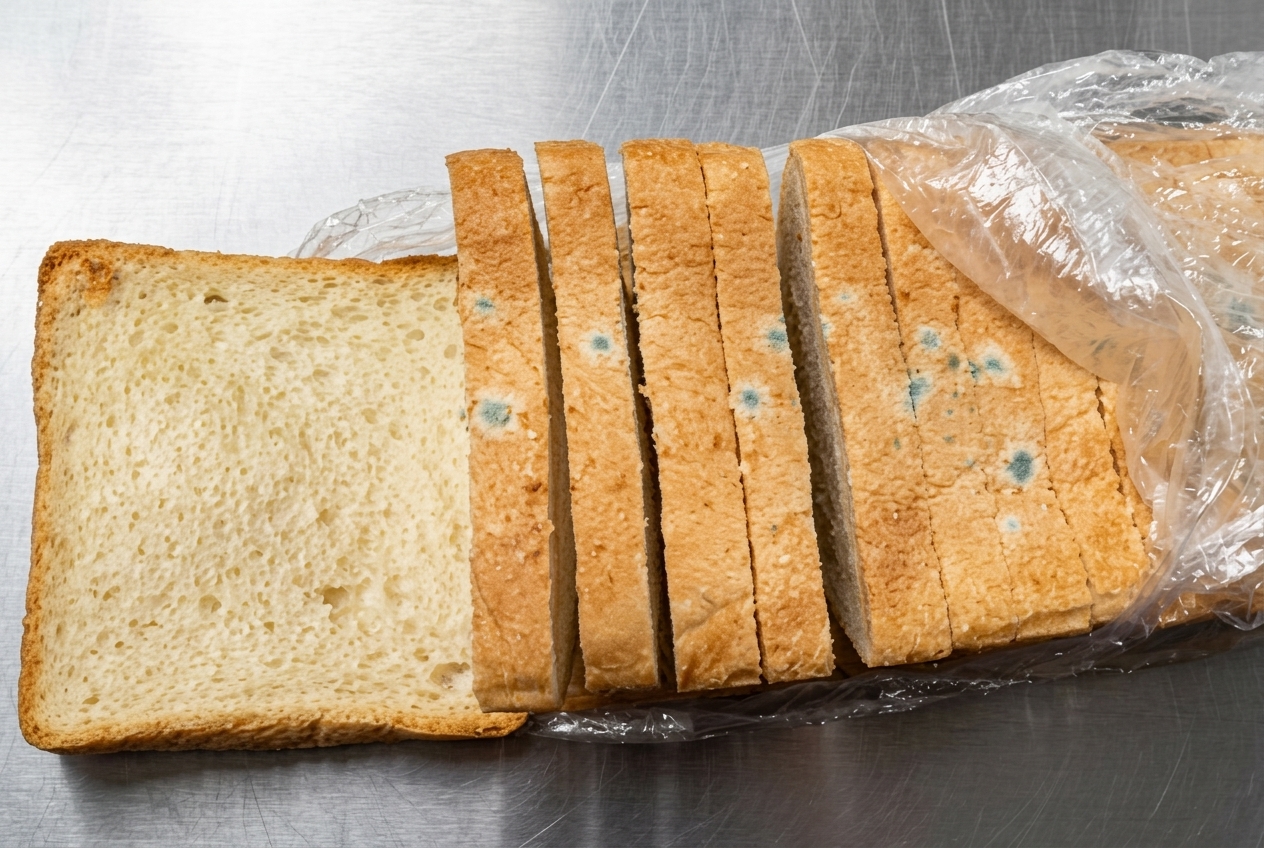
Fresh crumb is already moist enough to support fungal growth. Condensation supplies free water right at the surface, and warm stacked crates may hold the bread at the mild temperatures molds favor. Under those conditions, a single spore can develop into a mature colony in roughly two to four days, so early growth may show up while the bread is still in the distribution chain.
Sourdough offers some protection. Its higher acidity, produced by lactic acid bacteria during fermentation, tends to slow mold considerably compared with standard pan bread. That margin narrows when spore load is high and humidity stays trapped in plastic, and acidified loaves may still mold within four to five days under those conditions.
Process Options When the Truck Cannot Wait
Lines facing dispatch pressure usually combine several adjustments rather than relying on one fix:
A few degrees at the slicer can decide whether a shift ends with clean blades and stable shelf life or with crushed slices, unplanned stops and returns from retailers. Plants that measure core temperature consistently and size cooling capacity to real throughput usually find that the time saved by bagging warm comes back as scrap, downtime and complaints, although the right balance depends on each line’s layout, products and delivery routes.
😊 Thanks for reading!
Sources:
- Bread Cooling, BAKERpedia, https://bakerpedia.com/processes/bread-cooling/
- Bread Slicing, BAKERpedia, https://dev.bakerpedia.com/processes/bread-slicing/
- The Science of Staling, BAKERpedia, https://bakerpedia.com/the-science-of-staling/
- Mold, American Society of Baking, https://asbe.org/article/mold/
- Optimizing Automated Bakery Packaging, Bakery Industry Insider, https://bakeryinsider.com/automated-bakery-packaging-downtime/
- From 90 Minutes to 5 Minutes: How Vacuum Cooling Transforms Bakery Operations, Bakery Industry Insider, https://bakeryinsider.com/90-minutes-5-minutes/
- Impact of Storing Condition on Staling and Microbial Spoilage Behavior of Bread, Foods (PMC), https://pmc.ncbi.nlm.nih.gov/articles/PMC7824337/
- Functional Polymer and Packaging Technology for Bakery Products, Polymers (PMC), https://pmc.ncbi.nlm.nih.gov/articles/PMC9501505/
- Reciprocating bread slicer device, cutting blade and method for manufacturing the blade, WO2013025101A1, Google Patents, https://patents.google.com/patent/WO2013025101A1/en
- Packaged Bread and Mold: The Science of Shelf Life, Puratos, https://www.puratos.com/blog/mold-packaged-bread-understanding-the-science-behind
- How Moisture Causes Food Spoilage Inside Sealed Packaging, Desiccare, https://desiccare.com/blogs/blog/how-moisture-causes-food-spoilage-inside-sealed-packaging
- Horizontal slicing machines with band blade, Dovaina, https://dovaina.lt/products/horizontal-slicing-machines-with-band-blade/
- Starch Gelatinization: Why You Must Wait Before Slicing, S.D Timer, https://sdtimer.com/learn/starch-gelatinization.html
- Rye Bread Guide: Baking with Rye Flour, JayArr Bread, https://jayarrbread.com/blog/rye-bread-guide/
- Bakery Vacuum Cooling vs Spiral Cooling Systems, Allcold, https://allcoldcooling.com/bakery-vacuum-cooling-vs-spiral-cooling-systems-which-is-better-for-your-business/