Why Tissue Bread Layers Peel Cleanly: The Role of the Closed Pullman Pan
Keeping sub-millimeter laminated layers parallel and intact through oven spring would likely be the main challenge in producing tissue bread at scale. The lidded Pullman pan, together with dough strength and roll-in fat selection, could largely determine whether the finished cube peels into clean, flexible sheets.
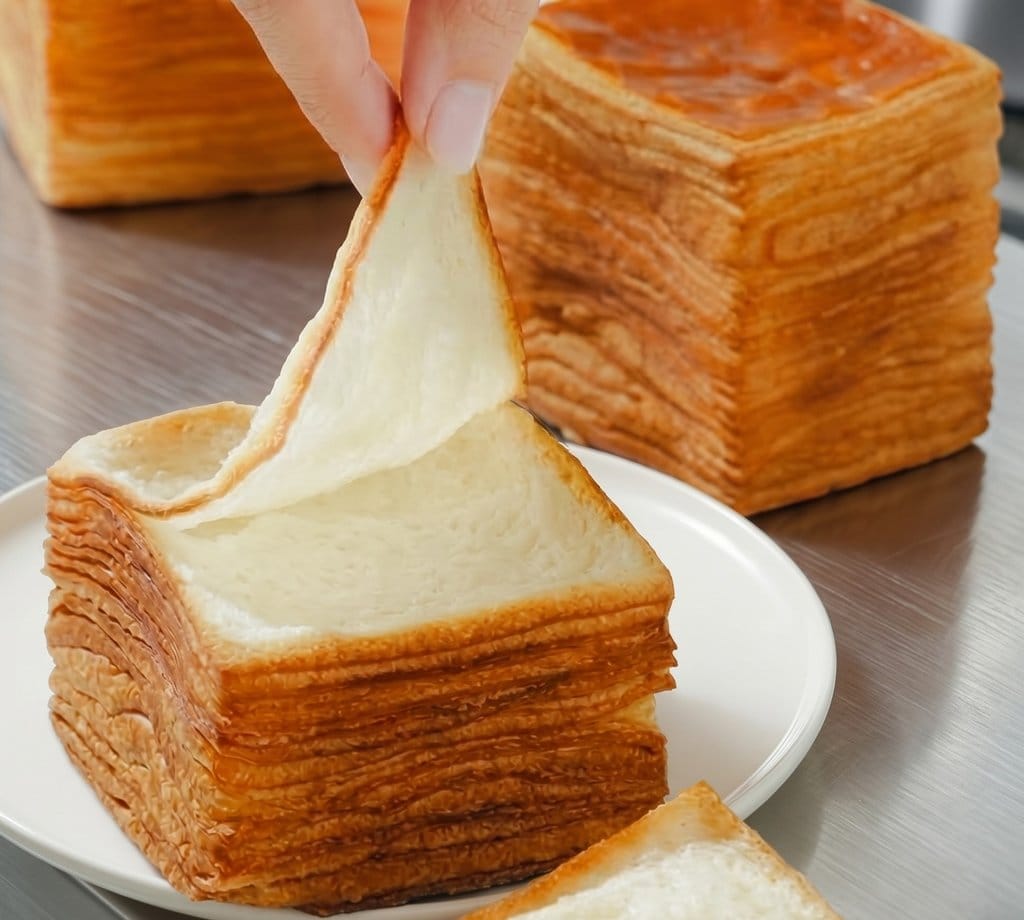
The contemporary version of this product, a cube whose layers peel away individually like tissues, gained traction through Truffle Bakery in Hannam-dong, Seoul, which popularized the “Tissue Bread” name and was widely reported as a viral sensation by mid-2024.
Base Dough Rheology for Repeated Sheeting
On high-speed laminating lines, flour quality targets focus directly on sheeting performance, balancing resistance to roller shear against the extensibility needed for deep gauge reduction:
Hydration is deliberately kept tighter, around 54%, compared to standard pan bread formulas that often exceed 62%. Keeping free water restricted prevents moisture from migrating into the butter layers during sheeting, which would otherwise destabilize the fat emulsion and smear the lamination.
Formulation would support this balance in several ways:
Roll-In Fat Selection: Butter Versus Industrial Margarine
The laminating fat influences both machinability and eating quality. Typical contrasts between the two fat types include:
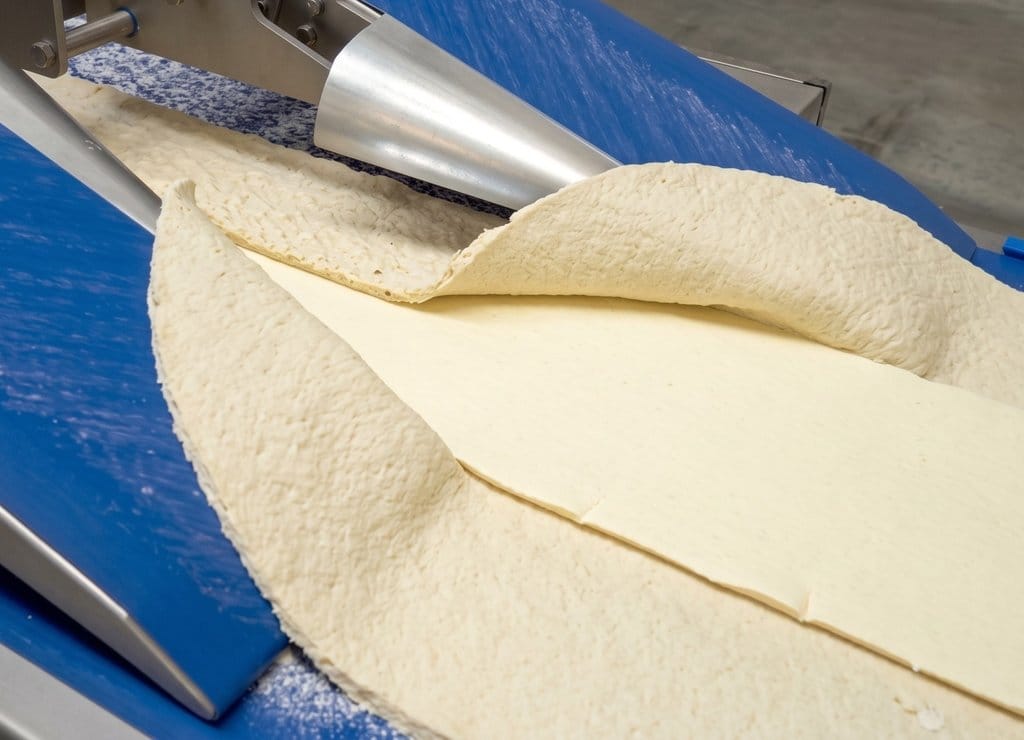
On a continuous high-speed line, butter might oil out or tear the sheet if dough temperature climbs above 19°C through friction and shear. Margarine, with a more constant yield stress, would typically tolerate these conditions with less risk of melting. Fat selection could therefore involve weighing line tolerance against flavor and mouthfeel.
Lid Confinement During Oven Spring
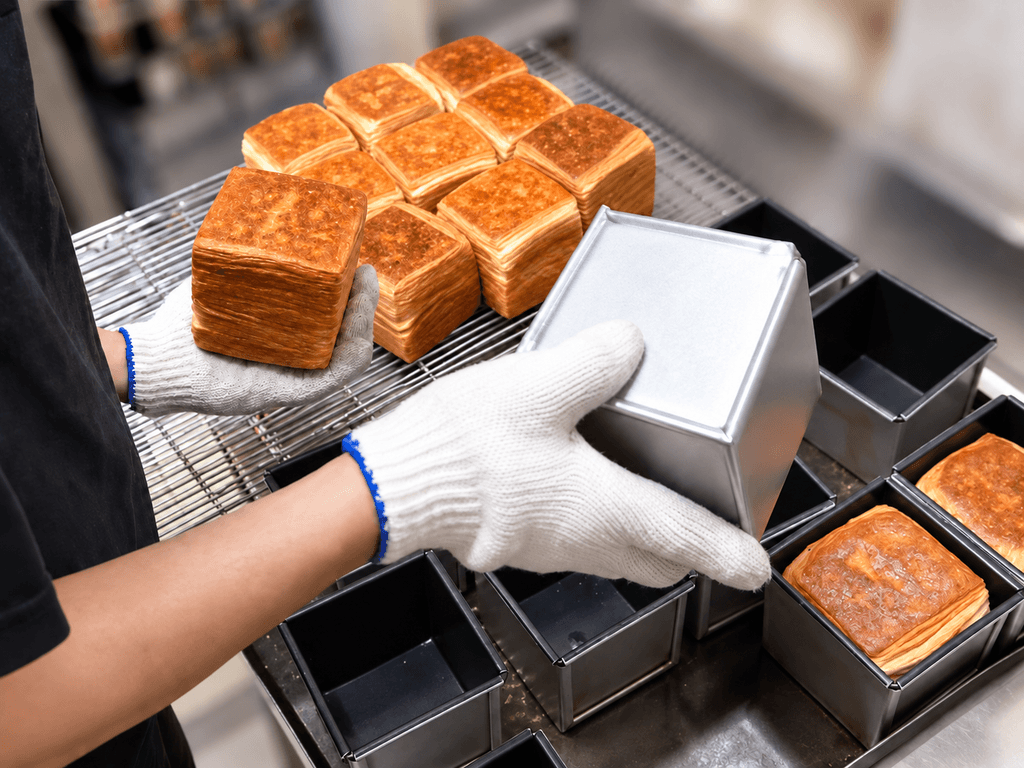
In the first 10 minutes of baking, water vaporization and thermal expansion of trapped gases drive a rapid increase in volume. In an open pan, this expansion would mostly travel upward, which could cause the top to burst open, crack, and disorganize the lamination.
Once the dough contacts the sealed lid, upward expansion stops. Pressure inside a confined fluid acts equally in all directions, so internal pressure would redistribute toward the corners, side walls, and edges of the pan.
This contained pressure compresses the dough layers against the films of melted fat, preventing asymmetric puffing. The layers consolidate into continuous, parallel horizontal planes that, after cooling, peel away like sheets of paper without tearing the crumb.
Steam Retention Inside the Closed Pan
The residual air volume in a closed Pullman pan is small. Moisture released from the dough early in the bake quickly saturates this space, reaching 100% relative humidity at the dough and metal interface.
This saturated environment produces three direct effects:
Browning Control and Heat Transfer Through the Pan Walls
The formulation carries high levels of browning substrates, including sucrose, lactose, and lysine from milk and butter solids. Under direct oven exposure, these would likely brown quickly.
😊 Thanks for reading!
Sources:
- Ferrari, S. “Tissue Bread: Does This Viral Korean Snack Really Have 1000 Layers?” Daily Meal, 2024: https://www.thedailymeal.com/1617918/what-is-viral-tissue-bread/
- Puratos Taste Tomorrow. “Seoul’s trending pastries and baked goods to put on your watchlist.” 2024: https://www.puratos.co.id/en/blog/taste-tomorrow/seoul-trending-pastries-and-baked-goods-to-put-on-your-watchlist
- Jødal, A.S., Larsen, K.L. “Investigation of the relationships between the alveograph parameters.” Scientific Reports, Nature Portfolio, 2021: https://pmc.ncbi.nlm.nih.gov/articles/PMC7935897/ (
- Zhang, L., Yang, W., Xu, K., Long, L., Ye, H. “Study on Moisture Phase Changes in Bread Baking Using a Coupling Model.” Foods, MDPI, 2025: https://pmc.ncbi.nlm.nih.gov/articles/PMC12071401/
- Chen, Y., Gavaliatsis, T., Kuster, S., Städeli, C., Fischer, P., Windhab, E.J. “Crust treatments to reduce bread staling.” Current Research in Food Science, Elsevier, 2021: https://pmc.ncbi.nlm.nih.gov/articles/PMC8050008/
- Centre for Industrial Rheology. “Butter vs Margarine Spread.” Rheology Lab UK, 2021: https://www.rheologylab.com/articles/food/butter-v-margarine-spread/
- SwissBake Technical Team. “The Role of Butter in Laminated Pastries.” SwissBake, 2023: https://www.swissbake.in/blog/the-role-of-butter-in-laminated-pastries