4 Croissant Fillings Driving the 2026 Bakery Trend Cycle
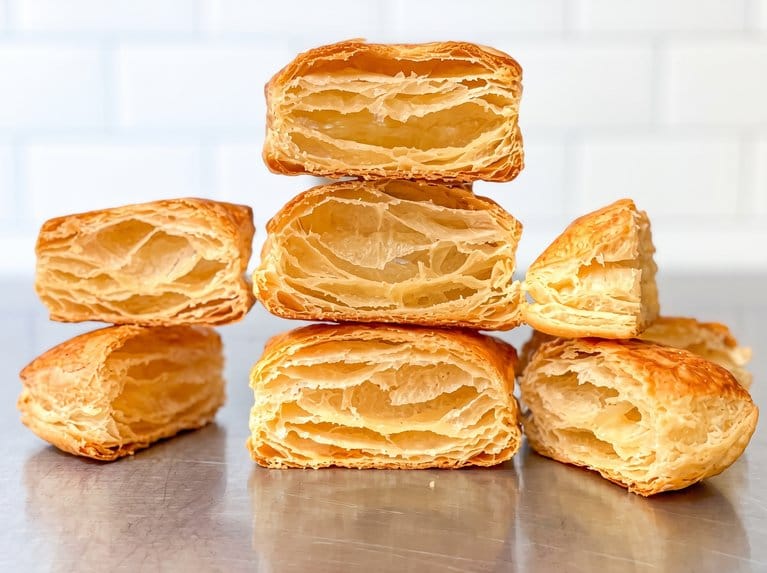
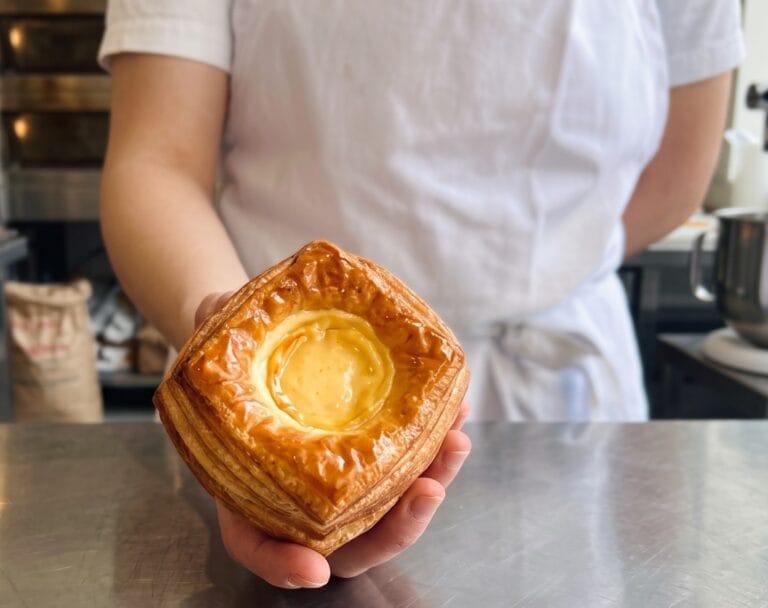
Laminated dough demands fillings that hold their structure without crushing air cells, resist moisture migration that softens the flaky crust, and deliver bold sensory contrast.
Why Filling a Croissant Could Be an Engineering Problem
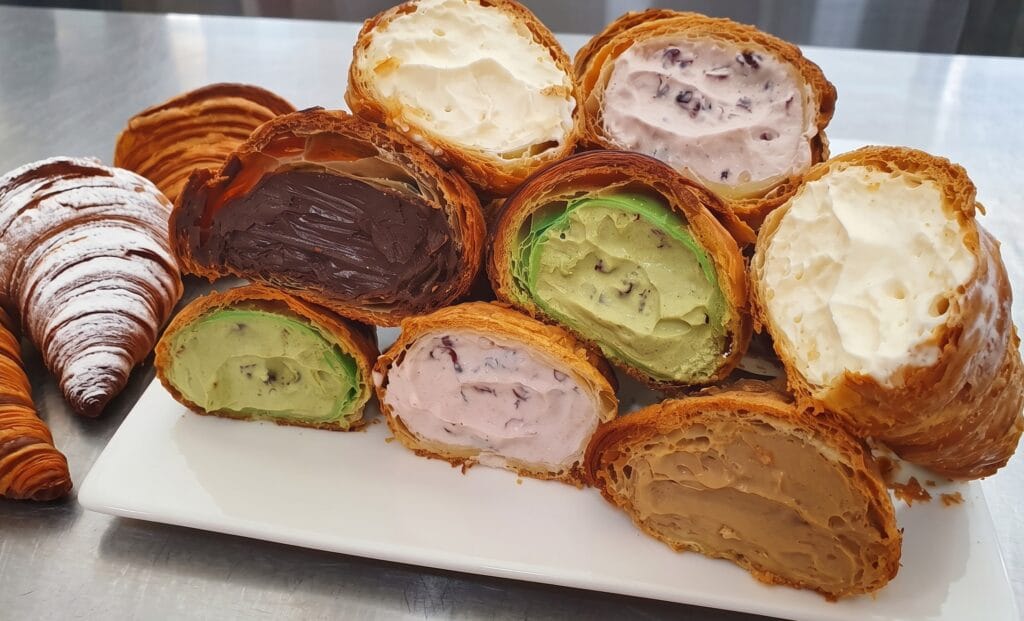
A croissant’s identity depends on the coexistence of two opposing moisture environments. The outer crust stays crisp only when its water activity remains below 0.45, while the soft inner crumb sits near 0.86 to 0.90. Introducing any filling creates a gradient between these zones. Water naturally migrates from the wetter filling toward the drier shell, often softening it within hours.
At the same time, the filling must be fluid enough to pump or inject through narrow nozzles at production speed, yet firm enough at rest to avoid pooling at the base or collapsing the delicate air cells under its own weight. Solving both problems simultaneously, moisture balance and rheological stability, is the core technical challenge behind every formulation below.
1. Pistachio Praliné, Tahini, and Toasted Kataifi Threads
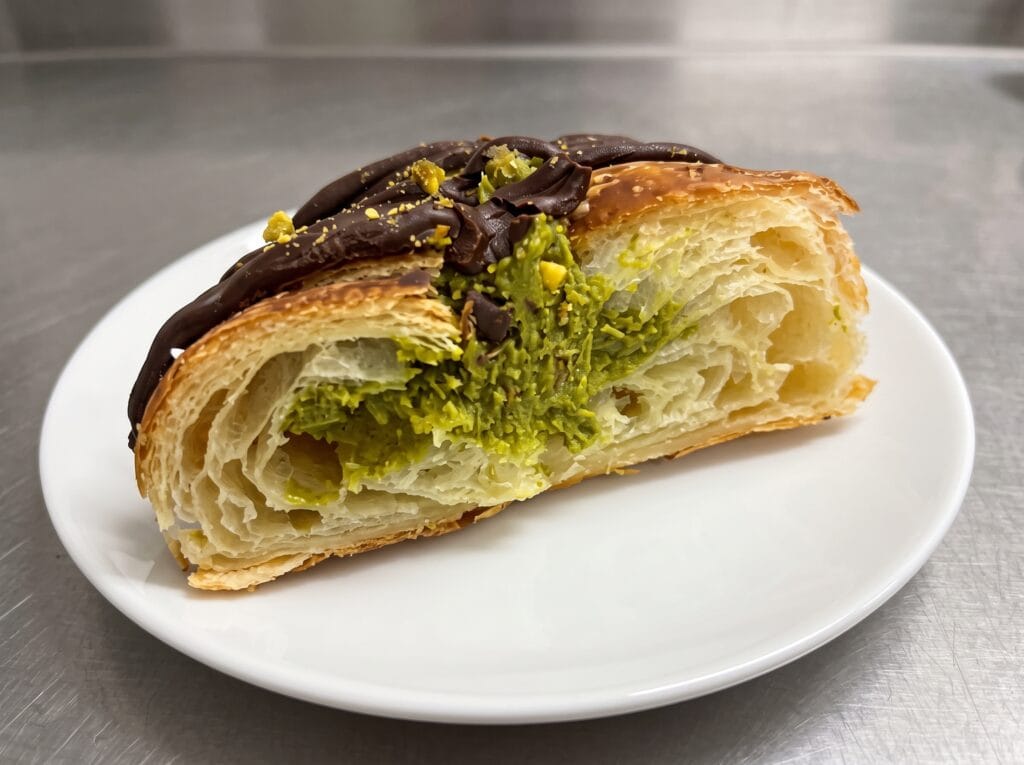
This filling builds on the viral “Dubai Chocolate” trend, elevating it for premium bakery. A dense, anhydrous emulsion of pure roasted pistachio paste and tahini suspends crispy kataifi threads fried in clarified butter.
Key technical advantages:
The assembly is done entirely cold: the croissant is baked and then cooled to below 25°C. It should be filled using a wide-mouth nozzle to preserve the kataifi strands intact.
2. Purple Ube Cloud with Elastic Mochi Core
Driven by visual appeal and the Asian-inspired “texture mash-up” movement, this dual-component filling pairs a silky ube cream with a chewy mochi center.
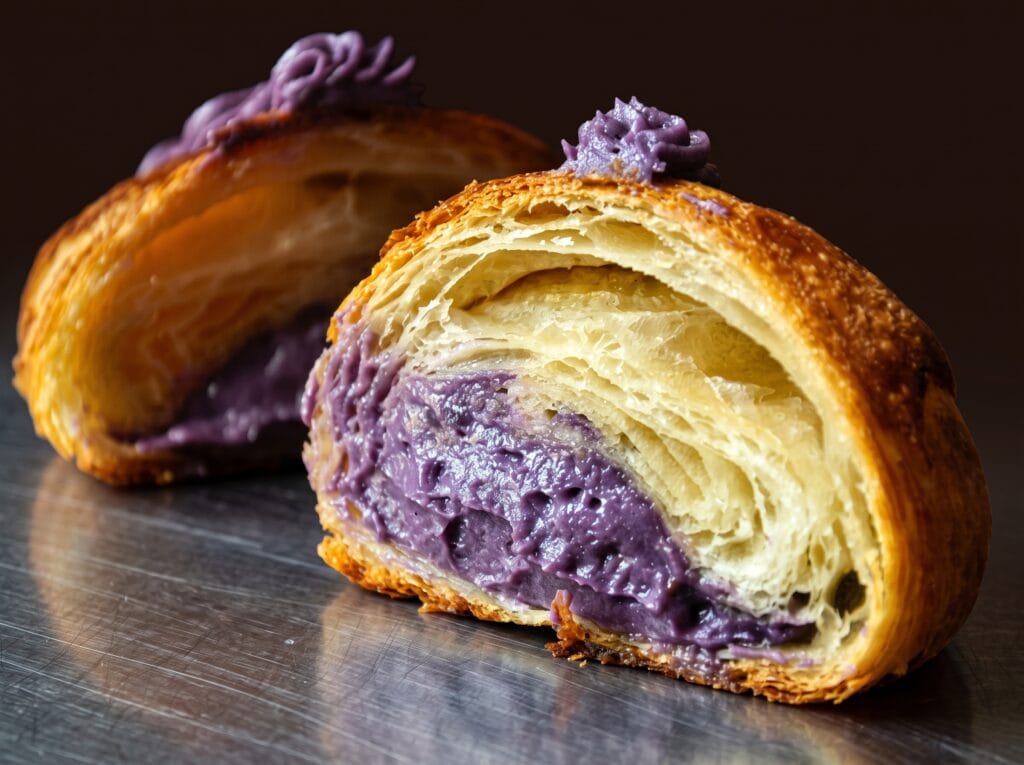
The ube cream is formulated as a stabilized namelaka-style emulsion (an ultra-creamy, velvety ganache), firm enough to support the inner crumb without weighing down delicate air pockets, while remaining airy and spoonable. At the center, the mochi core delivers a distinctly chewy, elastic texture that stretches on the bite without tearing the surrounding pastry.
The critical challenge is retrogradation.
Cold storage may cause the starch chains in traditional mochi to recrystallize and harden.
Adding trehalose (15 to 20 % of the carbohydrate base) alongside small amounts of maltitol syrup and glycerol helps suppress this crystallization, keeping the mochi soft at display temperatures between 4 and 18 °C.
Both components are matched to a narrow water-activity window of 0.74 to 0.77, minimizing the driving force for moisture transfer between them and toward the pastry shell. A blend of amidated low-methoxyl pectin and xanthan gum in the ube cream helps lock free water through calcium-ion cross-linking, limiting syneresis to less than 0.5 % over 48 hours.
3. Brown Butter Miso Salted Caramel
This filling merges the Maillard-driven nuttiness of browned butter solids with the deep enzymatic fermentation notes of white shiro miso. The result is a toffee with pronounced umami, balanced salinity, and a malty, complex aftertaste.
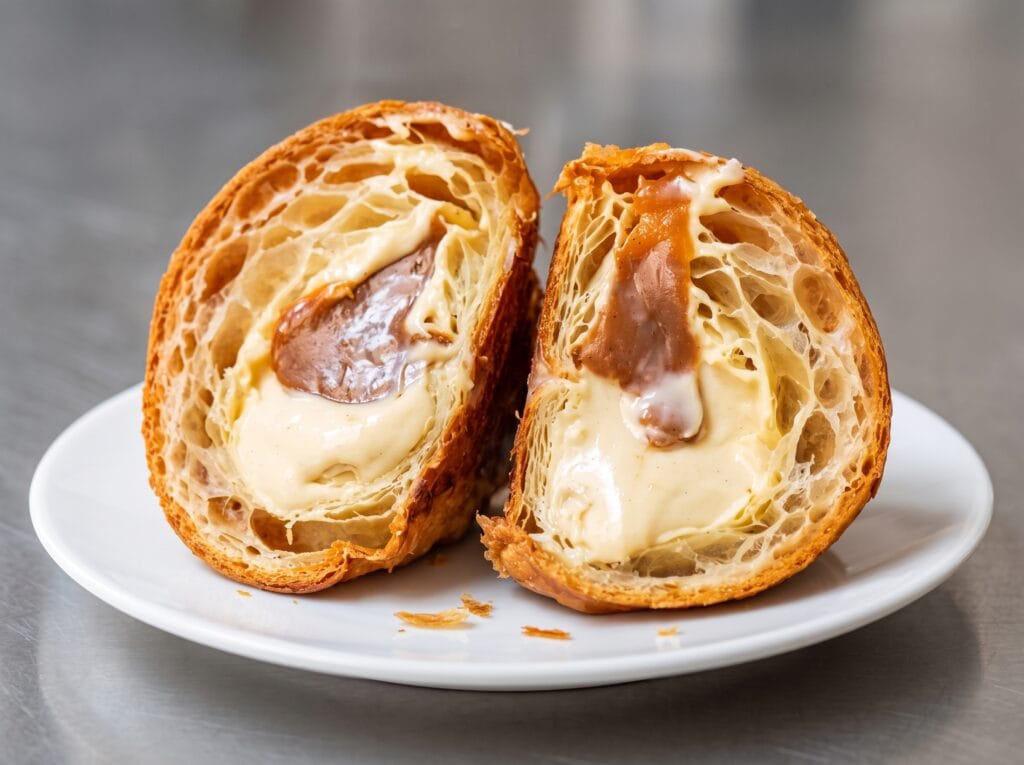
The emulsion of butterfat and concentrated sugar is stabilized with non-GMO sunflower lecithin and a small addition of low-acyl gellan gum, which together help prevent oil separation across the 15 to 35 °C service range.
Injection should occur warm. The caramel is held in a heated hopper at 35 °C, where its viscosity drops enough for clean pumping, then injected through two basal points into the cooler croissant at 20 °C.
4. Aerated Matcha Ganache with Yuzu Fluid Gel
Ceremonial-grade matcha from Uji delivers astringent, herbaceous, and chlorophyll-forward notes that contrast sharply with the punchy citrus terpenes of yuzu. The filling is engineered in two concentric layers.
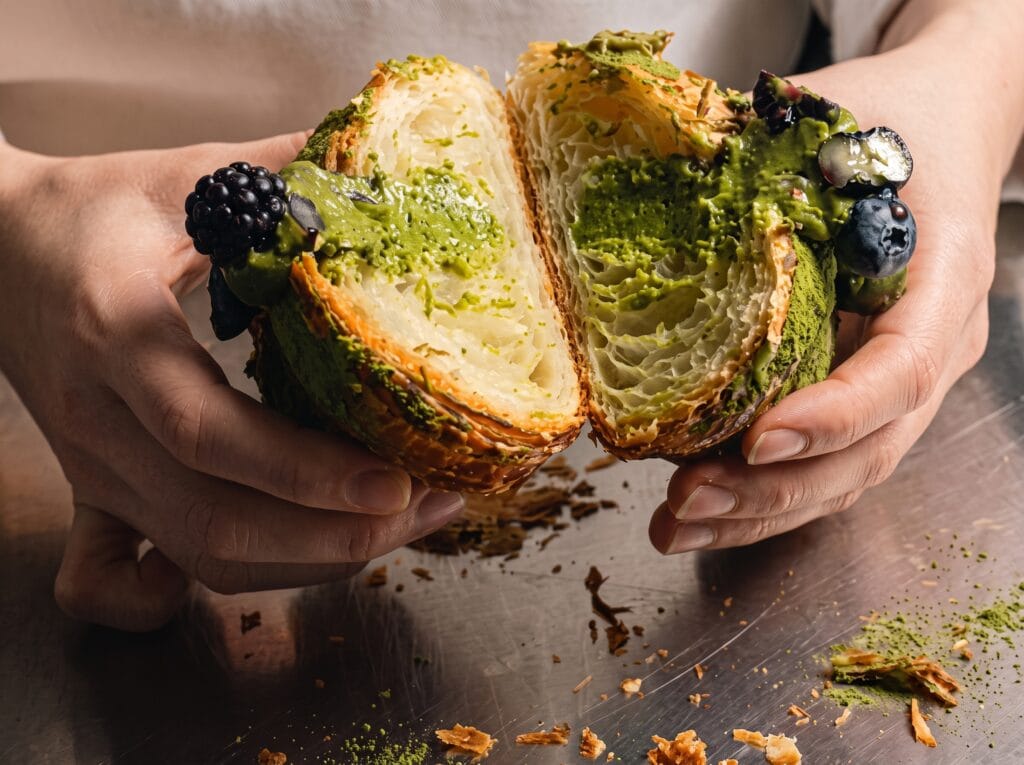
The outer layer is a whipped (montée) ganache with a light, aerated structure that cushions the bite without heaviness. The inner core is a fluid gel of yuzu, made by shearing an agar or gellan network during cooling. At rest it holds its shape, but under the force of a bite it flows instantly, releasing a burst of clean acidity at a pH near 3.2.
That acidity poses a risk:
Citric acid could degrade the gluten network of the surrounding pastry. The design solution is encapsulation. The yuzu gel sits entirely enclosed within the ganache’s continuous fat phase, which acts as a physical shield.
Injection temperature is kept between 12 and 15 °C to preserve the bubble microstructure of the aerated ganache.
😊 Thanks for reading!
Sources:
- Puratos US (Texture Trends, Hybrids, Ube Mochi): https://vertexaisearch.cloud.google.com/grounding-api-redirect/…
- Puratos US: https://vertexaisearch.cloud.google.com/grounding-api-redirect/…
- Chewco: https://vertexaisearch.cloud.google.com/grounding-api-redirect/…
- Délifrance (Dynamic Sensory, Miso Caramel): https://vertexaisearch.cloud.google.com/grounding-api-redirect/…
- Mosaic Flavors & Finsbury Foods (Miso Caramel, Umami, Brown Butter): https://vertexaisearch.cloud.google.com/grounding-api-redirect/…
- Bakery and Snacks / British Baker: https://vertexaisearch.cloud.google.com/grounding-api-redirect/…
- Viscovery: https://vertexaisearch.cloud.google.com/grounding-api-redirect/…
- Bakels & Barry Callebaut (Filling Technology, Sensory Textures): https://vertexaisearch.cloud.google.com/grounding-api-redirect/…
- Bakels & Barry Callebaut: https://vertexaisearch.cloud.google.com/grounding-api-redirect/…
- Cauvain, S. P., Baking Problems Solved; Edwards, W. P., The Science of Bakery Products.