Molecular Butter: The Future of Bakery Lipids
Dairy butter prices remain notoriously volatile, creating severe margin squeezes for industrial bakers. Standard plant oils often ruin delicate pastry textures while accelerating deforestation. Fortunately, innovative startups are now engineering exact molecular replicas of dairy fat, which could permanently stabilize supply chains and elevate baked goods.
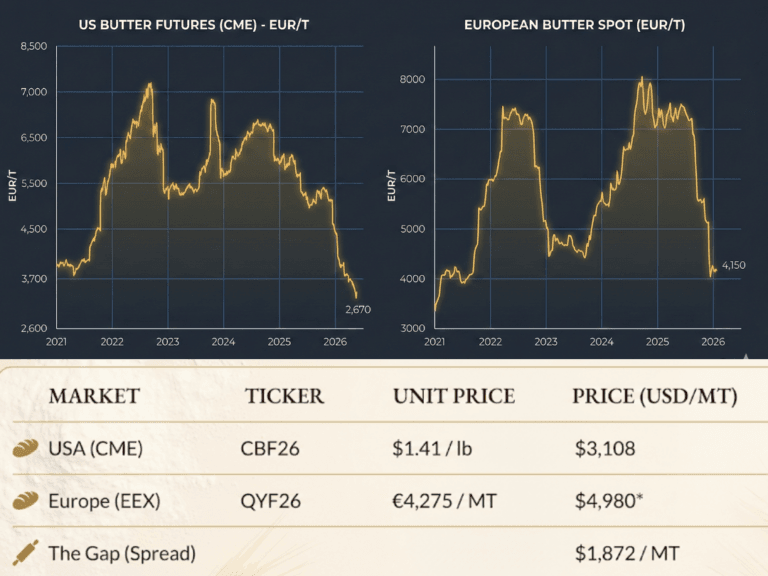
The global industrial baking sector might be navigating profound structural shifts, driven by the extreme cyclicality of dairy lipids. Between 2021 and 2022, European butter prices experienced massive spikes, surging past 7,000 EUR/T and eventually touching nearly 8,000 EUR/T by 2025. While prices corrected briefly, CFD markets saw them rise again to 4,900 EUR/T by March 2026. For industrial scale bakeries, this volatility could fundamentally alter procurement economics.
Replacing butter in industrial baking may not be a simple volumetric exchange. Butter offers a specific matrix of physical chemistry, thermodynamics, and rheology. Any viable replacement should likely satisfy three critical parameters:
Standard plant based alternatives, which rely on palm, soy, and coconut oils, might present severe functional limitations and environmental challenges. In response, a new vanguard of biotechnology firms has emerged, which could replicate dairy butter from the molecular level upward.
Thermochemical Synthesis
One of the most disruptive approaches could bypass agriculture entirely. The California based startup Savor synthesizes functional fats from foundational elemental precursors, utilizing carbon dioxide, water, and methane.
The process involves generating syngas and alkanes, oxidizing them into fatty acids, and esterifying them into triglycerides.
According to recent industry reports, Savor operates a pilot facility in Batavia, Illinois, producing butter that could look and taste like the traditional product without the greenhouse gas emissions associated with cows. Savor’s formulation possesses a wide range of fatty acids, creating a broad melting curve that has been empirically validated by Michelin starred pastry chefs.
Precision Fermentation
Precision fermentation might represent another paradigm shift, potentially transitioning lipid production from agricultural tracts to highly controlled bioreactors. By leveraging oleaginous microorganisms, biotechnology firms could dictate the exact lipid profile produced.
The Road Ahead
The integration of these novel lipids could rely heavily on achieving cost parity and navigating complex regulatory landscapes.
In the United States, ingredients derived from novel processes might reach the market through the Generally Recognized As Safe (GRAS) pathway. Conversely, the European Union presents a rigorous barrier, potentially requiring comprehensive pre market authorization under the Novel Food regulation.
Ultimately, replacing butter has evolved into a strategic migration toward engineered lipids, which could offer infinite customizability and absolute supply chain resilience.
😊 Thanks for reading!
Sources:
- Savor Process Outline: https://www.savor.it/process
- CBS News Chicago (Savor Batavia Facility): https://www.cbsnews.com/chicago/news/butter-carbon-bill-gates-batavia-illinois/
- Food Ingredients First (Melt&Marble Series A): https://www.foodingredientsfirst.com/news/melt-marble-7m-investment.html
- Fonterra (Nourish Ingredients Partnership): https://www.fonterra.com/nz/en/our-stories/articles/fonterra-and-nourish-ingredients-join-forces-to-develop-innovative-new-products.html