
A Wider Seeder Gate Won’t Stop Seed Loss From Oven to Bag
When sesame seeds detach on high speed pan bread lines, plants often compensate by overdosing expensive toppings. Most of that loss happens because plain water evaporates before the crust sets, leaving seeds exposed to proofing expansion, oven spring, slicer blades, and friction inside the bag.
Pre-Proof Seeding Versus Post-Proof Application
Industrial bread and roll lines apply sesame toppings at two distinct points, and each position creates different mechanical trade-offs.
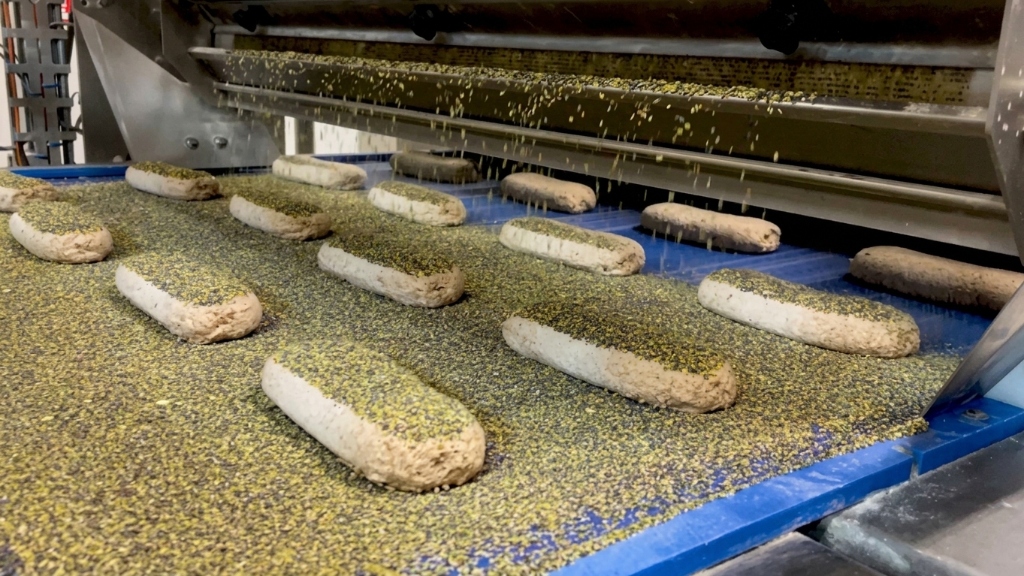
In pre-proof setups common on continuous pan bread and roll lines, the shaped dough piece leaves the final moulder, passes a wetting roller, damp cloth, or fine spray, and moves through a seed bed or cascade before panning. Excess dry seeds drop into a collection bin beneath the belt. Because the dough is still firm and compact, a gentle top roller or pressure belt can press the seeds slightly into the tacky gluten surface.
That early embedment still has to survive final fermentation. As yeast generates gas during proofing, the dough surface stretches substantially. If proofer relative humidity drops too low, moisture evaporates from the outer layer and forms a tight, inelastic skin. When that dry skin expands inside the oven, it tends to crack and push embedded seeds outward.
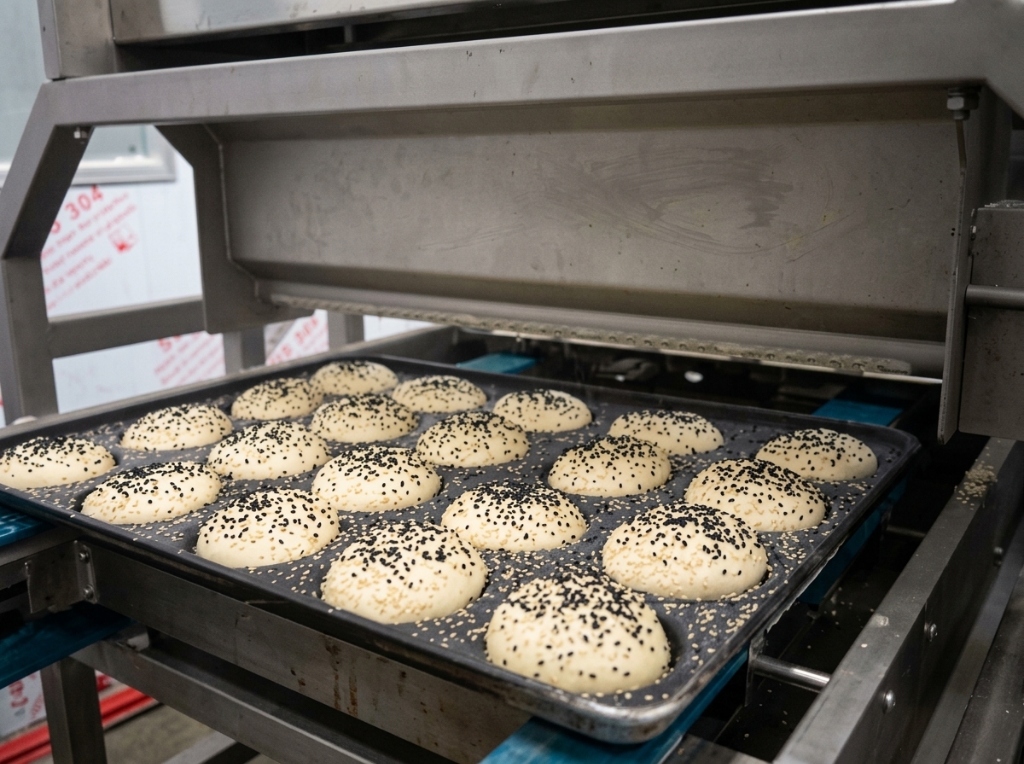
Post-proof application, standard on high speed bun and roll plants, takes place after the trays leave the proofer and immediately before baking. Trays pass through a fine water mist and then beneath either a perforated vibrating hopper or a grooved spindle triggered by pan movement. Avoiding proof expansion helps keep topping distribution uniform, yet fully proofed dough is too fragile for heavy pressing, so retention relies almost entirely on the liquid film and early oven heat.
Why Plain Water Loses Its Grip Before the Crust Sets
Sesame seeds have a smooth, oil rich hull that resists simple wetting. Plain water carries high surface tension and evaporates rapidly during proofing or the opening seconds inside a tunnel oven, often before native flour starches can form a cohesive bond around each seed.
Several routine line conditions can weaken that interface even further:
Surface Starch Gelation and the Slicing Trade-Off
For surface starch to gelatinize into a continuous paste that anchors toppings, free water needs to remain on the dough while the crust heats through roughly 74 to 99 °C. Inside a tunnel oven, keeping moisture condensed on the surface long enough typically requires a brief, high humidity inlet zone with gentle airflow so water condenses before shifting to evaporation.
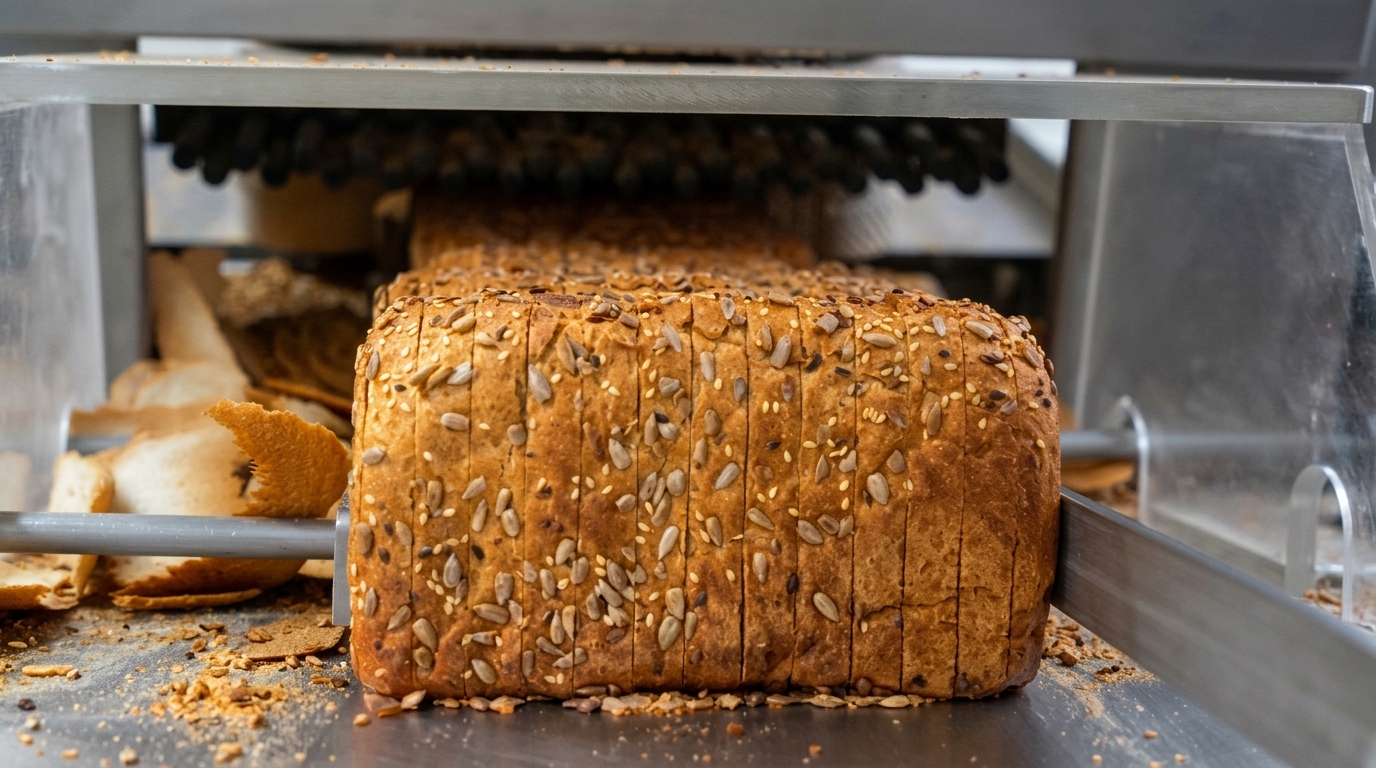
That same starch paste layer creates a direct trade-off at the slicing station. A thicker gelatinized layer tends to turn glassy and brittle as the loaf cools, developing a fine mosaic of surface cracks. When a crazed crust meets reciprocating or band slicer blades, rigid crust flakes can break away and carry seeds with them. Achieving a smooth, pliable crust that slices cleanly without crumbling usually means keeping inlet steam as brief as necessary to lock the surface, followed by drier baking zones.
Recommended Reading:
Gummy Slices and Sweating Bags Start When Dispatch Pressure Shortens Bread Cooling
Slicing bread above 35 °C causes gummy blades, crushed sidewalls, and bag condensation that triggers mold within days. Learn how to balance line speed.
Bakery Industry InsiderMoisture Migration Inside the Bag and Mechanical Shedding
Seed loss does not stop at the oven discharge. Pan bread typically exits the oven with a moist crumb near 44% moisture and a much drier, thin outer crust closer to 15%. Lines commonly use compressed air and soft vacuum cups to depan loaves, sometimes paired with a dedicated vacuum unit to remove surplus loose seeds before spiral cooling prepares the bread for slicing.
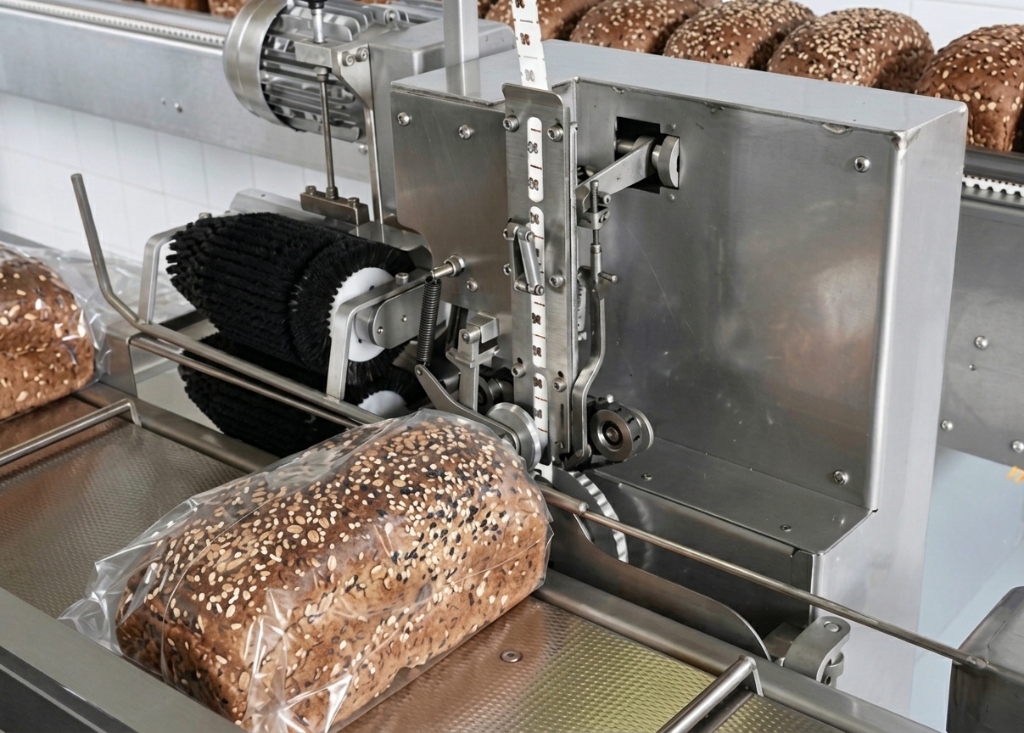
Once loaves are sliced and sealed inside moisture impermeable plastic bags, water migrates steadily from the crumb into the drier crust until equilibrium is reached. While this softening gives sandwich bread the resilient texture consumers expect, it also relaxes weak surface bonds. Combined with shear from slicer blades, rubbing against bagger scoops, and vibration during transit, seeds held only by an evaporated water film tend to collect in the bottom of the bag.
Starch Adhesives and Precision Seeding Systems
To improve retention without introducing the cold storage demands and nozzle clogging of liquid egg wash, or the surface stickiness of sugar washes, many industrial plants adopt cold dispersible starch and hydrocolloid glazes. These plant based suspensions disperse easily in cold water, stay stable in holding tanks for hours without gelling, form a thin viscous bridge that flexes during oven spring, and bake to a dry, non sticky finish.
Pairing adhesive chemistry with targeted mechanical control cuts seed loss across the line:
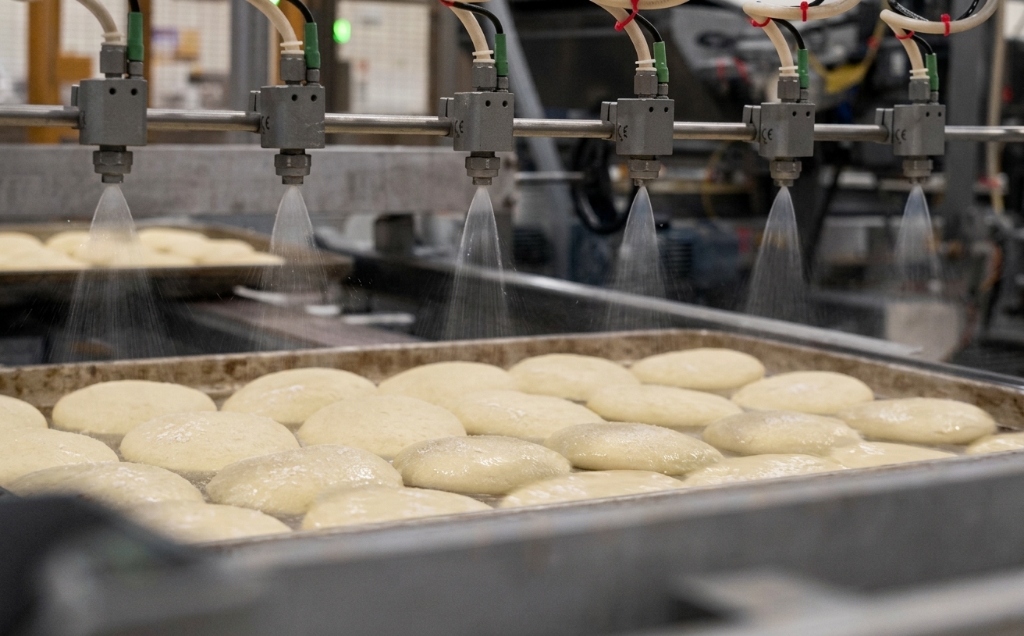
Keeping sesame anchored from moulder to retail shelf rarely improves simply by opening the seeder gate wider. Aligning dough surface cleanliness, cold dispersible starch adhesion, brief inlet steam control, and targeted seed recovery lets bakeries reduce topping giveaway, limit slicer fouling, and deliver cleaner finished bags, though the practical balance always depends on each line’s product mix, oven airflow, and capital priorities.
😊 Thanks for reading!
Sources:
- Marsh, D. & Cauvain, S.P., Technology of Breadmaking (2nd ed., Chapter 4: Mixing and Dough Processing), Springer, 2007
- Wiggins, C. & Cauvain, S.P., Technology of Breadmaking (2nd ed., Chapter 5: Proving, Baking and Cooling), Springer, 2007
- Bent, A.J., Technology of Breadmaking (2nd ed., Chapter 9: Speciality Fermented Goods), Springer, 2007
- Cauvain, S.P. & Young, L.S., Bakery Food Manufacture and Quality: Water Control and Effects (2nd ed., Chapter 5), Wiley-Blackwell, 2008
- Optimizing Bakery Efficiency: A Case Study in Seed Adhesion Using Gecko, Spraying Systems Co., https://www.spray.com/fi-fi/blog/optimizing-bakery-efficiency-a-case-study-in-seed-adhesion-using-gecko
- Baking Glazes Solutions, KMC, https://www.kmc.dk/solutions/bakery/baking-glazes
- Rotary Drum Seeder, US Patent US6520111B2, Google Patents, https://patents.google.com/patent/US6520111B2/en
- Methods and Apparatus for Applying Edible Toppings and Adhesives, US Patent US8545917B2, Google Patents, https://patents.google.com/patent/US8545917B2/en
- Dry Seed and Inclusion Depositing and Reclaim Hopper, AXIS Automation, https://axisautomation.com/topping/seeder/
- Efficiency and Sustainability: The New Recipe for Success in Baking, Food & Drink Technology, https://www.foodanddrinktechnology.com/feature/60551/efficiency-and-sustainability-the-new-recipe-for-success-in-baking/
- Gummy Slices and Sweating Bags Start When Dispatch Pressure Shortens Bread Cooling, Bakery Industry Insider, https://bakeryinsider.com/gummy-slices-sweating-bags-shortened-bread-cooling/