
A Rotating Spit and Thin Films of Batter Build the Rings of a Tree Cake
A pan cake must push heat from the metal wall into a thick core before the crust dries out. The tree-ring cake avoids that conflict by baking dozens of thin batter films on a rotating spit, shifting process control toward flour selection, batter rheology and radiant heat management.
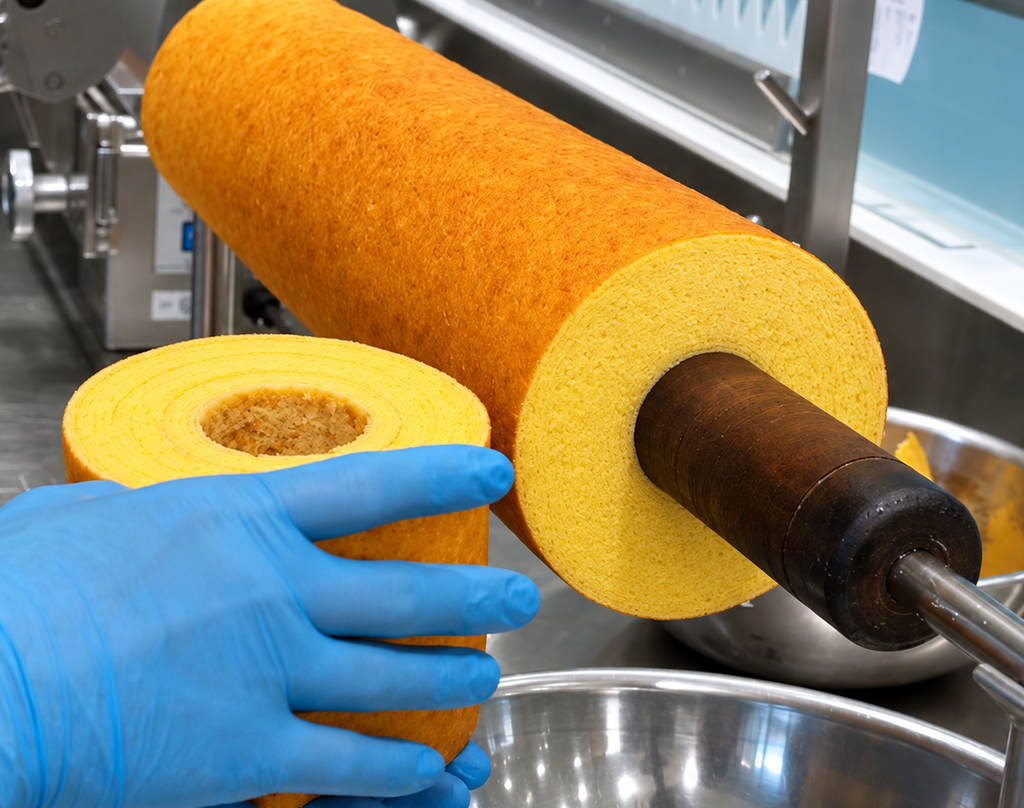
A Cake Built Outward Instead of Baked Inward
Baumkuchen, German for “tree cake”, belongs to the spit cake family, products baked on a horizontal rotating shaft. Sliced crosswise, its thin golden lines resemble the annual rings of a tree trunk.
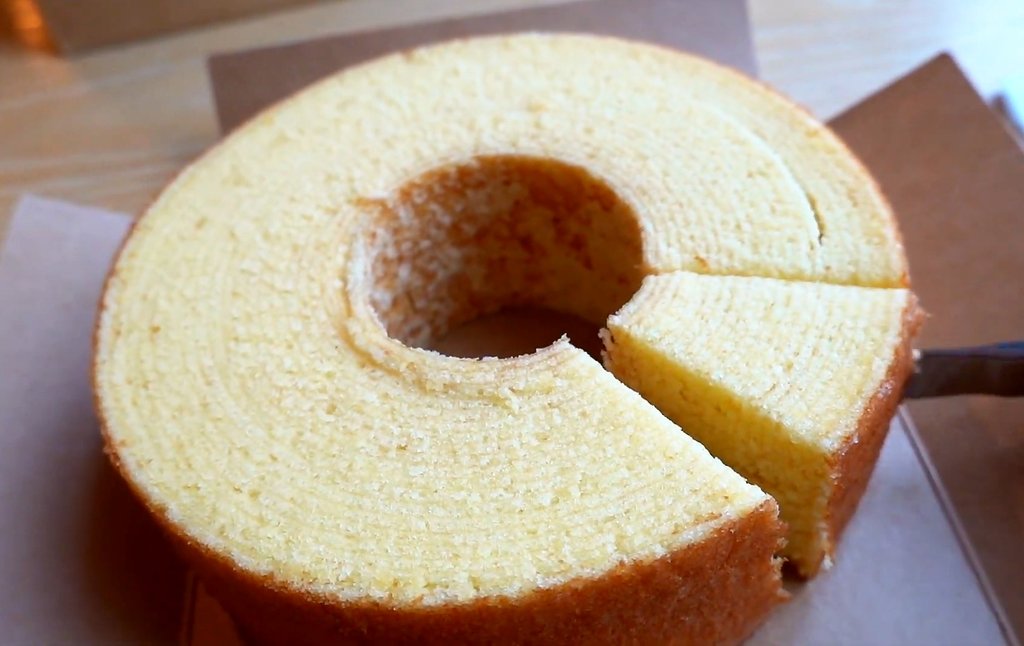
In a pan, outer zones tend to dry and set long before the core reaches the temperature needed to gelatinize starch. The spit method avoids this by splitting the total mass into many thin films:
In one small-batch production, a manual cell builds 23 layers from rice flour milled on site. A full cycle on this type of equipment can demand 40 to 90 minutes of continuous attention per batch.
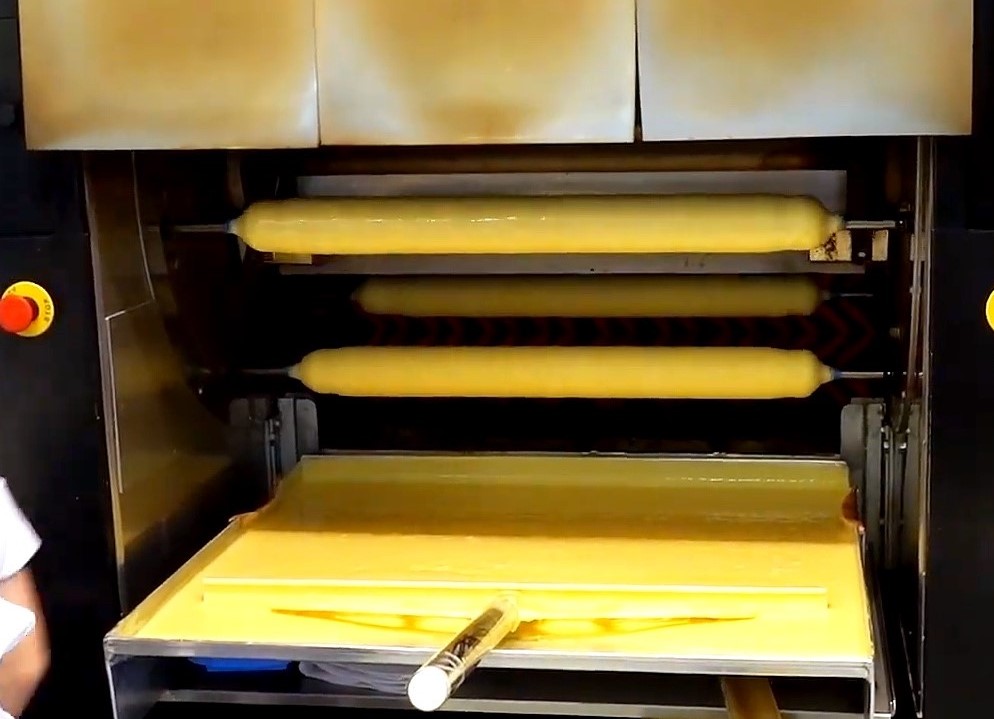
The Flour Needs Low Gluten Potential
Traditional formulas rely on butter, eggs, sugar, salt and flour, typically at about one part flour, one part butter and two parts whole egg, without baking powder. Fine bakery goods in Germany usually start from light, low-ash flours, and published formulas often blend wheat flour with a large share of pure starch. One formula even uses more cornstarch than flour.
The batter sits in an open trough for the whole bake and undergoes repeated contact, stirring and smoothing. With a stronger wheat flour, that prolonged work may gradually develop gluten, the elastic network that glutenin and gliadin proteins form when wheat flour is hydrated and worked. Rising elasticity could cause drag marks, uneven films and a rubbery crumb.
Diluting flour with starch and carrying a high load of butter and egg tends to keep gluten formation low. Fat coats flour particles and limits protein contact with water, while egg proteins supply most of the setting structure as they coagulate.
Parts of the Asian market go further and use 100% rice flour, which contains no gluten-forming proteins. Grinding then becomes a critical variable:
Batter Rheology on a Rotating Mandrel
Low-gluten and gluten-free cake batters usually behave as shear-thinning fluids, losing apparent viscosity while sheared and recovering it at rest. Many also show thixotropy, a time-dependent version of the same behavior.
On the spit, this behavior is useful:
Rotational speed interacts with all of this. Too slow, and gravity may build a thicker lobe on the underside; too fast, and the liquid film could be thrown toward the heating panels. Heat losses at the chamber end walls tend to thicken the edges of the cake, so some lines scrape or trim the ends between layers.
How Radiant Heat and Maillard Browning Draw the Rings
After the first layer, each new film bakes almost entirely by thermal radiation from burners or electric elements facing the shaft. Radiant energy lands directly on the wet surface, driving fast evaporation and browning while the new film shields the layers already baked underneath.
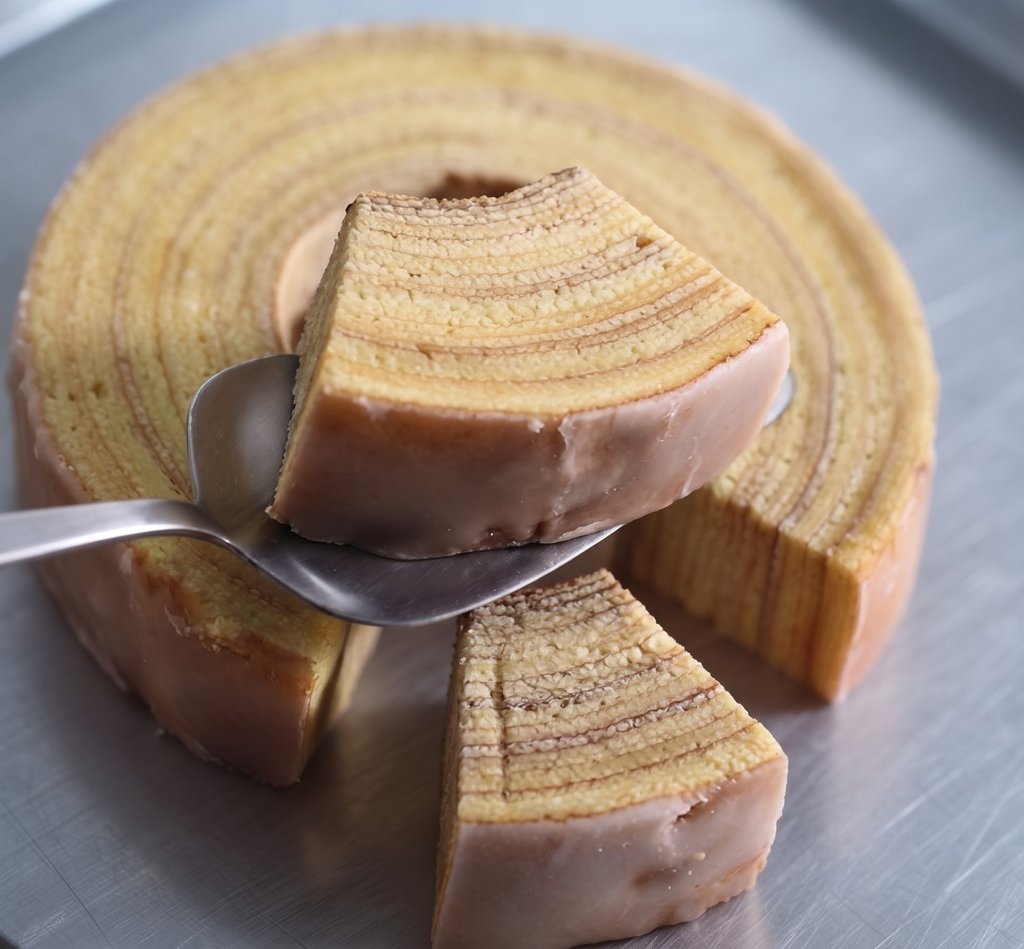
As the outer face dries, two browning routes can run in parallel:
Each cycle leaves a thin browned skin on the outer face. When the shaft returns to the trough, raw batter wets that skin and bonds to it as egg proteins coagulate and starch gelatinizes, but the pigment stays trapped as a sharp dark line. Twenty-three cycles give twenty-three rings.
The geometry keeps changing. Every layer increases the radius, shortening the distance between cake surface and emitters and altering the time each layer needs. In manual setups the baker compensates by eye, and a film that stays too wet and heavy may cause the whole mass to slip off the mandrel.
Cooling, Cutting and the Path to Automation
A freshly baked roll is very soft because much of its butter is still molten, and if left hanging still, its lower side may sag into an egg shape and push the central hole off center. Hanging rolls are rotated intermittently until the fat sets. Resting them until the next day lets moisture equalize and keeps the cut surface smooth.
Scaling efforts mostly target operator dependency and energy:
😊 Thanks for reading!
Sources:
- https://www.youtube.com/watch?v=AIwBjl5QWDw
- https://www.chungnam.go.kr/cnportal/media/article/view.do?articleNo=MD0003170998&menuNo=500166&pageIndex=
- https://baumkuchenfarm.com/about-baumkuchen/
- https://kokorocares.com/blogs/blog/baumkuchen-exploring-the-origins-of-german-tree-cake-in-japan
- https://bakefromscratch.com/origin-of-a-classic-baumkuchen/
- https://www.instrumentation.co.za/16764r
- https://bakerpedia.com/processes/gluten-free/
- https://bakerpedia.com/processes/maillard-reaction/