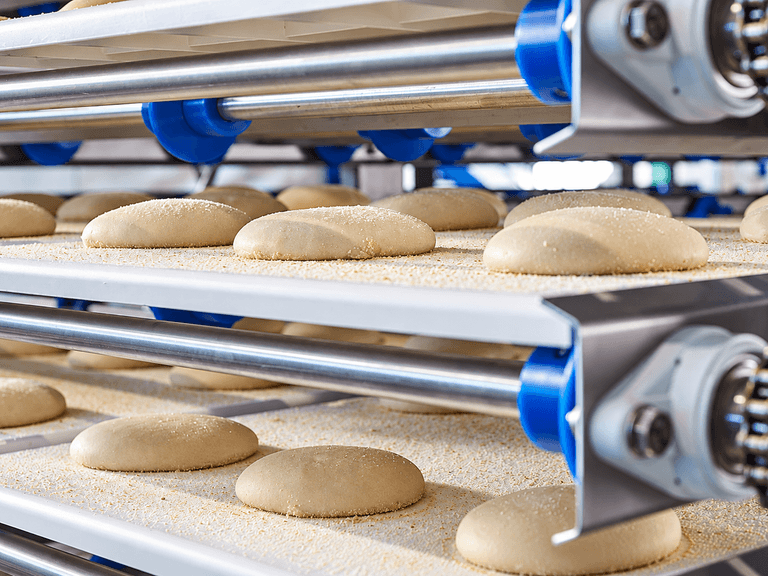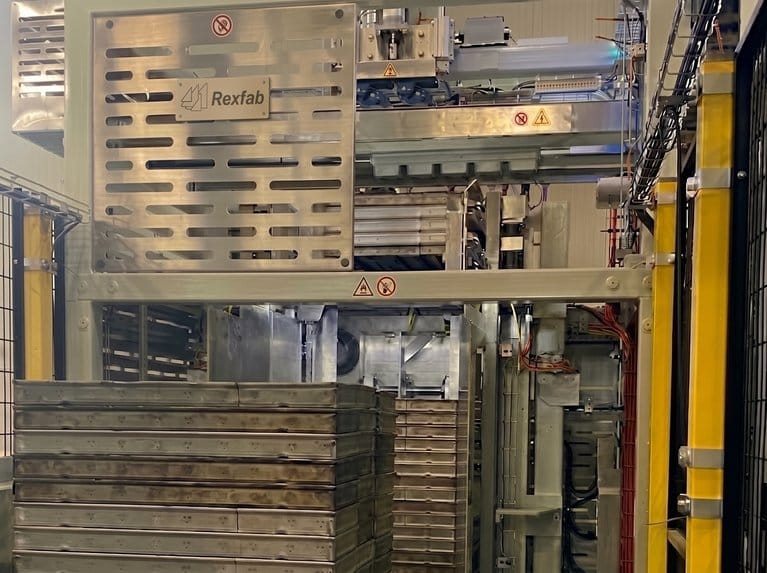
Why Levain-Style Cookies Can be Hard to Run on Industrial Lines
Levain-style cookies pack cold, dense dough with large chocolate chunks and nuts. On continuous lines, that payload can stall extruders, smear chocolate and separate fat from the matrix. Designing the carrier dough first gives the forming equipment a realistic chance of portioning it cleanly.
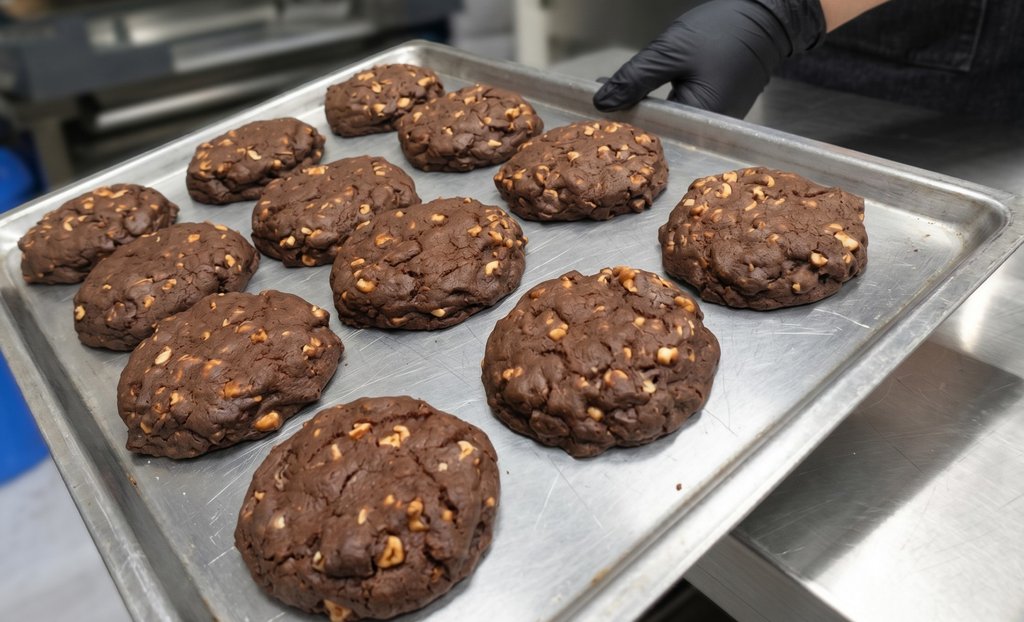
How Continuous Cookie Forming Works
Most industrial lines for soft, chunky doughs shape each cookie by extrusion. The basic sequence:
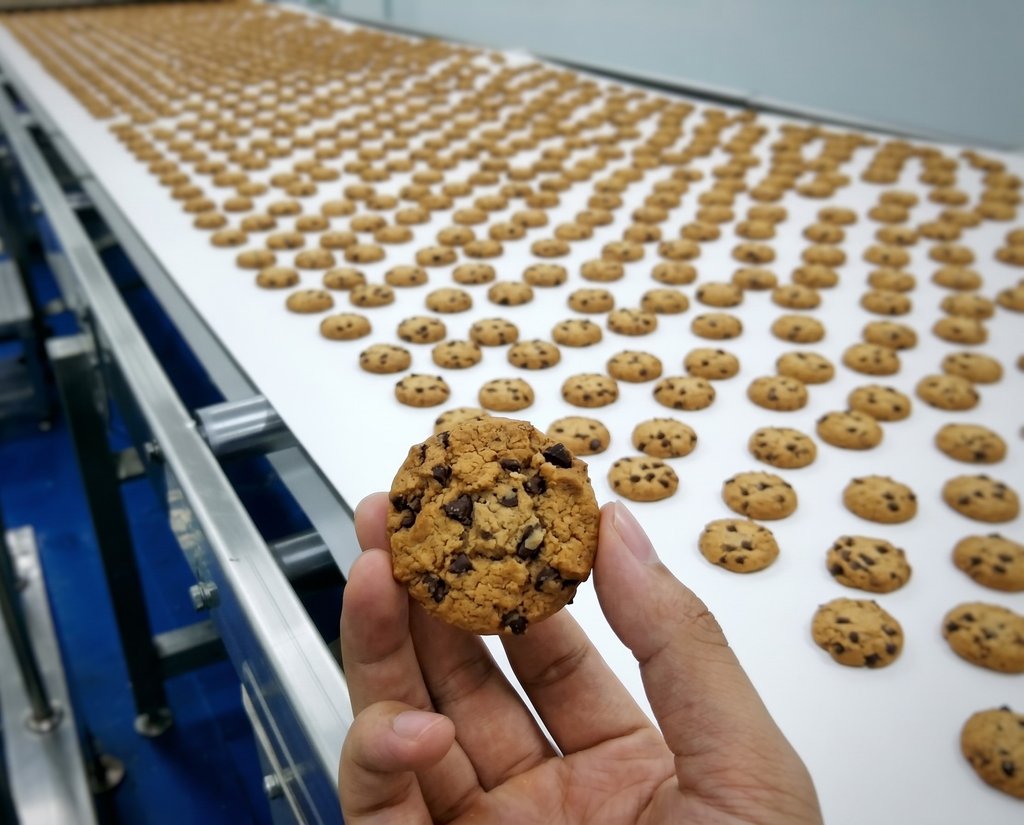
Every stage applies pressure and friction to the dough. With large inclusions, the narrow points are the roll gap, the chamber and the die opening.
What the Carrier Dough Has to Do
In Levain-style formulas, the inclusion load can approach or exceed the weight of the flour. The base matrix around those solids has three jobs that pull in different directions:
An extrudable cookie dough behaves like a weak gel, where the elastic response dominates over the viscous one. While that elastic character holds, chunks tend to stay anchored in the matrix. When it fades, the dough may start to behave more like a liquid flowing around the solids.
Inclusion Dragging and Extruder Blockage
When a dough carries enough water to lower its viscosity, chips and chunks tend to drag behind the dough during extrusion and can eventually clog the extruder. As the carrier phase thins, it can flow past the solids, which then crowd together and bridge across the narrowing channel.
Common contributing factors include:
Shear-thinning behavior works in favor of the line. Hydrocolloids such as xanthan and guar gum can raise dough consistency while increasing thinning under shear. The dough core can then move as a stiff plug carrying the chunks, with lower resistance at the wall, and recover firmness quickly after leaving the nozzle.
Water and Gluten Control
Low added water keeps the dough short.
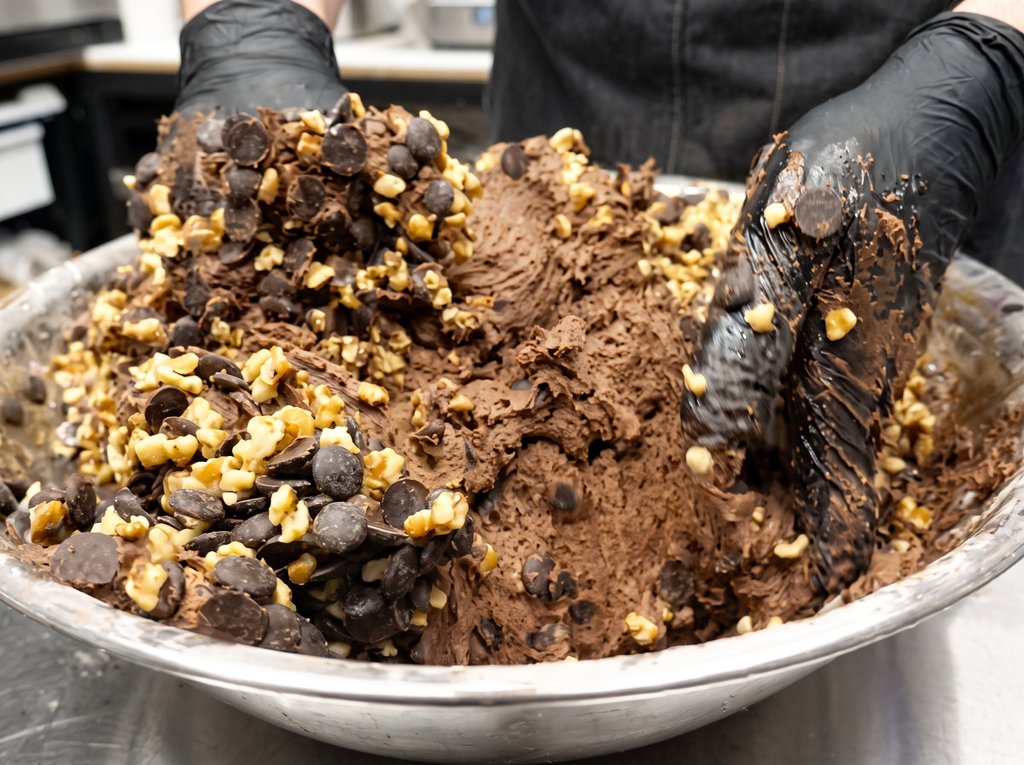
A continuous gluten network does not form in wheat doughs until added water exceeds roughly 15% of flour weight. Fat also breaks the protein phase into discrete regions, limiting strand formation.
A developed gluten network could bring elastic recovery after extrusion, rising nozzle pressure and a harder bite. Typical levers to limit it:
Fat Crystal Structure and Oiling Out
Oiling out happens when free oil migrates toward machine walls and inclusion surfaces. It can lead to loss of cohesion, erratic slip on feed rolls, chunks detaching during cutting and baking, and a greasy final texture.
Variables to consider:
Fat choice shapes the whole matrix. In texture testing, a dough made with high-solid palm fraction was very hard, liquid olein produced a soft dough with little structure, and butter sat between both.
Dough Temperature as a Supporting Variable
Wire-cut and deposited doughs typically run between 16°C and 24°C. Above that range, early fat melting can cause shape loss, erratic weights, sticking to cutters and excessive spread in the first minutes of baking.
Because these doughs carry so little water, chilling the water alone has limited effect. In common practice:
How Forming Equipment Interacts With the Matrix
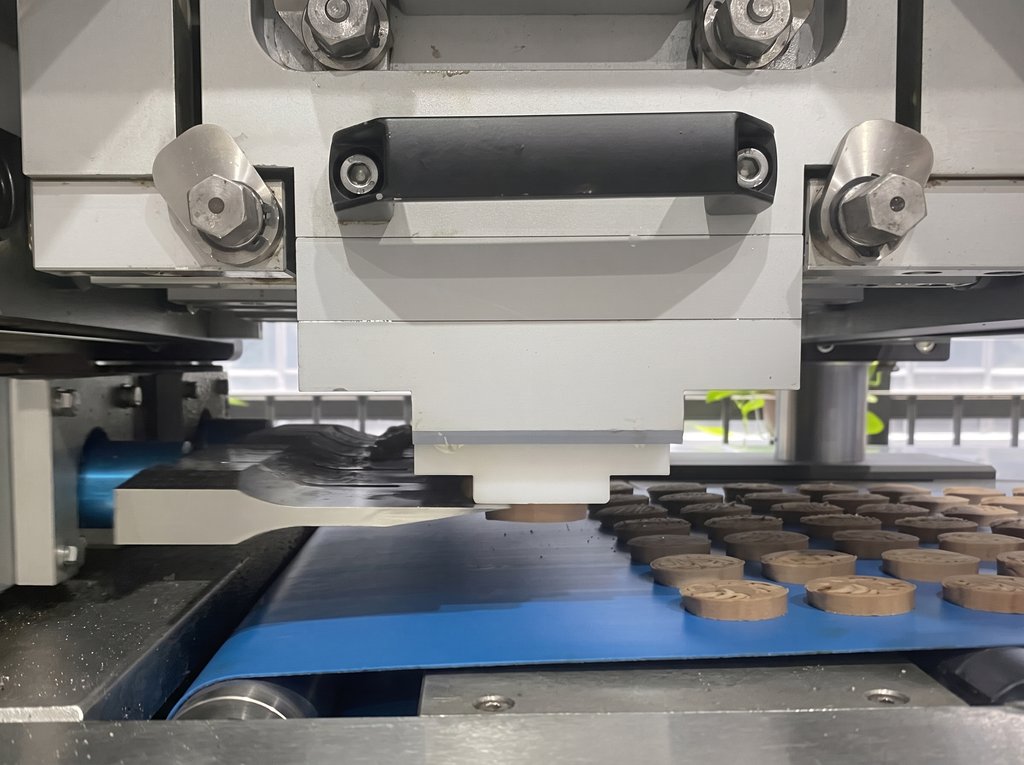
Even a well-built carrier dough meets mechanical limits at the former:
Friction creates heat that can melt chocolate chips directly into the surrounding dough.
Line Impact
On most lines, the carrier matrix sets the ceiling on what forming equipment can achieve. A dough with controlled water, stable fat crystals and enough elastic structure tends to hold chunks, keep weights consistent and reduce stoppages from clogging or wire breaks. Ingredient specifications, mixer cooling capacity and existing formers will constrain how far each variable can move, so incremental adjustments, tracked against piece weight and scrap, often give the clearest view of margin gains.
😊 Thanks for reading!
Sources:
- Cauvain, S. P. (2017). Baking Problems Solved, 2nd Edition. Woodhead Publishing / Elsevier.
- Cauvain, S. P. & Young, L. S. (2008). Bakery Food Manufacture and Quality: Water Control and Effects, 2nd Edition. Wiley-Blackwell.
- Weller, M. & Carreño, C. (2020). A Good Bake. Alfred A. Knopf.
- Feinstein, P. (2025). How to Bake Levain-Style Cookies Like a Pro. Fine Dining Lovers. https://www.finedininglovers.com/explore/articles/how-bake-levain-style-cookies-pro
- Mamat, H. & Hill, S. E. (2014). Effect of fat types on the structural and textural properties of dough and semi-sweet biscuit. Journal of Food Science and Technology. https://pmc.ncbi.nlm.nih.gov/articles/PMC4152542/
- Varghese, C. et al. (2020). Influence of Selected Product and Process Parameters on Microstructure, Rheological, and Textural Properties of 3D Printed Cookies. Foods. https://pmc.ncbi.nlm.nih.gov/articles/PMC7404992/
- Baimaganbetova, S. et al. (2024). Investigation of Rheological and Flow Properties of Buckwheat Dough with and Without Xanthan and Guar Gums for Optimized 3D Food Printing Across Temperature Variations. Foods. https://pmc.ncbi.nlm.nih.gov/articles/PMC11727620/
- Ranasinghe, M. et al. (2024). Valorizing date seeds through ultrasonication to enhance quality attributes of dough and biscuit, Part-1. Ultrasonics Sonochemistry. https://pmc.ncbi.nlm.nih.gov/articles/PMC11379672/
- Banks, L. et al., Nabisco Brands Inc. (1989). EP0312391A2, Method for controlling the spread of soft cookies. https://patents.google.com/patent/EP0312391A2/en
- Groff, E. T. et al., Reading Bakery Systems Inc. (2002). US6450796B1, Rotating nozzle die machine for dough extrusion. https://patents.google.com/patent/US6450796B1/en
- Hill, B. D. (1998). GB2315238A, Biscuit making roller. https://patents.google.com/patent/GB2315238A/en