Is Your Pan Handling System Undermining Production Line Profitability?
In high-speed baking operations, even minor pan-handling failures can trigger costly downtime, making smarter automation a critical advantage for protecting throughput, product quality, and profitability.
Commercial baking operations are scaling rapidly to meet wholesale demands, driving production lines to operate at unprecedented speeds. As continuous facilities accelerate throughput, downstream synchronization has become a primary operational bottleneck. Today’s plant managers must balance rising labor costs and strict hygiene standards while maintaining constant product flow.
The Downtime Challenge
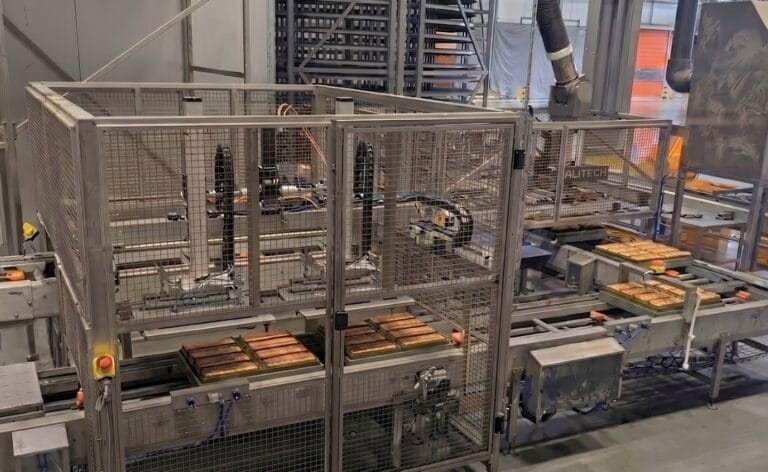
When an outdated pan handling system experiences a mechanical jam, the entire high-speed production line grinds to a sudden halt. Because automatic plants lack manual intervention at the panning stage, these equipment jams can quickly ruin active batches. Delays after mixing alter dough consistency as water continues to be absorbed and dough temperatures shift, leading to excessive softening or rapid degrade from over-fermentation.
The Engineering Solution
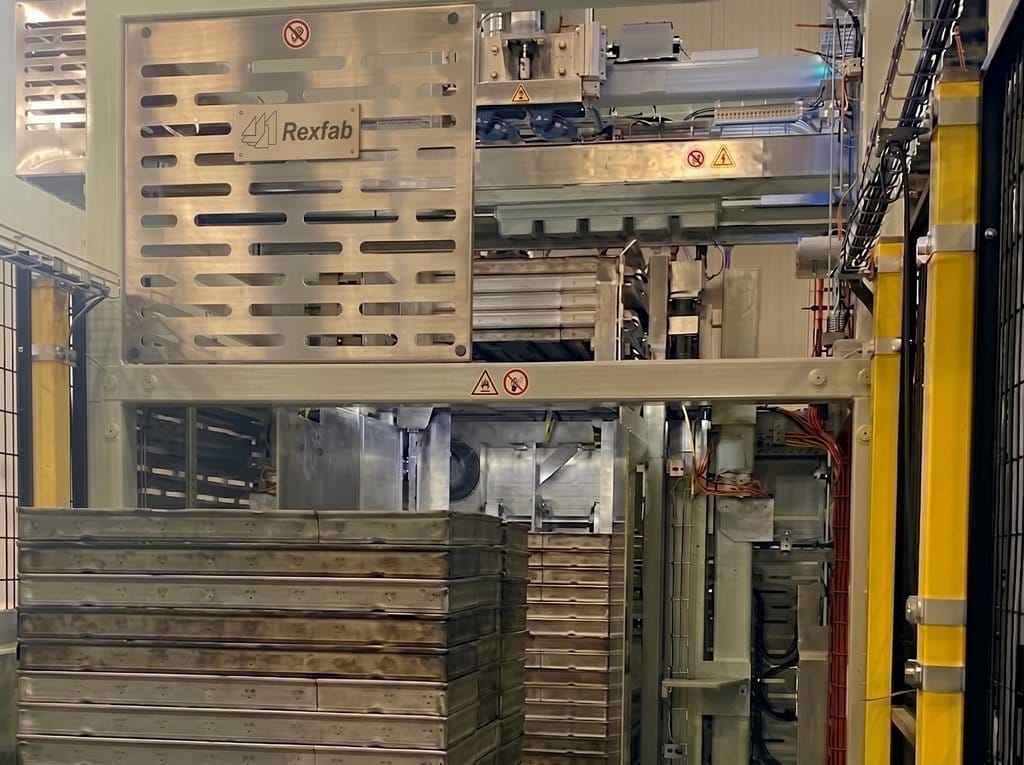
To address these high-speed vulnerabilities, Rexfab developed the fully electric Pan Stacker – Pan Unstacker (PSPU). Utilizing advanced electromagnetic technology and precision servo-motors, this system ensures smoother, gentler pan handling that eliminates the mechanical faults of pneumatic designs.

While formulation adjustments like “No-Time” Dough (NTD) processes and formal crisis plans mitigate batch losses during stoppages, eliminating the mechanical root cause of downtime remains the most effective long-term strategy for high-volume bakeries.
Optimizing Panning Systems
As baking plant speeds increase, panning processes must evolve to cope with faster throughput capacities. Traditional drop systems are increasingly replaced by retraction belts that rapidly withdraw to drop a tray of dough pieces every cycle, indexing the tray between fillings. Other advanced lines synchronize the flow of the tin strap with the dough product so that pieces are panned seamlessly “on the move.”
Selecting Durable Materials
The physical durability of baking pans plays a significant role in preventing line jams. Traditional steel pans (typically 0.8mm thick) offer superior structural rigidity compared to black anodized aluminum, which is prone to warping under automated handling systems. Warped or damaged pans are a primary culprit for downstream indexing failures.
Quantified Financial Return
Implementing a fully electric PSPU delivers immediate, measurable cost savings by addressing mechanical wear and operational waste.
Real-world performance data from systems running for over five years reveals $170,000 in annual savings when replacing pneumatic with electric pan handling.
See Where the $170,000 in Annual Savings Come From
Get the 5-year operational benchmark comparing electric vs. pneumatic handling across pan wear, energy usage, spare parts, and downtime labor.
Upgrading to an all-electric pan handling system yields a rapid return on investment by systematically reducing the four main categories of operational waste: product loss, energy consumption, spare parts, and labor downtime.
Simplified System Controls.
The entire machine is coordinated by an industrial-grade controller (PLC), essentially a heavy-duty, computerized “brain” mounted inside the electrical cabinet.
This processor manages the split-second timing required to stack, index, and unstack baking pans without collisions, running specialized software designed to prevent system crashes.
The Baker’s Dashboard.
Operators manage this machinery using an intuitive, high-resolution touchscreen operating panel (the HMI).
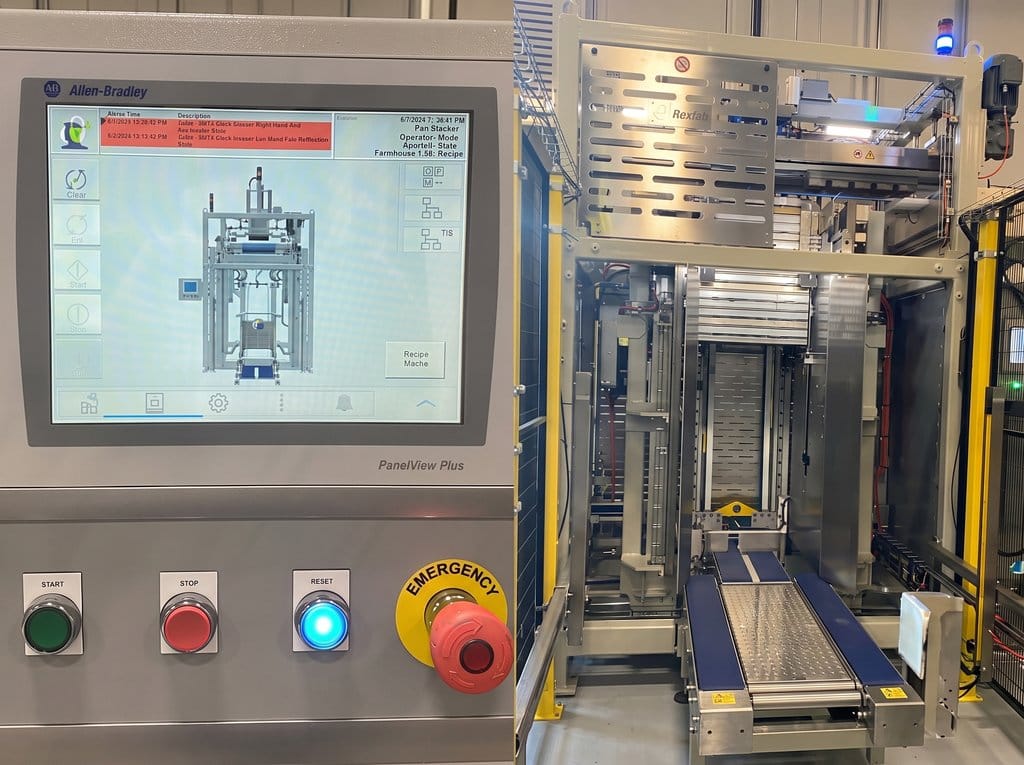
Acting as a user-friendly translator between human operators and the computer processor, the screen makes it simple for bakery floor staff to run operations.
Secure Remote Support
An integrated virtual private network (VPN) creates an encrypted digital “hotline” for off-site engineers.
If an issue arises, Rexfab technicians can securely access system diagnostics remotely to troubleshoot, bypassing long delays for on-site mechanics.
Automatic Recipe Adjustments
Instead of relying on wrenches, hand-cranks, and downtime to manually slide guide rails for different pan dimensions, motorized pushers (electric actuators) automatically shift the guide walls to exact pan specs when a recipe is chosen on-screen.
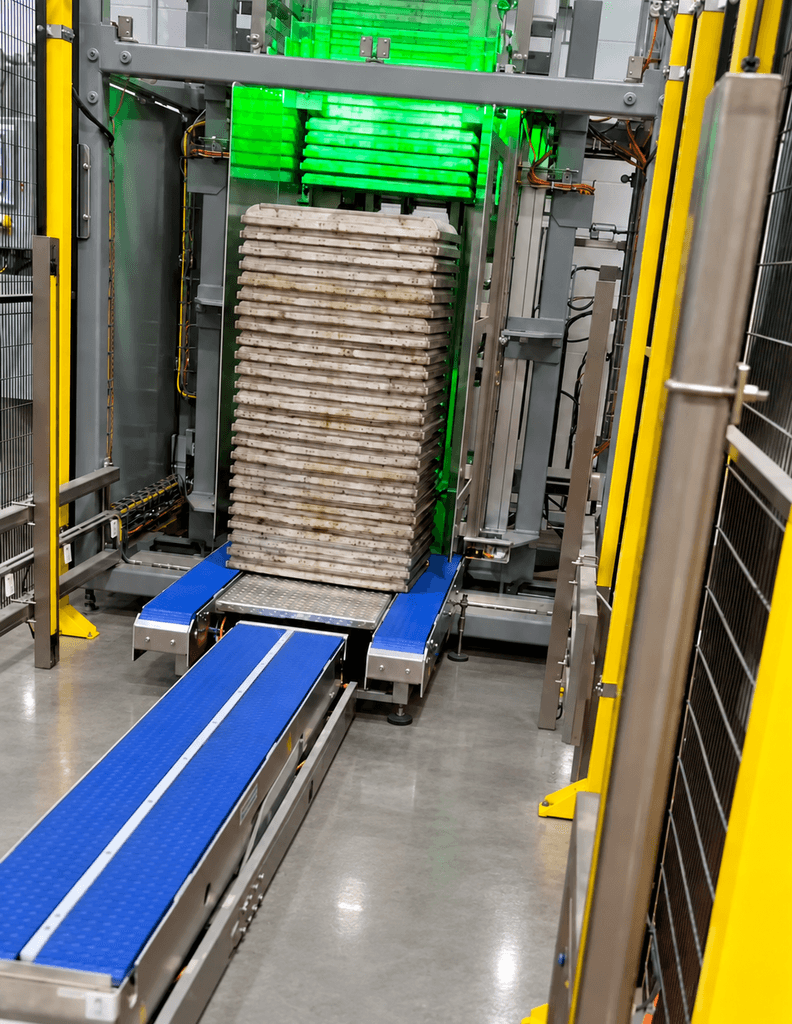
Technical Capacity Parameters
The system is engineered to handle highly diverse product lines while maintaining maximum throughput.
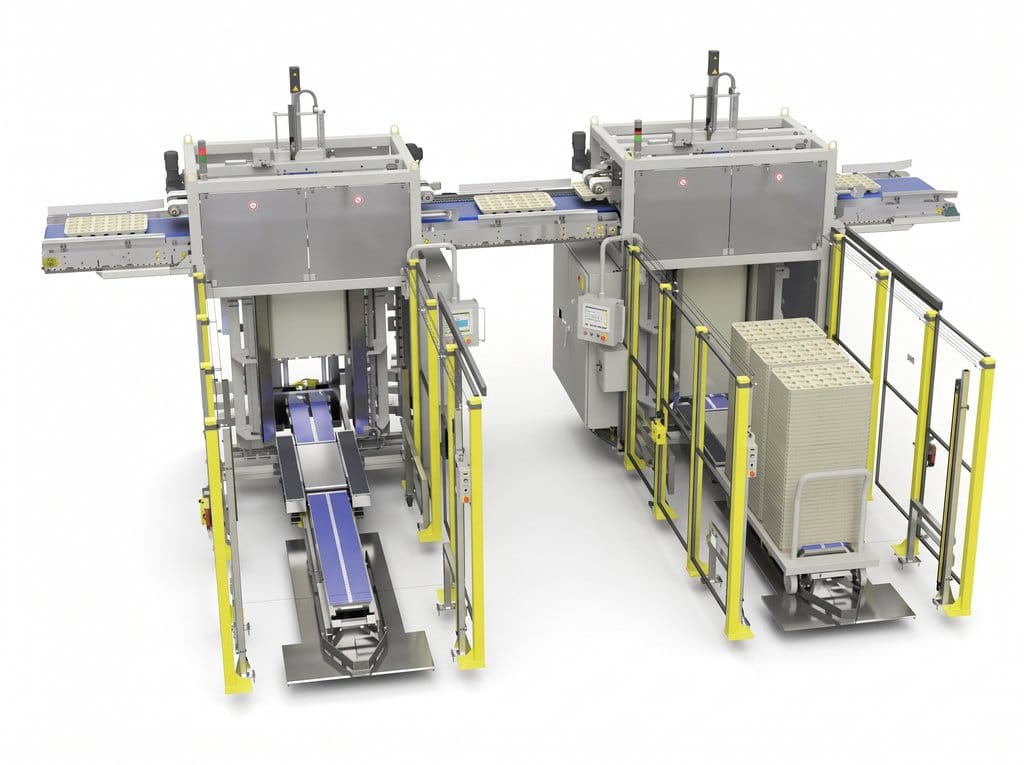
The performance and physical envelope specs include:
Find more information here:
About The Company

35 Years of Experience in Bakery Automation
Rexfab, established in 1990, designs and manufactures automated downstream handling systems for commercial bakeries in North America. The company’s engineering focus spans conveyor systems, pan handling, and depanning equipment, with an emphasis on sanitary design, operational reliability, and total cost of ownership. Rexfab is headquartered in Sherbrooke, Québec, with a U.S. office in Erlanger, Kentucky.
Performance Automated solutions that outperform safety and sanitation standards, delivering dependable, steady productivity.
Committed Partnership More than equipment, a partner from conception to installation and through the full lifespan of the system.
Data • Automation • Reliability • Safety The four pillars shaping Rexfab’s vision for the future of the baking industry.
Canada: 4845 Robert-Boyd, Sherbrooke, QC J1R 0W8 USA: 2791 Circleport Dr, Erlanger, KY 41018 Toll-free: +1 877 303-4490 | Office: +1 819 846-4490 | info@rexfab.com | rexfab.com
References
- Rexfab Technical Specs: Pan Stacker – Pan Unstacker. (2026).
- “Automating Subprocesses in a High-Volume Bakery Facility,” Rexfab Engineering Insights. (2026).