Natural Preservation for Longer Shelf Life: New Developments in Smart Packaging
High humidity bakery products face rapid microbiological spoilage, traditionally requiring synthetic preservatives or expensive gas flushing. Next-generation active packaging might solve this by integrating photocatalytic nanomaterials and microencapsulated probiotics directly into the polymer matrix; effectively neutralizing spoilage flora, extending shelf life, and eliminating chemical dough additives.
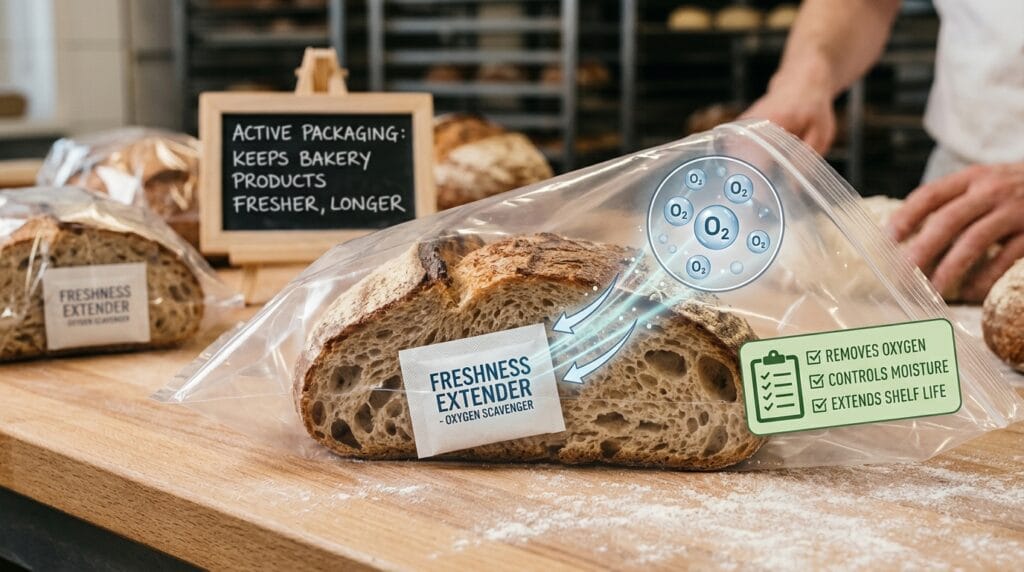
The thermodynamic interaction between a finished product and its storage environment has reached a technical turning point. Packaging technology has transitioned from a passive, multi-stratum barrier into a biochemically active system. Recent scientific literature and international patent filings from early 2026 suggest a maturation in active packaging architectures specifically designed for the preservation of high-moisture bakery matrices.
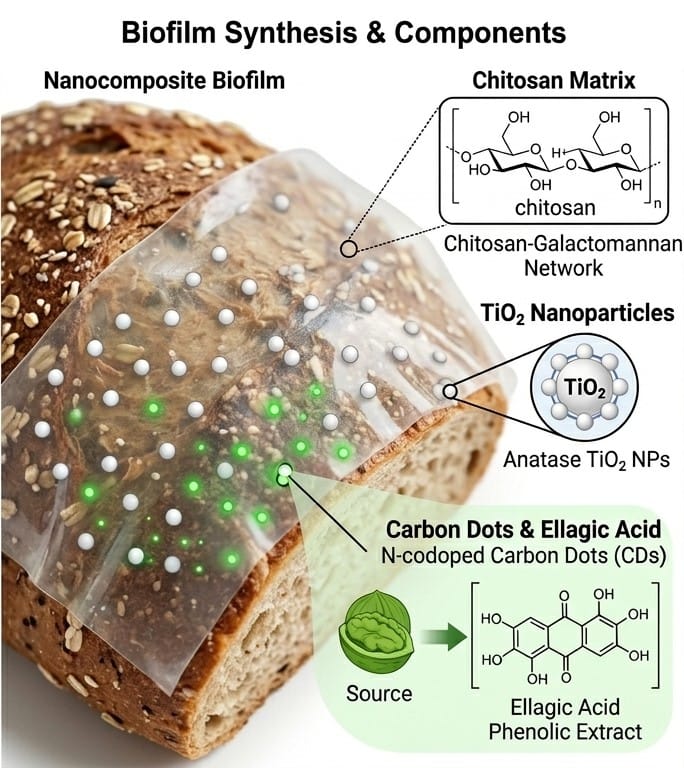
Mechanistic research in materials science now documents the scalable synthesis of nanocomposite biofilms. These matrices often utilize cationic polymers, such as chitosan, or galactomannan networks like guar gum. These bases could be molecularly doped with nitrogen-codoped carbon dots and titanium dioxide (TiO2), or enriched with phenolic plant extracts like ellagic acid derived from green walnut shells.
At the level of physical chemistry and quantum mechanics, the integration of TiO2 into high-density polyethylene (HDPE) films might catalyze a continuous generation of Reactive Oxygen Species (ROS). Because TiO2 is an inherently photosensitive wide band-gap semiconductor, it could transform the headspace of the package into a localized sterilization zone when exposed to ambient light.
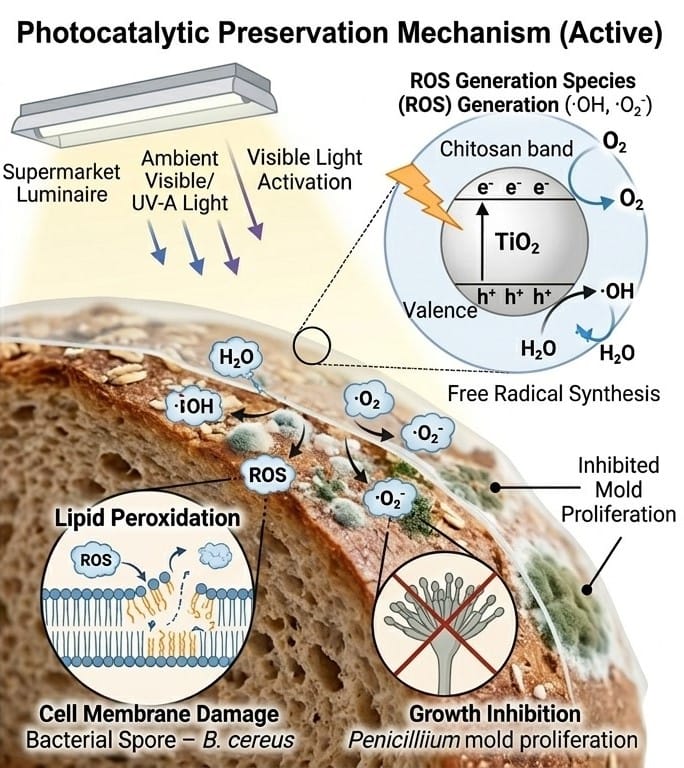
The Photocatalytic Preservation Mechanism
The process follows a specific sequence of electron-hole interactions:
- Photon Activation: When the package is irradiated by visible light or UV-A from supermarket luminaries, electrons in the TiO2 valence band may jump to the conduction band.
- Radical Synthesis: This jump should leave behind positive holes, which might react with interstitial water and headspace oxygen to generate cytotoxic hydroxyl radicals and superoxide anions.
- Lipid Peroxidation: These microscopic free radical clouds could relentlessly attack transmembrane peptide bonds and catalytically peroxidize the polyunsaturated fatty acids in the cell walls of spoilage flora.
- Growth Inhibition: This oxidative stress might destroy the structural integrity of filamentous mold conidia, osmotolerant yeasts, and bacterial spores like Bacillus cereus; severely inhibiting radial proliferation on the bread crust.
Probiotic Biocontrol and Micro-gradient Architectures
A secondary technical branch in active packaging involves competitive microscopic biocontrol. This paradigm utilizes bioactive probiotic coatings deposited on the internal polymer surface or applied via cold nebulization post-baking. These systems may use cryoprotected microencapsulation of strains like Lactobacillus acidophilus supported on biopolymeric starch substrates.
The rehydration of these bacterial consortia, triggered by water vapor migration within the package (Aw > 0.85), could resume metabolic activity without degrading the bread quality. Instead, they might compete through ecological exclusion by consuming free surface sugars before pathogens can establish a colony.
The Bioactive Defense Mechanism
The formulation of this organic shield relies on the following metabolic pathways:
- Metabolite Secretion: The rehydrated probiotics might excrete secondary metabolites, including broad-spectrum bacteriocins and organic acids.
- pH Modulation: This excretion could configure a localized micro-gradient of lactic and acetic acid, which should create a lethal pH environment for fungal sporulation.
- Dynamic Shielding: This creates a proactive defense system that should remain active as long as the product maintains its moisture profile, effectively adapting to the internal atmosphere of the bag.
Impact on Production Efficiency and Shelf Life
The direct benefit for the production line might be substantial, as these technologies could eliminate the need for expensive ethanol spraying or nitrogen gas flushing. By shifting the preservation responsibility to the packaging material, bakeries could simplify their formulation by removing synthetic calcium propionate or other “dirty label” preservatives.
Industrial results suggest that the microbiological shelf life might extend exponentially, potentially doubling the standard window for sliced breads. This could reduce waste throughout the supply chain and lower logistical costs associated with frequent restocks. Furthermore, the presence of probiotics on the product surface might allow manufacturers to leverage “gut-health” marketing claims, aligning technical performance with consumer health trends.
Production managers should observe a decrease in the total cost of ownership (TCO) for preservation systems, as the efficiency of the active film remains consistent regardless of minor fluctuations in dough temperature or post-oven cooling times. This shift represents a move toward more robust, autonomous food safety architectures in the bakery sector.
😊 Thanks for reading!
Sources:
https://www.frontiersin.org/journals/nutrition/articles/10.3389/fnut.2026.1789610/full https://pmc.ncbi.nlm.nih.gov/articles/PMC9501505/ https://www.mdpi.com/2413-4155/8/3/58 https://www.researchgate.net/publication/398163091_Chitosan-based_active_packaging_film_incorporated_with_TiO2N_co-doped_carbon_dots_to_extend_the_shelf_life_of_bread
For further reading on key industry advancements, see our featured guides: Shaping Donuts by Extrusion, How to Control Expansion and Appearance with Scoring, and Robotics for Industrial Baking.