Optimizing Pan Lifecycle Economics: How Electromagnetic Handling Cuts Pan Rebuilds by 90% and Glazing Cycles by 25%
Reduce pan damage, extend coating life, and unlock measurable savings with a gentler, precision-driven approach to automated pan handling.
High-capacity automation in industrial baking has dramatically increased output, but it has simultaneously exposed production lines to severe mechanical stresses.
To maintain sanitation standards and rapid throughput without manual greasing, modern industrial bakeries rely on high-performance pans coated with specialized, non-stick finishes like polymer or silicone glazes.
The Mechanical Strain of Legacy Systems.
Traditional automated handling systems, specifically legacy pneumatic pan stackers and unstackers, utilize violent, high-impact mechanical forces to move and orient pans.
While a physical jolt is biochemically necessary at the depanner stage to release baked products and transition crumb structures from fragile foam to a stable sponge, subjecting empty baking pans to repeated high-velocity impacts during stacking and unstacking serves no operational purpose.
This continuous, harsh banging rapidly deforms the structural integrity of standard 0.8 mm steel or less robust black anodized aluminum pans.
The Chemistry of Damaged Coatings.
The mechanical shocks of pneumatic indexing shear and peel non-stick coatings, exposing raw metal.
When raw steel or aluminum is exposed to moist dough, a chemical reaction occurs that forms dark iron or aluminum oxides, resulting in undesirable black spots on baked goods.

Mitigating mechanical impact during non-baking phases is therefore essential to prevent structural warping, maintain food safety, and preserve the non-stick surface coatings.
The Variable-Force Solution.
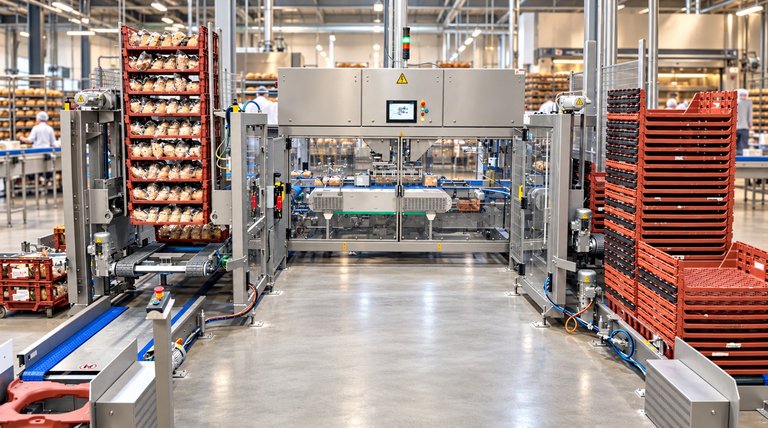
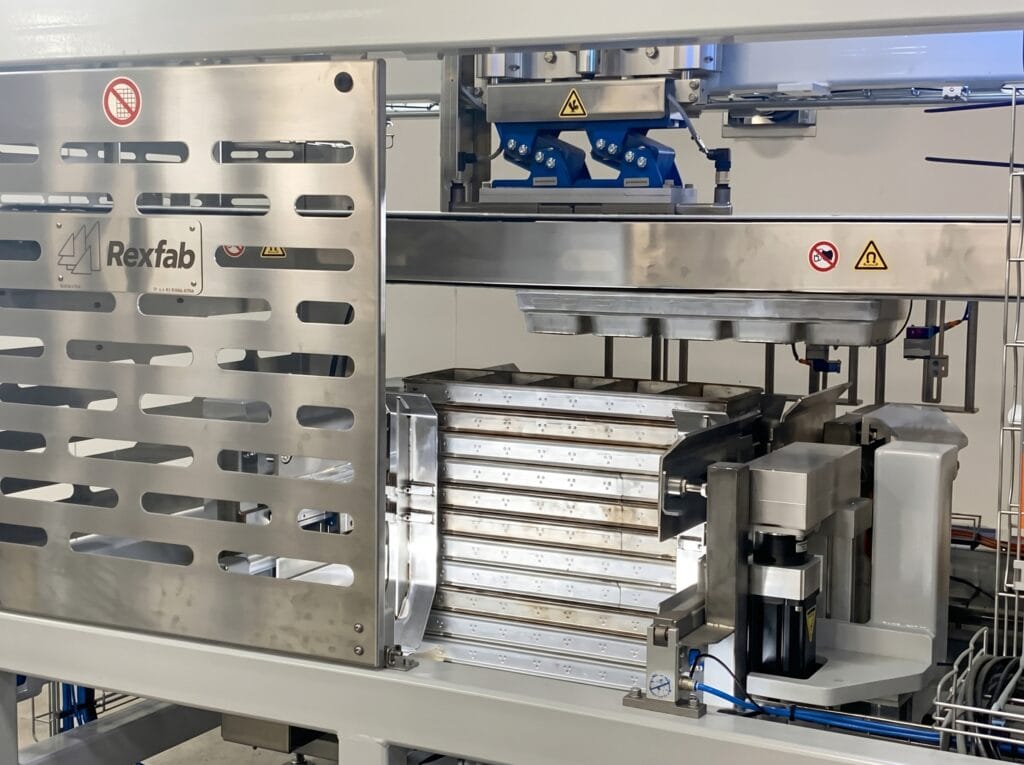
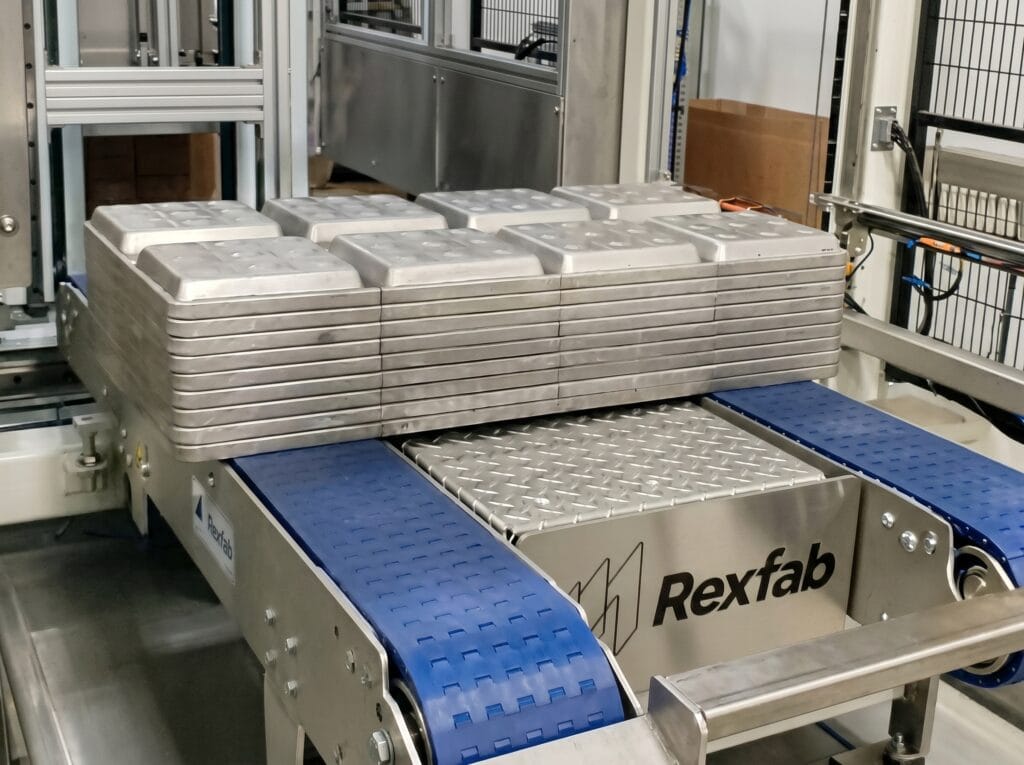
To eliminate these destructive impacts, Rexfab has developed the fully electric Pan Stacker – Pan Unstacker (PSPU).
By replacing violent pneumatic cylinders with controlled, variable-force electromagnetic heads and precision servo-motors, this system transitions automated pan handling from chaotic mechanical impact to precise, gentle manipulation. This technological shift directly targets the root causes of pan wear, reducing structural deformation and glazing depletion.

INSIGHT: Moving from pneumatic cylinder actuation to closed-loop servo-motor indexing allows acceleration profiles to be dynamically tuned per recipe. This prevents “impact spikes” that exceed the yield strength of the pan’s metallic substrate.
Total Cost of Ownership (TCO) Impact.
Implementing the Pan Stacker – Pan Unstacker delivers quantifiable operational savings by eliminating pneumatic energy waste, reducing maintenance requirements, and extending the operational lifespan of the pan fleet. An empirical analysis of systems in continuous service reveals significant, repeatable annual savings across multiple operating categories:
Pan-Related Cost Savings: Extends the physical lifespan of the pan fleet, savings costs through three key mechanisms.
25% Less Glazing: Requires fewer glazing cycles by preserving the protective polymer layer.
90% Fewer Pan Rebuilds: Minimizes the need for mechanical reshaping and structural pan rebuilding.
10% Reduced Pan Aging: Extends the total lifespan of the pan substrate.
Operational Efficiency and Line Flexibility.
Beyond cost reductions, the Pan Stacker – Pan Unstacker is engineered to integrate seamlessly into diverse bakery layouts and handle various pan profiles without manual intervention.

The elimination of high-pressure air discharge and metal-on-metal slamming drops operational noise levels below 85 dBA at 1 m. This reduction directly supports OSHA hearing conservation compliance and improves operator safety.
Simplifying Maintenance Protocols.
Maintenance teams require long service intervals and minimal daily intervention.
The PSPU utilizes high-specification, lube-free synchronous belts and sealed ball bearings that are permanently lubricated for the service life of the bearing.
This design dramatically reduces lubrication frequency and prevents food-contact areas from becoming contaminated by grease or oil drippings.
By replacing high-impact pneumatic handling with precision-controlled electromagnetic and servo-driven technology, Rexfab’s Pan Stacker–Pan Unstacker demonstrates how modern bakery automation can significantly reduce pan damage, extend coating life, lower maintenance requirements, and improve operational efficiency without sacrificing throughput.
About The company

35 Years of Experience in Bakery Automation
Rexfab, established in 1990, designs and manufactures automated downstream handling systems for commercial bakeries in North America. The company’s engineering focus spans conveyor systems, pan handling, and depanning equipment, with an emphasis on sanitary design, operational reliability, and total cost of ownership. Rexfab is headquartered in Sherbrooke, Québec, with a U.S. office in Erlanger, Kentucky.
Performance Automated solutions that outperform safety and sanitation standards, delivering dependable, steady productivity.
Committed Partnership More than equipment, a partner from conception to installation and through the full lifespan of the system.
Data • Automation • Reliability • Safety The four pillars shaping Rexfab’s vision for the future of the baking industry.
Canada: 4845 Robert-Boyd, Sherbrooke, QC J1R 0W8 USA: 2791 Circleport Dr, Erlanger, KY 41018 Toll-free: +1 877 303-4490 | Office: +1 819 846-4490 | info@rexfab.com | rexfab.com
References
- Pyler, E. J., & Gorton, L. A. (2008). Baking Science & Technology (4th ed.). Sosland Publishing.
- Cauvain, S. P., & Young, L. S. (2007). Technology of Breadmaking (2nd ed.). Springer.
- Rexfab. Pan Stacker–Pan Unstacker (PSPU), Technical Specifications and Features. Rexfab Inc., 2024.
- Rexfab. Total Cost of Ownership (TCO) Analysis, Rexfab Pan Stacker–Pan Unstacker. Rexfab Inc., 2024.