Acidifying Puff Pastry Dough Could Increase Lift, but May Drive Shrinkage and Toppling
Acidifying puff pastry dough could protonate gluten polymers, creating electrostatic repulsion that would increase extensibility and lift by 15% to 25%. However, stretched chains might store entropic strain, potentially triggering heat-induced elastic recoil (snap-back) that could drive dimensional shrinkage and toppling during baking.
Why Acids Would Increase Pastry Lift
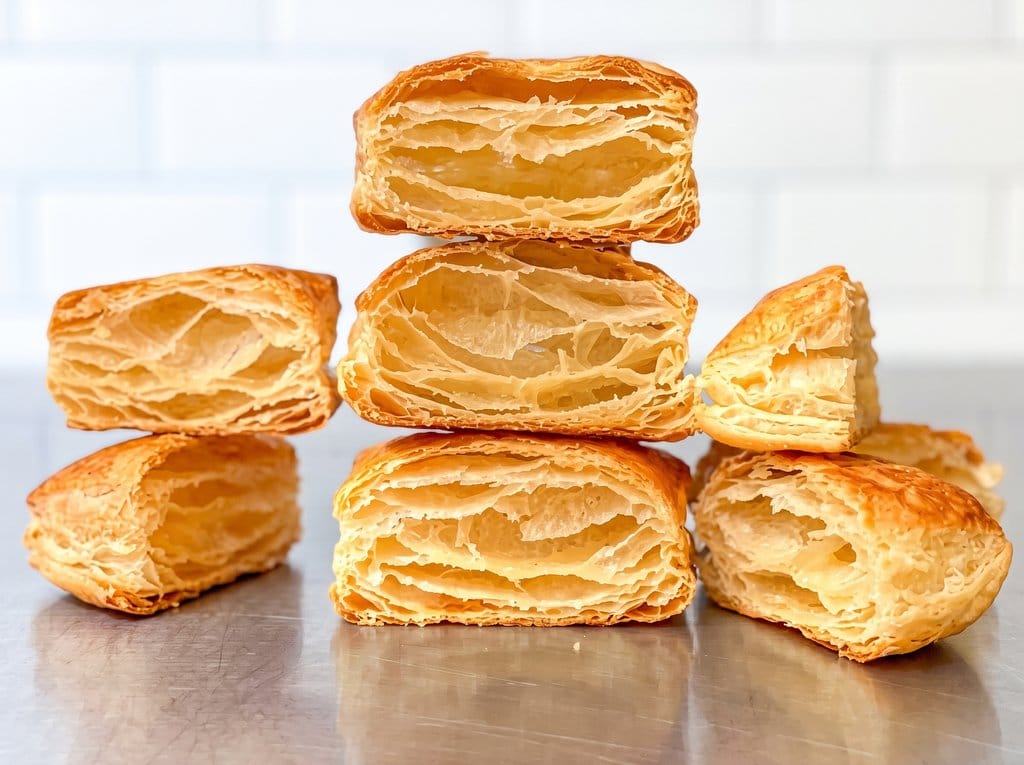
Puff pastry relies entirely on mechanical leavening. There is no yeast-driven gas production. The vertical rise of the laminated structure depends on steam pressure trapped between thin dough layers separated by roll-in fat.
In a typical base dough at native pH (around 5.8 to 6.2), gluten proteins tend to maintain a relatively dense, elastic network held together by hydrophobic interactions and disulfide bonds. This elastic resistance could cause micro-tears during repeated sheeting passes, allowing steam to escape laterally and reducing overall lift.
When a food-grade acid lowers the dough pH toward 4.2 to 5.0, several changes would likely occur:
Each intact dough layer would then retain steam pressure more effectively during baking at 200 to 230 °C, expanding like a series of stacked micro-balloons before protein coagulation sets the structure.
The Shrinkage and Topple-Over Problem
The same chain-unfolding that improves lift would simultaneously store elastic energy in the stretched polymer network. During baking, this stored tension tends to release as the dough heats and water evaporates, a phenomenon often described as entropic snap-back.
Several consequences may follow:
Flour-to-Flour Variability in Shrinkage Response
A fixed acid dose applied to different flours would typically produce wider variation in shrinkage than in lift. This variability likely stems from differences in the natural buffering effects of flours and in gluten rheology, though the precise mechanisms would remain difficult to isolate.
Current understanding points to mineral content and ash level as key factors:
This means that dosing acid by fixed recipe percentage, without monitoring actual paste pH, could produce erratic results whenever the flour lot or supplier changes.
An additional risk at very low pH values involves endogenous aspartyl proteases in the flour, which would reach their activity optimum around pH 3.8 to 4.5. If the pH drops far enough, these enzymes could hydrolyze peptide bonds irreversibly, degrading the gluten network and potentially causing structural collapse during baking.
Comparative Behavior of Common Acidulants and Alternatives
Not all acids would affect puff pastry dough in the same way:
Among non-acid alternatives, inactivated yeast (as a source of reduced glutathione) could relax the gluten without generating the entropic recoil associated with acid-driven chain unfolding. Transglutaminase at low dosages (5 to 15 ppm) might consolidate the laminated structure through covalent cross-linking, supporting lift without the dimensional instability that acid addition would introduce.
😊 Thanks for reading!
Sources:
- Cauvain, S. P. (2017). Baking Problems Solved (2nd Edition). Woodhead Publishing / Elsevier. ISBN: 978-0-08-100765-5.
- Telloke, G. W. (1991). Puff Pastry I: Process and dough ingredient variables. FMBRA, Chorleywood, UK. ResearchGate
- Mora Mundo, A. (2017). Estudio del efecto de la enzima α-amilasa en la microestructura de la pasta hojaldre. Facultad de Química, UAEMex. Repositorio UAEMex
- Kim, S.-Y., Choi, H.-W., Lim, S.-T., et al. (2019). Effect of organic acids on bread quality improvement. Food Chemistry, 278, 267-273. PubMed
- BAKERpedia. (2024). Puff Pastry | Baking Processes. BAKERpedia
- BAKERpedia. (2024). Transglutaminase | Baking Ingredients. BAKERpedia
- Bunge Loders Croklaan B.V. (2019). Self-Emulsifying Fat Composition. US Patent Application US 2019/0037874 A1. Google Patents