Why Your Scone Dough Gets Sticky: Mixing Temperature and Lipid Plasticity on the Production Line
When making scones at high scale, premature melting of solid fats in the mixer could generate sticky doughs that clog extrusion hoppers and collapse on the baking pan. Controlling the friction temperature could preserve lipid plasticity, guaranteeing a continuous flow on the line and a flaky final structure.
The Behavior of Solid Fats in the Bowl
Incorporating solid butter cubes alongside flour, sugar, and baking powder is a delicate operation at an industrial scale. The sustained friction of metallic mixer attachments transfers heat directly to the dough matrix. If the temperature exceeds the lipid’s melting point, the butter transitions to a liquid state before entering the oven. This phase change coats the flour proteins with an oily film, blocking optimal hydration and impeding the formation of a strong structural network.
Consequences of Premature Melting
A dough that fails to retain its fat in a solid state often presents multiple failures during continuous processing.
Control Strategies on the Mixing Line
To maintain fat plasticity and ensure high machinability, operators must dissipate the heat generated by the mixer’s mechanical energy.
The Role of Lipids in the Oven
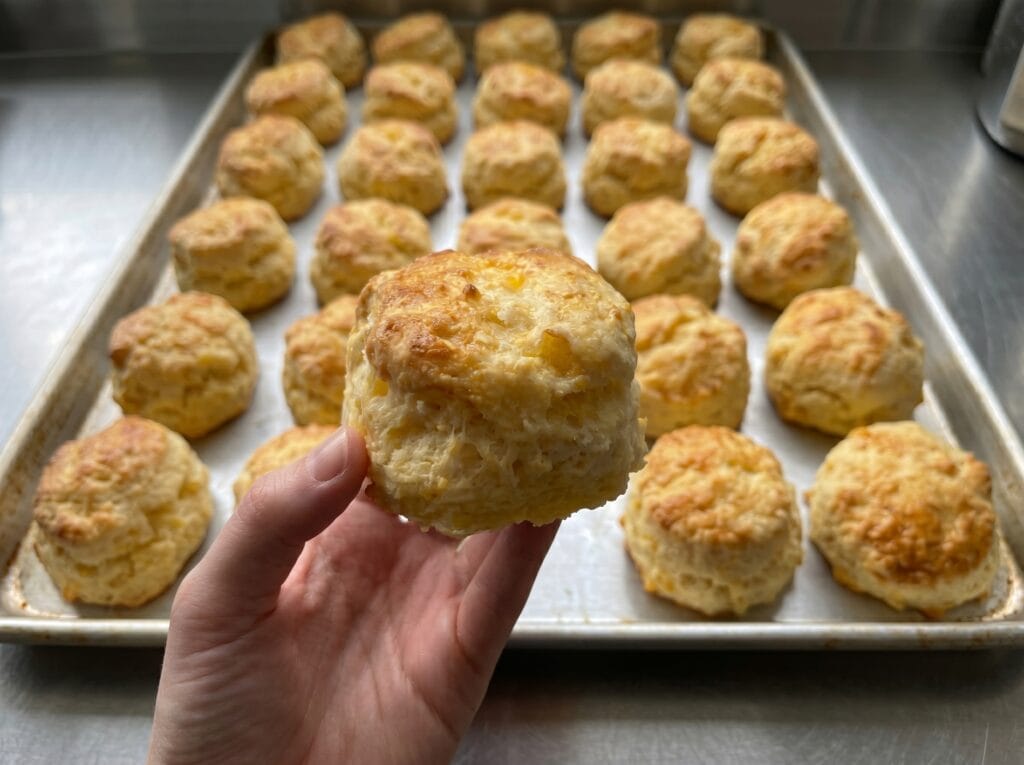
Success in co-extrusion and encrusting equipment depends directly on the state of the dough entering the hopper. A homogeneous distribution of solid fat, fragmented into small particles, lubricates the passage of the dough through moving parts without leaving residue adhered to the metal.
Upon entering the oven, these intact fat particles melt through the action of convective or radiant heat. The water contained within the butter converts into small steam pockets that push the structure upward. This volume change separates the internal layers of the dough, defining the open cellular architecture and fracturability demanded by the market.
Accurately controlling the mixing temperature not only prevents jams and reduces waste in automatic forming equipment. This predictable thermal management optimizes production line speed, eliminates unscheduled stops for machinery cleaning, and ensures that the plant’s overall efficiency reaches maximum profitability.
😊 Thanks for reading!
Sources:
- Cauvain, Stanley P. Baking Problems Solved (2nd ed.). Woodhead Publishing, 2017.
- https://www.youtube.com/watch?v=tLn_JQXYGeM&list=PL2XK3LozaikbYuj0_pVmWOszs8SLAgSFv&index=59
If you found this article helpful, explore our related coverage on Hydration and Gluten Development: Comparative analysis of mixing technologies, Machine Learning-Designed Enzyme Complexes: The New Path to Clean-Label Dough Conditioning, and Spelt Dough Processing: Adjustments to Prevent Tearing and Line Failures.