Why Mixing Duration Dictates the Volume of Gluten-Free Bread
Achieving optimal loaf volume in industrial gluten-free bread lines depends on precise air incorporation during mixing. Without a gluten network, batter-type doughs rely entirely on mechanical shear to trap gas nuclei within hydrated hydrocolloid matrices, meaning minor timing errors cause structural collapse or dense crumbs.
The Physical Mechanism of Air Capture in Gluten-Free Batters
Unlike conventional wheat doughs, where gliadin and glutenin proteins align under mechanical shear to form an elastic gluten network, gluten-free formulations do not build a cohesive, viscoelastic matrix. Instead, gluten-free doughs exist as high-viscosity batters or liquid-solid suspensions. Therefore, the mechanical work performed during the mixing phase does not develop protein elasticity, but instead serves two entirely different functions:
Air bubbles incorporated during mixing serve as the physical nuclei for carbon dioxide gas generated by yeast during fermentation, as well as steam expansion during the early stages of baking. Carbon dioxide cannot generate new gas bubbles on its own within a dough or batter, it can only diffuse into existing void spaces created during mixing.
If the mixing process is terminated prematurely, the batter contains fewer and larger air pockets. This under-aeration limits the potential for even gas expansion during the proofing and oven-spring phases, which often generates a dense, low-volume loaf with an irregular, coarse crumb structure.
The Hydration and Shear Dynamics of Hydrocolloid Systems
In gluten-free batters, hydrocolloids such as hydroxypropyl methylcellulose, known as HPMC, xanthan gum, or psyllium husk fiber replace the gas-retaining function of gluten. These polymers require a specific window of time to absorb free water and build a continuous, viscous phase.
During the initial minutes of mixing, the torque resistance of the batter increases as the dry hydrocolloid particles hydrate and swell. As water is sequestered into this polymer network, the viscosity of the continuous phase rises, creating a matrix capable of stabilizing the liquid-gas interface.
The mechanical action of the mixer blades must continue long enough to distribute these hydrated gums uniformly. This uniform distribution ensures that the viscosity is consistent throughout the batch, preventing localized weak spots where gas bubbles might coalesce and rupture.
Recommended Reading:
The Consequences of Under-Mixing and Over-Mixing on Crumb Architecture
Deviating from the optimal mixing window generates severe consequences for the structural integrity of the final loaf:
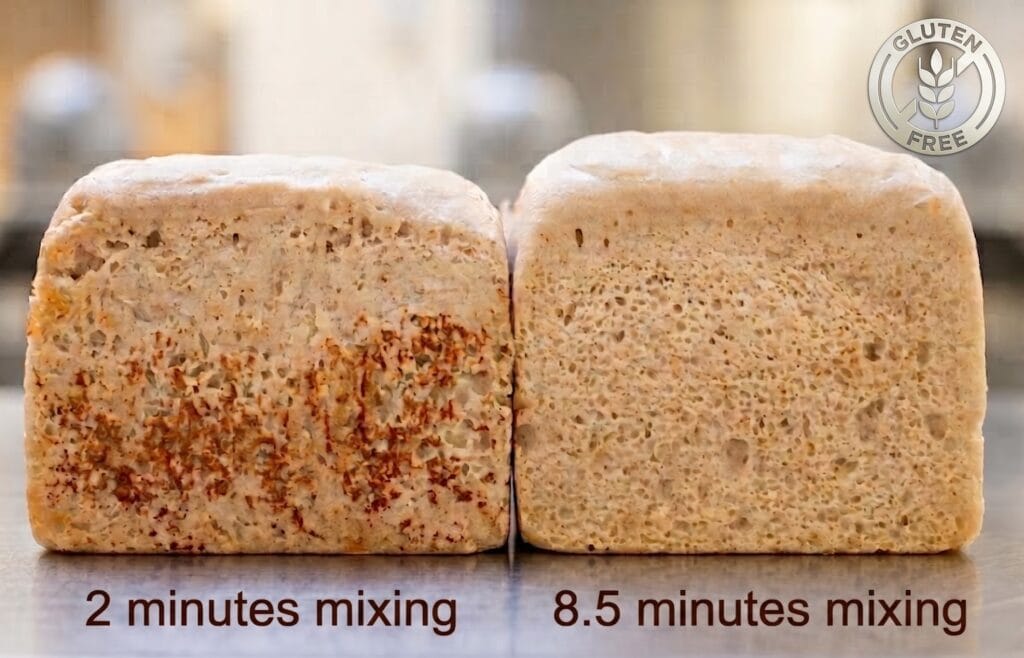
Under-mixing (for example, mixing for only 2 minutes): this short cycle fails to capture a sufficient population of microscopic air bubbles. In addition, the hydrocolloids may not achieve full hydration, leaving excess free water in the batter. This uncomplexed water reduces batter viscosity, causing gas bubbles to rise to the surface and escape during proofing. The resulting loaves are heavy, with a flat or sunken top crust and a rubbery, under-baked crumb.
Over-mixing: although a longer mix time, typically about 8.5 minutes in standard mixers, initially increases batter volume by maximizing air entrapment, excessive mechanical shear can eventually degrade the delicate hydrocolloid-starch complexes. In high-shear hydration systems, this mixing limit can extend up to 10 minutes, depending directly on the resistance and type of hydrocolloid used. Under prolonged shear, the viscosity of the batter collapses, reducing its yield stress. This viscosity loss weakens the bubble walls, making them too thin and fragile to support the expanding gas during baking, which can provoke a sudden collapse in the oven.
Industrial Monitoring of Dough Stiffness and Viscosity
To prevent these volume deficits on high-speed production lines, automated bakeries utilize online torque recording mixers or laboratory Brabender instruments to track dough stiffness in real-time. By measuring the torque resistance, in Newton-meters, over the course of the mixing cycle, the system records the physical development of the batter.
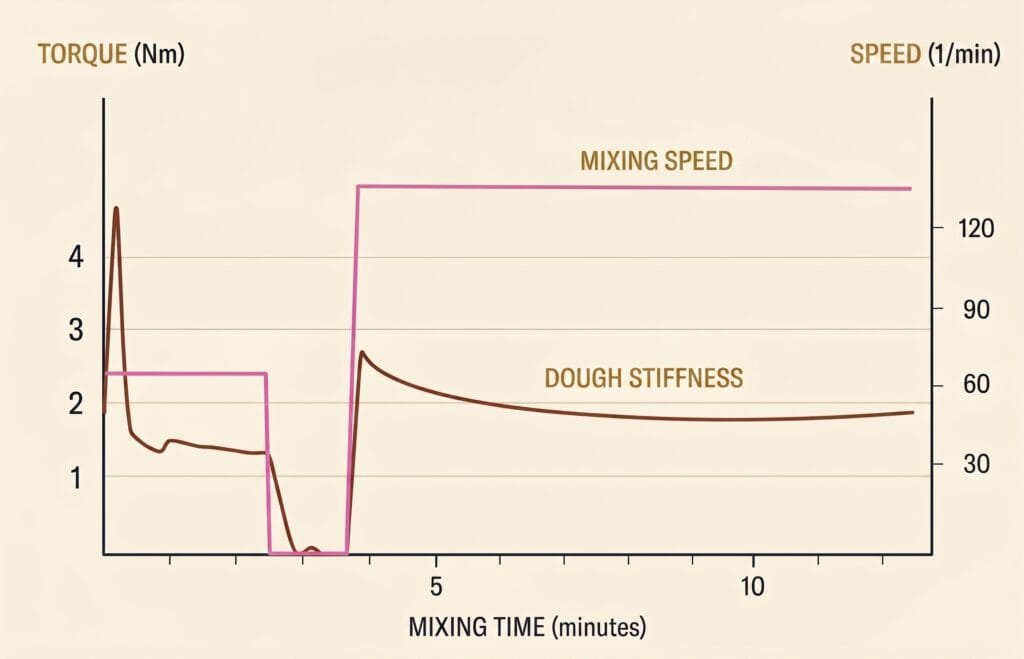
The resulting curve typically displays a rapid initial spike in stiffness as hydration begins, followed by a plateau where viscosity and air incorporation stabilize. Identifying the exact duration of this plateau allows operators to program precise mixing setpoints.
Optimizing this step ensures that the batter achieves its maximum gas-retaining capacity before entering the depositor. Ultimately, this tight control over mixing kinetics stabilizes the cellular architecture of the crumb, reduces product waste, maximizes slicing efficiency, and protects the overall profitability of the industrial plant.
😊 Thanks for reading!
Sources:
- DuPont Nutrition & Health (Nutrition & Biosciences). “How does mixing time influence the volume of gluten-free bread?”. Video Transcript and Technical Application Notes, 2018. URL: http://googleusercontent.com/youtube_content/0
- Belorio, M., and Gómez, M. “Effect of Hydration on Gluten-Free Breads Made with Hydroxypropyl Methylcellulose in Comparison with Psyllium and Xanthan Gum.” Foods, 2020, 9, 1548.
- Krupa-Kozak, U., Drabińska, N., Rosell, C.M., Piłat, B., Starowicz, M., Jeliński, T., and Szmatowicz, B. “High-Quality Gluten-Free Sponge Cakes without Sucrose: Inulin-Type Fructans as Sugar Alternatives.” Foods, 2020, 9, 1735.